After the “WiFi OLED Mini Weather Station with ESP8266“, here is another one: this time with Touch LCD :-):

LCD Weatherstation with ESP8266
After the “WiFi OLED Mini Weather Station with ESP8266“, here is another one: this time with Touch LCD :-):
LCD Weatherstation with ESP8266
I’m convinced that this ‘Internet of Things’ thing-thing is not real. Pure marketing and buz words without any added value, right? The IoT hype is so bizar: it must be originated by aliens which have taken over the brains of all the Pointy-haired Bosses of the world? There is no useful application or use case out there!
But wait! There *is* actually good use case, at least for the geeks of this world. We all love clocks as we want to know the time, and we all love the weather forecast so we can plan accordingly. At least I usually do :-).

SQUIX ESP8266 Mini Weather Station
Many of the NXP OpenSDA boot loaders are vulnerable to Windows 8.x or Windows 10: write accesses of Windows can confuse the factory bootloader and make the debug firmware and bootloader useless. In this post I show how to recover the bootloader using MCUXpresso IDE and the P&E Universal Multilink.
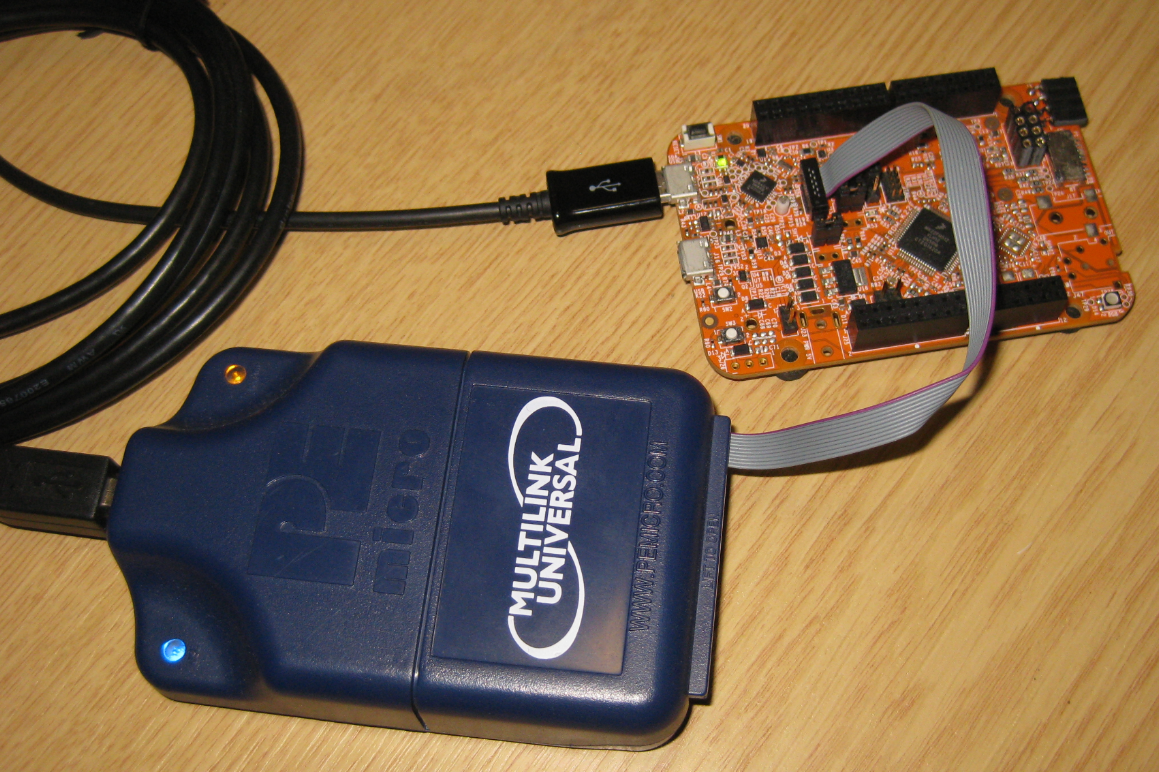
Using P&E Multilink Universal to restore the OpenSDA Bootloader on NXP FRDM-K22F Board
The tools and IDE market is constantly changing. Not only there is every year at least one new major Eclipse IDE release, the commercial tool chain and IDE vendors are constantly changing the environment too. For any ARM Cortex-M development, the combination of Eclipse with the GNU tool chain provided by ARM Inc. is the golden standard. But this does not mean that things can be easily moved from one IDE package to another.
While moving between Eclipse versions and GNU versions is usually not a big deal at all, moving between the Eclipse build tool integration is usually not simple. While the GNU MCU Eclipse plugins are widely used (see Breathing with Oxygen: DIY ARM Cortex-M C/C++ IDE and Toolchain with Eclipse Oxygen), the Eclipse based IDEs from the silicon vendors or commercial Eclipse toolchain vendors are using their own GNU toolchain integration. Which means the project files are not compatible :-(.
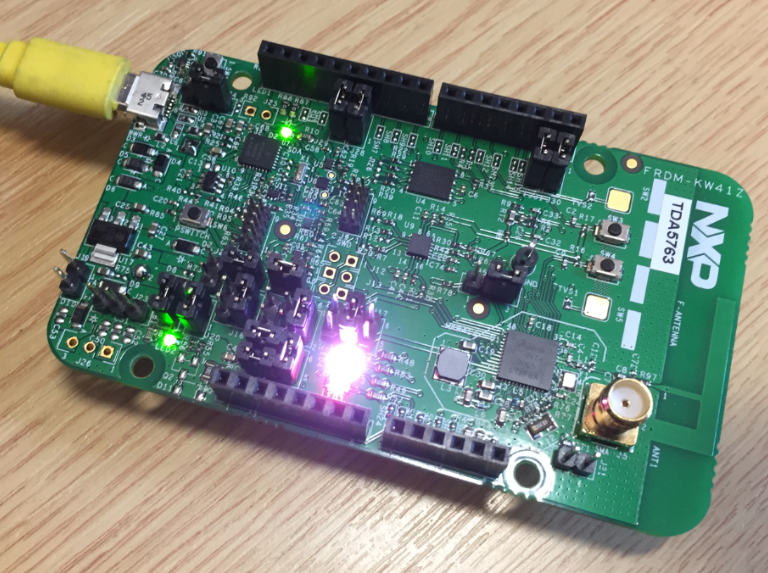
NXP FRDM-KW41Z Board
I love 3D printing as it enables me to create custom enclosures for all kind of projects. The NXP LPC-Link2 probe is great, but it lacks a protective enclosure. So I decided to create a custom enclosure. And as 3D filaments are available in different colors, I experimented with red and black and custom painting:

lpc-link2 enclosure
A bootloader on a microcontroller is a very useful thing. It allows me to update the firmware in the field if necessary. There are many ways to use and make a bootloader (see “Serial Bootloader for the Freedom Board with Processor Expert“). But such a bootloader needs some space in FLASH, plus it needs to be programmed first on a blank device, so a JTAG programmer is needed. That’s why vendors have started including a ROM bootloader into their devices: the microcontroller comes out of the factory with a bootloader in FLASH. So instead writing my bootloader, I can use the one in the ROM.

FRDM-KL03Z with ROM Bootloader
And as with everything, there are pros and cons of that approach.
For a next-gen course I’m evaluating different platforms, and one of it are modules based on the NXP i.MX ARM architectures. In this article I have a look a the Variscite DART-6UL development kit which includes the NXP i.MX6Ultralite ARM Cortex-A7 plus a 7″ capacitive touch LCD:

Variscite VAR-DVK-6UL_LO Kit
For a research project, we are going to send a satellite with an embedded ARM Cortex microcontroller into space early next year. Naturally, it has to work the first time. As part of all the ESA paperwork, we have to prove that we tested the hardware and software thoroughly. One piece of the that is to collect and give test coverage evidence. And there is no need for expensive tools: Free-of-charge Eclipse and GNU tools can do the job for a space mission 🙂

Eclipse with Coverage Views
BLE (Bluetooth Low Energy) sensor devices like the Hexiwear are great, but they cannot store a large amount of data. For a research project I have to collect data from many BLE devices for later processing. What I’m using is a Python script running on the Raspberry Pi which collects the data and stores it on a file:

Raspberry Pi with Python controlling a set of Hexiwear BLE Devices
For many projects it would be cool to build a custom USB Joystick device, either as custom game controller for Windows or any USB host which can be used with a USB Joystick. Instead buying one, why not build my version? All what I need is a USB capable board, some kind of input (potentiometer, push buttons) and some software, and I have my USB Joystick:

DIY USB HID Joystick Device

