In an IoT (Internet of Things, see “IoT: FreeRTOS Down to the Micro Amps“) project I’m using the Freescale KL15Z microcontroller. The nodes are moving around, and the board is using a special inductive charging ‘on the fly’ when nearby the charging station. The energy is stored in capacitors, so no batteries are needed. That worked very well, but some system failed: they need to quickly check sensor signals after power-up. Tracking down the problem, it was obvious that most of the systems failed because it took them too long to boot from the power-on reset. So I instrumented the application to toggle an LED so I can monitor what happens: It was over 400 ms after power-on! Yikes!
Finding Settings in Processor Expert Components
Processor Expert components are making things very easy to configure: go a component, use the component inspector and change a setting. However, with the devices getting more and more complex, the list of settings or properties get longer and longer. To the point that it is hard to find a setting.
For example, where are the settings for the PLL in the CPU component?
FILLing unused Memory with the GNU Linker
In many of my applications I use a CRC/checksum to verify that the code/flash on the target is not modified. For this, not only the code/data in flash counts, but as well all the unused gaps in the memory map. Instead to leave it up to the flasher/debugger (which usually erases it to 0xFF), I want to fill it with my pattern. The GNU linker is using the pattern 0x00 for unused bytes inside sections. So this post is about to use the GNU linker to ‘fill’ the uninitalized FLASH memory with a pattern.
Preventing Reverse Engineering: Enabling Flash Security
Now I have invested a lot of time into my application, ready to be flashed on the devices and shipped. But wait: I don’t want that someone can read out the code from my device and have it reverse engineered. For this, I can ‘secure’ the device.
Tutorial: DIY Kinetis SDK Project with Eclipse – Board Configuration
In “Tutorial: DIY Kinetis SDK Project with Eclipse – Startup” I showed how to create a Kinetis SDK project from scratch. In this post it is about adding the board initialization files. With the board initialization the peripheral clocks and pin muxing is configured.
Formula Student Electric “grimsel” Testing in Alpnach
Here is another featured student project of this semester: Formula Student Electric (FSE). After the outstanding racing season with “Julier” in 2013, the students have designed and built a new and improved Formula Student Electric car “grimsel”, named after the Grimsel Mountain Pass.
Team Video:
Butterfly and Lavender
Gallery
This gallery contains 7 photos.
Our garden has a large area planted with lavender, and this pays off every summer: the color! the scent and flavour! And best of all: many, many bees and butterflies!
Programmable Ultrasonic Sensor Shield for FRDM Board
“Note to myself: post articles about what students have done this semester…”
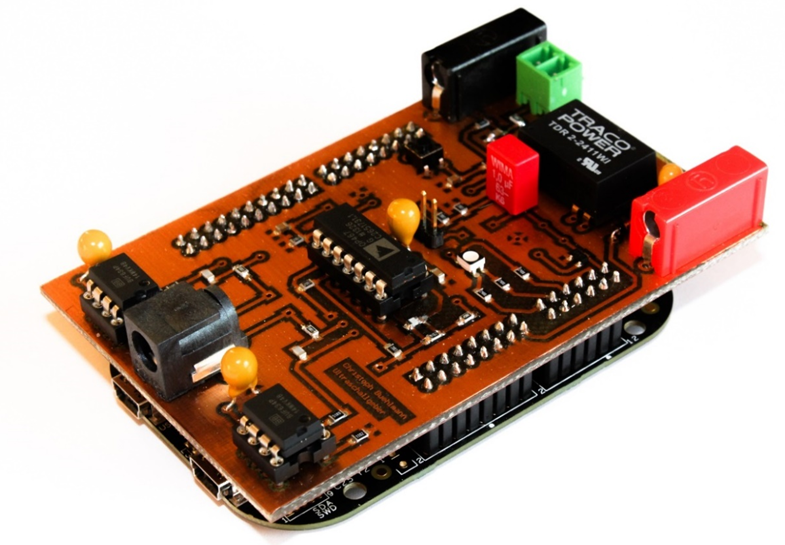
Students have turned in their semester project work. I have set for myself a goal to briefly describe to the ‘outside’ world what they did, as an inspirational source :-). So here is a first article about the project completed by Christoph Bühlmann who developed a shield for the FRDM-KL25Z board: a programmable ultrasonic shield:
Switching between ‘tabs’ and ‘no-tabs’ UI in Processor Expert
Newer releases of Processor Expert (e.g. in Kinetis Design Studio (KDS)) come with a ‘graphical’ (or ‘tabbed’) view of the Component Inspector. The UI elements are different and ‘tabs’ are using:
I like much more the earlier ‘no-tabs’ view. Luckily, there is a setting to switch the view back.
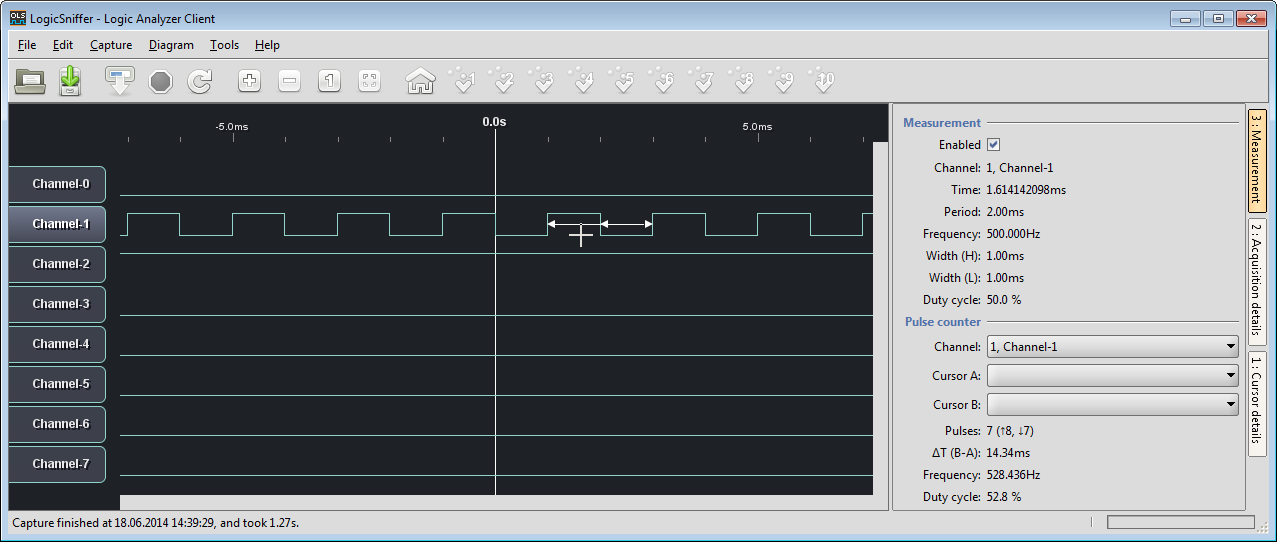
Updated Freedom Board Logic Analyzer with DMA
Question: How to build a low-cost logic open source logic analyzer for less than $15?
Answer: combine the Freedom KL25Z board with OLS!