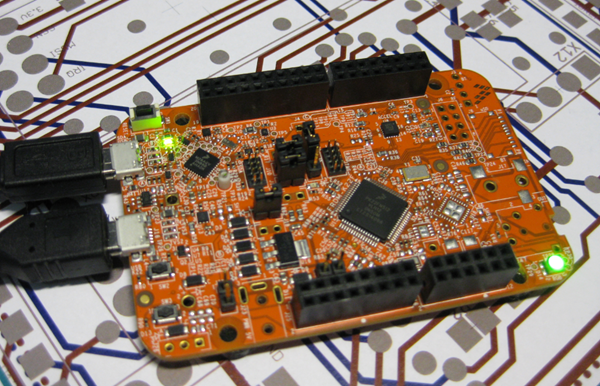
The FRDM-K22F is one of the latest members of the Freedom board families: 512 KByte Flash, 128 KB RAM and the usual Freedom board components on it. Unfortunately, Freescale decided not to populate the micro-SD card connector on the board, so from this perspective the FRDM-K64F is more value for the money. But the board has USB, so this makes it still interesting. And this is what this post is about: Adding USB to the FRDM-K22F board in a few minutes…
Tag Archives: technology
Code Coverage for Embedded Target with Eclipse, gcc and gcov
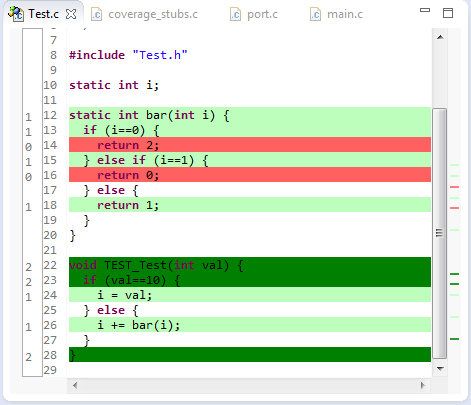
The great thing with open source tools like Eclipse and GNU (gcc, gdb) is that there is a wealth of excellent tools: one thing I had in mind to explore for a while is how to generate code coverage of my embedded application. Yes, GNU and Eclipse comes with code profiling and code coverage tools, all for free! The only downside seems to be that these tools seems to be rarely used for embedded targets. Maybe that knowledge is not widely available? So here is my attempt to change this :-).
Or: How cool is it to see in Eclipse how many times a line in my sources has been executed?
And best of all, it does not stop here….
Adding Multiple Include Paths to Build Settings in Eclipse
In Eclipse and CDT, I need to tell the compiler where it has to search for the header files. The normal way is to go to the compiler settings (menu Project > Properties > C/C++ Build > Settings) and then add the include paths, one by one, using the ‘+’ icon:
But for many include paths, this is a time-consuming process. But there is another way.
Sumo with GoPro, and other Sumo Videos
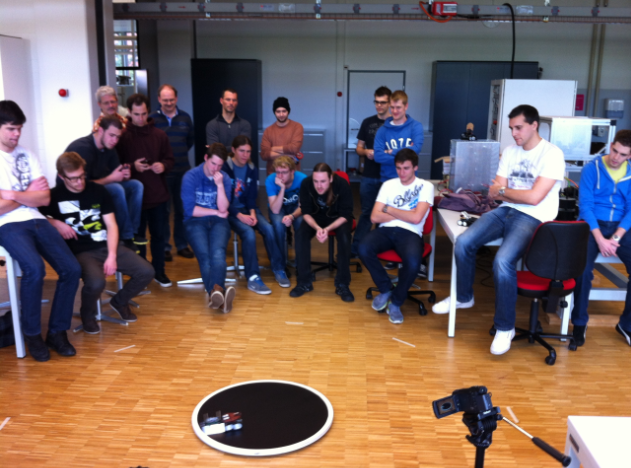
Here are the videos and results of the Mini-Sumo competition held on 19-Dec-2014 in Horw, Switzerland:
- Winner full-autonomous tournament: “The:Flash”
- Winner semi-autonomous tournament: “Banana-Rob”
See “Infotronic WS2014 Sumo Robots are Ready!” for all the robot portraits.
Autonomous Christmas Lab 2014 Video
Video
The team at the Autonomous Systems Lab under Roland Siegwart has produced the 2014 Robotics Christmas video, enjoy!
Happy Christmasing 🙂
Tutorial: IoT Datalogger with ESP8266 WiFi Module and FRDM-KL25Z
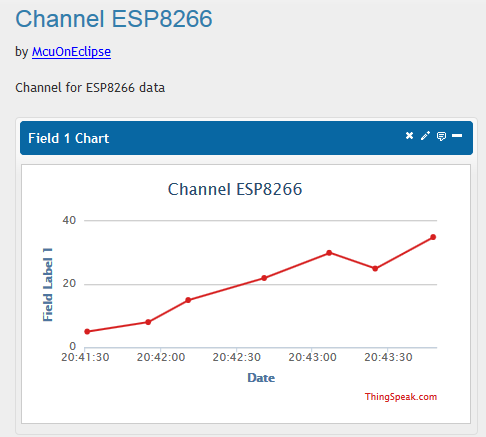
In my earlier post “Tutorial: Web Server with the ESP8266 WiFi Module” I used the ESP8266 WiFi module to run a local web server. This is a cool way to control devices inside my network. But to use that web page from the internet, I would need to open up my router which I don’t want to do for obvious reasons. Why not going the other way: host the web page in the internet, and have my board communicating with that internet page? This is exactly what this hype around IoT (Internet of Things) is all about :-).
McuOnEclipse Components: 07-Dec-2014 Release
Over the last weeks, several contributions, extensions and fixes have been added to the McuOnEclipse components, so a new release is available on SourceForge.
- Bug fix for RingBuffer.
- Better FreeRTOS task debugging with gdb.
- Better watchdog support with Shell component.
- Additional properties for PercepipTrace.
- New Utility function ScanDoubleQuotedString() to scan a double quoted string.
- LCDHTA with additional cursor functions.
- New devices supported in FSL_USB_Stack: K22FN1M (FRDM-K22F), KL24Z48M, USB host support for K22F120/K22FX512).
- RNet with nRF24L01+ to deal better with overflow situations.
- A new component FreeRTOS_Tasks to create FreeRTOS tasks.
Tutorial: Web Server with the ESP8266 WiFi Module
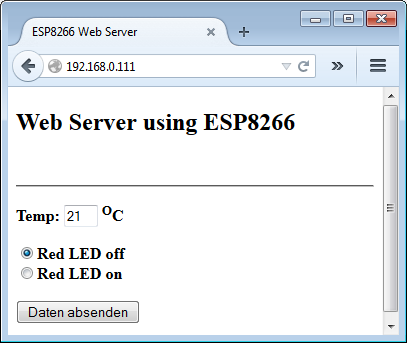
It has been a while since my first post about the ESP8266 (see “Cheap and Simple WiFi with ESP8266 for the FRDM Board“). The ESP8266 is a new inexpensive ($4.50) WiFi module which makes it easy to connect to the network or internet. Finally this week-end I have found the time to write up a tutorial:
how to implement a WiFi web server for the ESP8266 WiFi module and the Freescale FRDM-KL25Z board:
Continue reading
Tutorial: Playing MP3 Files with VS1053B and FRDM Board
I want to make some noise with this post!!! This tutorial is about adding music and sound capabilities to the Freescale Freedom board, and to have a lot of fun with it :-). I need this ability for a larger project working on for a while. But I thought I share that sub-part how to play sound files. So with this tutorial I can turn my Freescale Freedom board into a music or sound player :-). And adding sounds is a cool way for any project, and as the music is stored on an SD card it fits easily hours of music or sounds.
Tutorial: How to Erase the FLASH with the GNU GDB debugger
I have several applications where I store application specific information in the microcontroller FLASH memory (see “Configuration Data: Using the Internal FLASH instead of an external EEPROM“). I have run into issues recently with the Segger J-Link GDB server as by default it does *not* erase all the FLASH memory. So the question is: How can I erase all (or part) of the FLASH memory with GDB (e.g. in Kinetis Design Studio or in Eclipse)?