The good thing with failure is: it is an opportunity to learn :-).
So here is a case: For a STEM roadshow (see “MINTomat: World’s Most Complicated Bubble Gum Automata?“), we have produced in a rush an autonomous robot with a shiny printed 3D cover:
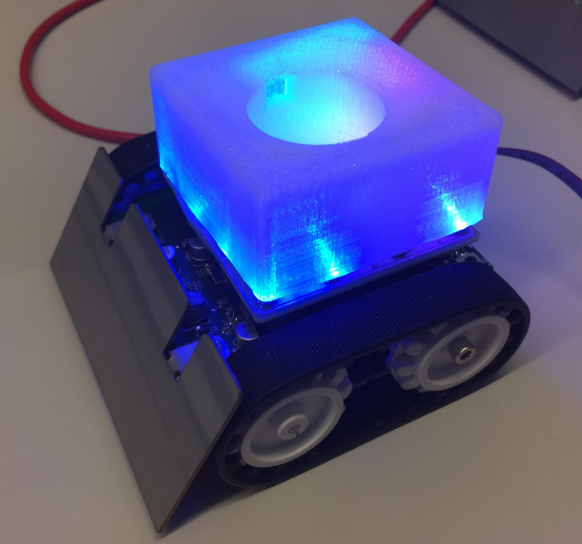
The good thing with failure is: it is an opportunity to learn :-).
So here is a case: For a STEM roadshow (see “MINTomat: World’s Most Complicated Bubble Gum Automata?“), we have produced in a rush an autonomous robot with a shiny printed 3D cover:
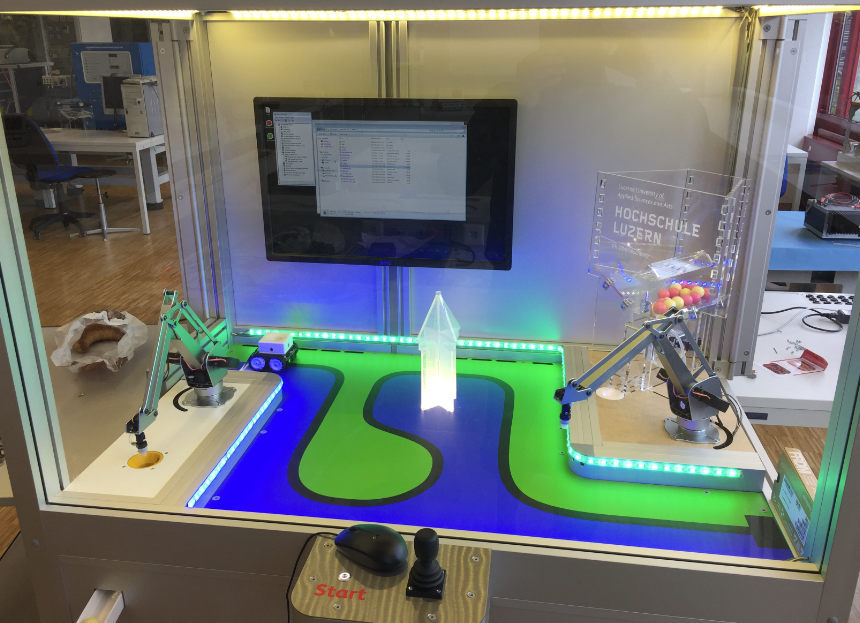
How to fascinate kids for technology? Show them that engineering is fun :-). At the Lucerne University of Applied Sciences and Arts we have created the ‘MINTomat’: a robotics system for STEM activities rewarding interaction with bubble gums:
Yes, pretty over engineered compared to a normal bubble gum automata, but that’s part of the fun :-).
This post is a bit off-topic. No, this is not one of my deep technical tutorials. It is not about all the muddy bits in hardware, and it is not about shiny and great tools. This post is about you all: WordPress counted 15’000 comments for McuOnEclipse!
I highly appreciate your thoughts, questions, requests, ‘likes’ and feedback you give. Please keep them coming!
Happy Commenting 🙂
PS: special thanks to Kevin P. and Jim T.: this blog would not exist without you!
It seems to me that not many developers use hardware trace? ARM indicates that maybe only <5% of developers are using trace. Too bad! Why are all the ARM Cortex microcontroller vendors putting a powerful hardware (and complicated!) trace engine into their devices, if only few developers are using it? Seems like a waste of silicon and an unnecessary price adder? Well, hardware trace can be a life saver: Because only with hardware trace the most complicated bugs and problems can be solved. And maybe because only the best are using it ;-).
In this article I proudly present my research how to get instruction trace out of the ARM Cortex-M4 microcontroller on a NXP TWR-K64F120M board with a Segger J-Trace for ARM:
‘Inversion‘ is an interesting meteorology phenomena: normally the air temperature gets colder the higher you get up in the mountains. With the inversion situation it is the other way round: cold air in the lower areas building a sea of fog, and warmer air and sunshine up above. Perfect for a hike, so sharing pictures from last weekend.
The first one is from the Haggenegg in Canton Schwyz, with the view to the South:
With the GNU compiler and linker I can place variables into custom sections (see “Defining Variables at Absolute Addresses with gcc“). This article is about how to get the section start and end address so I can for example access that range in my code. Or in general ways: how to use symbols defined in the linker script accessible in the C source code.
A new McuOnEclipse components release was long overdue, so I’m pleased to announce that a new drop is available with the following major changes:
Command line tools to build applications are great. But productivity goes up if I can use the standard Eclipse environment with GNU tools. This tutorial is about how to use standard and free GNU and Eclipse tools to build my FreeRTOS application for the ARM Cortex-M4 on i.MX7 🙂 :
My Toradex i.MX7Dual module comes with a preflashed Linux distribution (see “Tutorial: First Steps with NXP i.MX7 and Toradex Colibri Board“). As with any other things, Linux gets updated from time to time, and Toradex publishes new firmware. In this article I’m documenting how I can update Linux in the external FLASH on that module.
In my previous article (see “Tutorial: First Steps with NXP i.MX7 and Toradex Colibri Board“) I have booted the i.MX7 on a Toradex CPU module. In this post I’m showing how to run a FreeRTOS application on that board.