Ways to apply Eclipse CDT C/C++ Project Settings

Eclipse with its CDT managed Make system makes it easy to build projects, because it can handle a lot of the background tasks and settings between the project and the build setting. It can get a bit difficult if I want to include a library or other sub-source project for which I have to add extra compiler #define or add extra includes path settings.

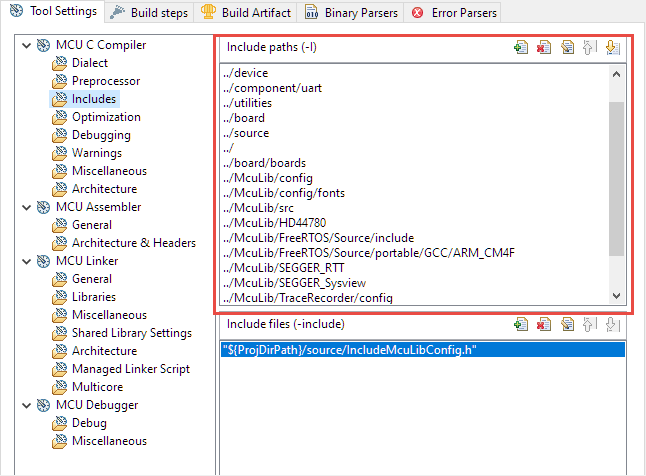
Eclipse project settings for incliude paths

Eclipse project settings for include paths

This article show the different ways I have found to make such imports (and exports) easier.

Continue reading

Listing Code and Data Size for all Files with the GNU size Utility in a Post-Build Action

The GNU size utility which is part of the GNU build tools shows code and data size for archive or object files. It is usually used as a post-build step in Eclipse CDT to show text, data and bss at the end of the build:

Detailed size information for each file

Detailed size information for each file

Continue reading

MCUXpresso IDE V11.1.0

Right before Christmas 2019, NXP has released a new version of the MCUXpresso IDE, the version 11.1.0. This gave me time to explore it over the Christmas/New-Year break and evaluate it for the next university semester. There are several new features which will make my labs using it easier, so I plan to get the course material updated for it.

MCUXpresso IDE V11.1.0 Welcome Screen

MCUXpresso IDE V11.1.0 Welcome Screen

After the break you will find the highlights …

Continue reading

Implementing FreeRTOS Performance Counters on ARM Cortex-M

When using an RTOS like FreeRTOS, sooner or later you have to ask the question: how much time is spent in each task? The Eclipse based MCUXpresso IDE has a nice view showing exactly this kind of information:

FreeRTOS Runtime Information

FreeRTOS Runtime Information

For FreeRTOS (or that Task List view) to show that very useful information, the developer has to provide a helping hand so the RTOS can collect this information. This article shows how this can be done on an ARM Cortex-M.

Continue reading

DIY ‘Meta Clock’ with 24 Analog Clocks

Human since 1982 claims

“Human since 1982 have the copyright to works displaying digital time using a grid arrangement of analog clocks…”

I’m not a lawyer, but without obligations (imho) I have removed the content.

You can read more of the details here: Copyright Law for Makers and Educators

Thanks for understanding,

Erich

OpenPnP Solder Paste Dispensing Video

OpenPnP (see “Building a DIY SMT Pick&Place Machine with OpenPnP and Smoothieboard (NXP LPC1769)“) is a cool open source framework to run Pick&Place machines. I have mentored and supported Tobias Mailänder who extended the PnP machine with the ability to dispense solder past on PCBs. Below a video (courtesy of Tobias Mailänder) which shows the machine in action:

It is still a prototype, but things are working very well.

Continue reading

World Stepper Clock with NXP LPC845

I really love clocks. I think this is I am living here in Switzerland. Beside of that: clock projects are just fun :-). After I have completed a single clock using stepper motors (see “DIY Stepper Motor Clock with NXP LPC845-BRK“), I wanted to build a special one which is able to show up to four different time zones: Below an example with London (UK), New York (USA), Beijing (China) and Lucerne (Switzerland):

Stepper Clock

Stepper Clock

Continue reading

Open Source LittlevGL GUI Library on Adafruit Touch LCDs with NXP LPC55S69-EVK

The NXP LPC55S69-EVK is a versatile board. In this article I show how it can be used with Adafruit TFT LCD boards, both with resistive and capacitive touch. For the software I’m using the open source LittlevGL GUI.

LPC55S69-EVK with Adafruit Touch LCD

LPC55S69-EVK with Adafruit Touch LCD

Continue reading

Open Source FTDI FT2232 JTAG and UART Adapter Board

In JTAG Debugging the ESP32 with FT2232 and OpenOCD I have used a FTDI FT2232 breakout board to JTAG debug with OpenOCD. With an adapter board on top of the TDI FT2232 the wiring is much easier and simpler to use:

JTAG Debugging the ESP32 with FT2232

JTAG Debugging the ESP32 with FT2232

Continue reading