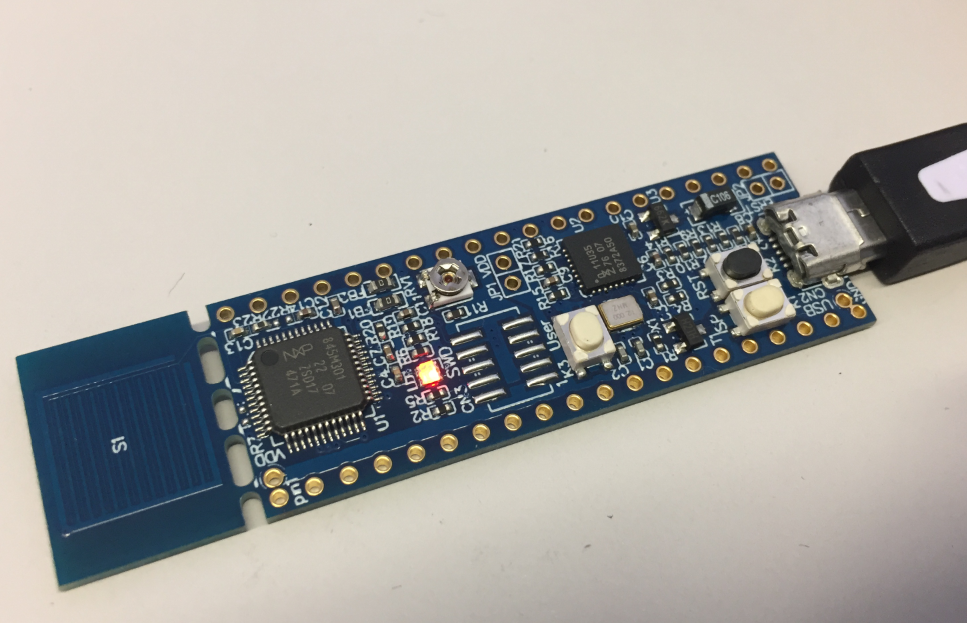
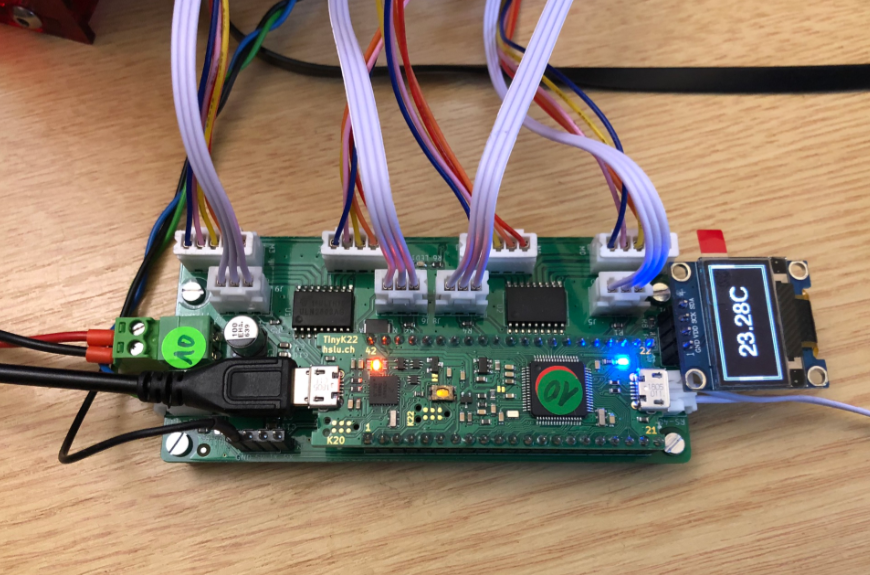
LoRaWAN with NXP LPC55S16 and ARM Cortex-M33

LoRaWAN is getting more an more popular, both for terrestrial and increasingly with low-orbit satellite systems. The ‘Long Range’ in ‘LoRa’ makes it an ideal solution for low-power and low data rate applications. For a university research project we selected the Semtech SX1261/62 transceiver together with the NXP LPC55S16 mikrocontroller. Because the board used for that project is not available for the public (yet), I share here how you can run the LoRaWAN stack with the NXP LPC55S16-EVK.

LoRaWAN with Semtech SX126x and NXP LPC55S16
Continue reading

McuOnEclipse Components: 26-Dec-2021 Release

I’m pleased to announce a new release of the McuOnEclipse components, available on SourceForge. This release includes several bug fixes, support for more devices, and updated components like FreeRTOS, MinINI, Percepio Tracealyzer and SEGGER SystemView.

SourceForge

SourceForge

Continue reading

Doubling the performance of NXP LPC845 with improved Flash Access Time

For more than two years I’m using the NXP LPC845 in my university courses. Beside of that it is used in many projects. First, because the LPC845-BRK board is small, breadboard friendly and inexpensive. Second, for many small projects that Cortex-M0+ provides just the right amount of processing power and memory.

NXP LPC845-BRK Board

If you search for ‘LPC845’ on my blog, you will find many articles about it. We are using the LPC845 in a research project, and one developer asked me why the LPC845 seems to run slower than expected. And I was sure that I wrote already an article about this, but to my disappointment: even Google did not find it? So complete this unfortunate gap, here is it: how to optimize the LPC845 and running it at full speed, with the hand-brake released.

Continue reading

Key-Value pairs in FLASH Memory: file-system-less minINI

Many embedded systems application need to store some kind of data in a persistent way: calibration values, settings or log information. For a smaller amount of data, using an external memory or file system is an overkill. In many system I’m using minINI to store key-value pars in in a ‘ini-file’ way, but it requires the use of a file system of some kind. minINI is great and efficient, and makes getting and storing data really easy. But for simple cases, a single FLASH memory page or sector is just all what I need. Instead managing that page directly, why not using minINI without a file system?

Continue reading

Adding RGBW Wings and Enclosure to a Debug Probe

I’m using debug probes on a daily base. They have to be functional, and I value functionality over aesthetics. For cost reasons many debug probe vendors either only provide a bare PCB without enclosure, or the enclosure is made of simple plastic enclosure.

That’s OK. But when I received my NXP MCU-Link Pro debug probe, I wanted to add an enclosure for it: Not only to add protection,but to have it look cool too :-).

MCU-Link Pro Enclosure
Continue reading

Visual Studio Code for C/C++ with ARM Cortex-M: Part 10 – Assembly Stepping

The Microsoft Visual Studio Code is a great IDE, but does not (yet?) implement features for true embedded usage. Or things are there to some level, but hard to use. One of these things is how to step in the assembly code. This article shows how to do this.

Continue reading

New “MCU-Link Pro”: Debug Probe with Energy Measurement

After the release of the NXP MCU-Link debug probe, there have been hints in the Eclipse based MCUXpresso IDE that there must be another one coming. And indeed: another and more powerful debug probe is now available: the MCU-Link Pro. It is not only a debug probe but a power/energy measurement tool too, including an extra LPC804 mikrocontroller which can be used for all kind of things, like automation or scripting.

NXP MCU-Link Pro
Continue reading

Visual Studio Code for C/C++ with ARM Cortex-M: Part 9 – RTT

For me the Cortex-Debug Visual Studio extension by marus25 is the standard way to use VSC for embedded development. Another ‘standard’ piece I’m using in many of my projects is the SEGGER RTT.

SEGGER RTT Output with Visual Studio Code
Continue reading

Tutorial: GNU gcov Coverage with the NXP i.MX RT1064

This tutorial shows how to use and collect coverage data using the GNU gcov tool. As board and hardaware I’m using the NXP i.MX RT1064 EVK:

MIMXRT1064-EVK running ThreadX
MIMXRT1064-EVK

While this tutorial uses this specific board, things are pretty generic and should be applicable for any other board or MCU.

Continue reading

MCUXpresso IDE 11.4.0

University exam grading are all done now and results are in the system, and it is already time to prepare for the fall semester. I always try to use the latest and greatest tools in my courses, and the NXP MCUXpresso IDE 11.4.0 just came out. So time to have a look and explore the changes and features.

Debugging with NXP MCUXpresso IDE 11.4.0
Continue reading