Finding Memory Bugs with Google Address Sanitizer (ASAN) on Microcontrollers

Dangling pointers and memory corruption problems are nasty issues for any developer, and usually hard to find and locate in the code. Luckily Google has developed an open source tool to solve such issues: the Address Sanitizer (ASAN). The tool is available for x86 and other desktop style architectures, including Android and Linux. This article describes how ASAN can be used for an embedded target, e.g. ARM Cortex-M4 or similar.
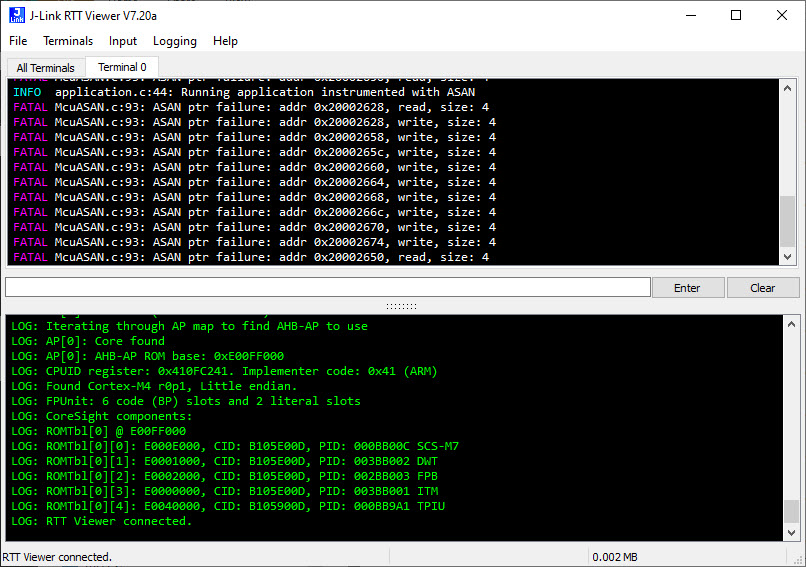
Catching memory errors on ARM Cortex-M4F with ASAN
Continue reading

Placing Code in Sections with managed GNU Linker Scripts

Managed linker scripts are great on one side: the simplify the otherwise complex GNU linker script handling. On the other side it requires knowledge how to tweak them in case ‘non-standard’ behavior is needed.

Continue reading

SWO with ARM Cortex-M33

One major concern of embedded system development is performance. Microcontroller have more MHz than in the past, but embedded applications are all about timing and real-time aspects.

The challenge is: how to get data off the target in realtime? SWO can help with this….

Continue reading

Using FatFS and MinINI with the NXP LPC55S16 EVK

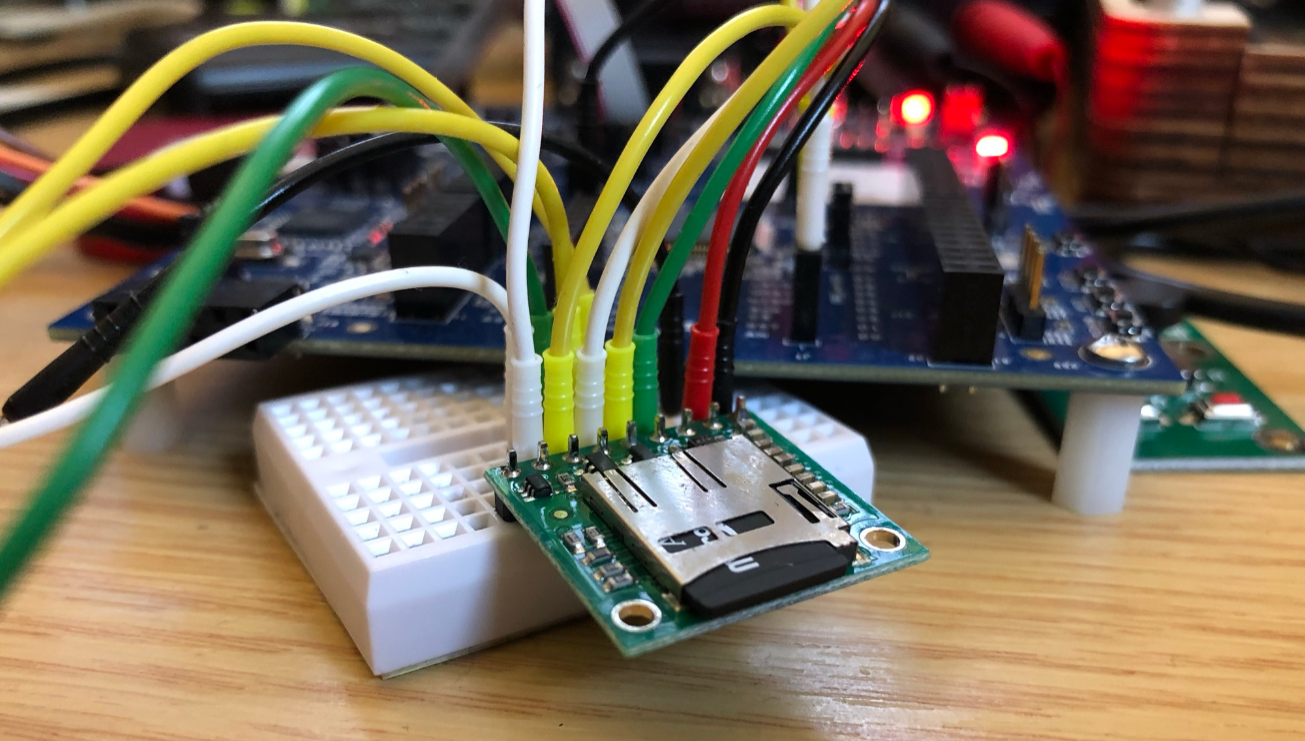
For a research project we selected the NXP LPC55S16 but because it has due the silicon shortage it is not available probably for the next 52 weeks (yikes!) we can use the EVK Board.

The FatFS file system from Elm Chan is the de-facto file system for many embedded systems. As such it comes integrated with silicon vendor SDKs like the NXP MCUXpresso SDK. The problem is that the SDK only has examples for things on the board, and because that board does not have a SD card socket, no example for using FatFS with an SDK card is provided :-(. So I had to create one, and you can get it from GitHub.

Continue reading

Visual Studio Code for C/C++ with ARM Cortex-M: Part 4 – Debug

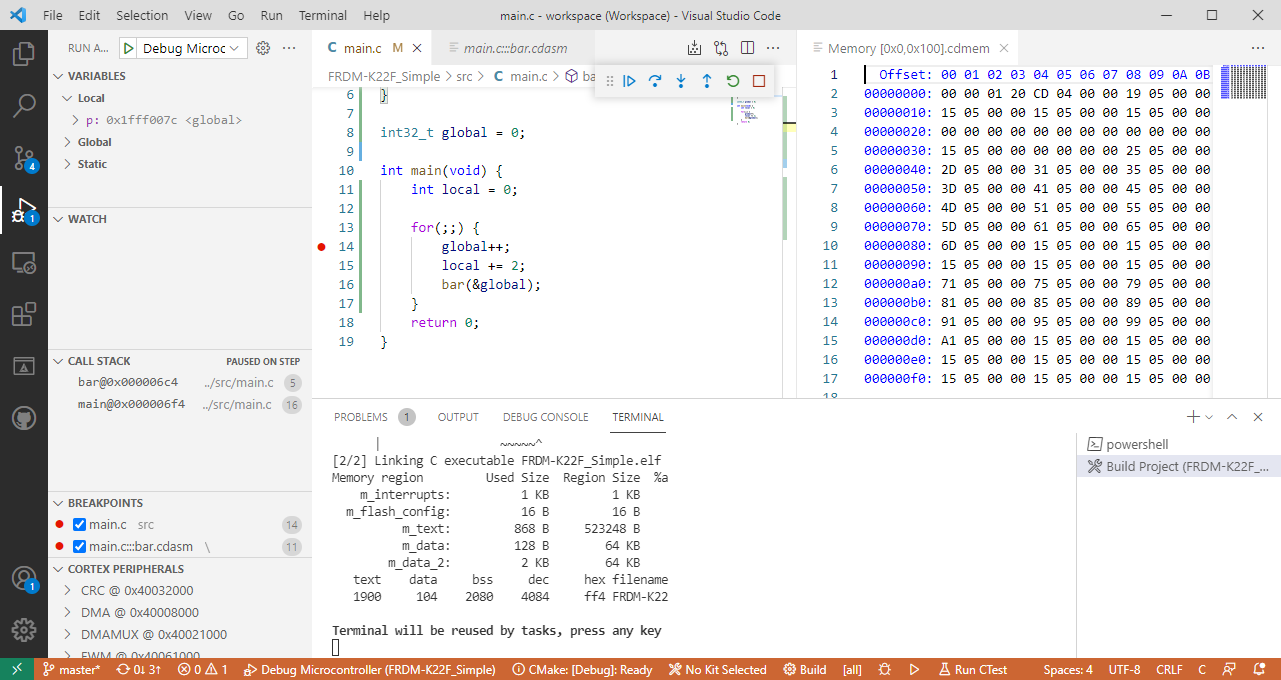
The previous parts were about installation, project setup and building. This one is about debugging an ARM Cortex-M Microcontroller with Visual Studio Code:

Cortex-M4 (NXP K22FN512) Debugging with Visual Studio Code
Continue reading

Visual Studio Code for C/C++ with ARM Cortex-M: Part 2 – Project

This is the second part of series or articles how to use the Microsoft Visual Studio Code for embedded development on ARM Cortex-M. In this part I’m going to show how to create and build a project using CMake running Make or Ninja as build system.

Building with Visual Studio a simple ARM Cortex-M Project (NXP K22FN512)
Continue reading

Upgrade to a new NXP MCUXpresso SDK

As time flies by, my projects are evolving. My lab projects get used over multiple semesters, and the MCUXpresso projects by default use the SDK version used at that time.

This is great because I do want to have control over what SDK is used. But from time to time it makes sense to upgrade a project to a newer version. In this post I’ll show how an existing project can be upgraded to use a new SDK.

Continue reading

MetaClockClock Build Instructions

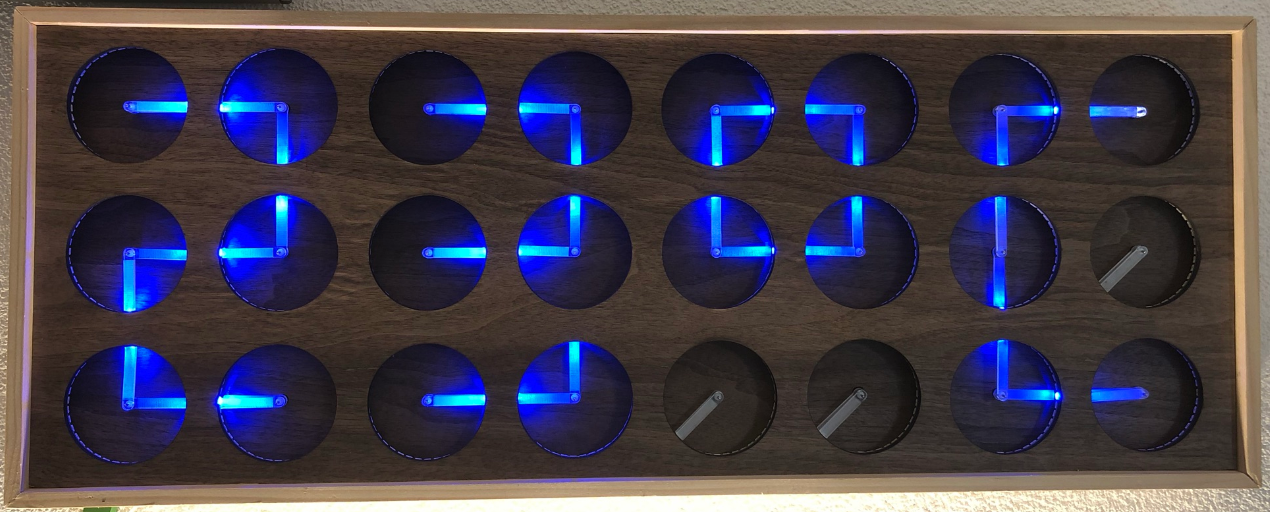
If you are not aware (yet?): it looks like the COVID pandemic caused a global silicon and microcontroller shortage with lead times >50 weeks in some cases. The microcontroller I have used for the MetaClockClock build (see “New MetaClockClock V3 finished with 60 Clocks” and “MetaClockClock V4 for the Year 2021“) is affected by this too, but I had luck and still enough microcontrollers to build a few more boards.

So I still have enough for building a new variant with it (not finished yet). While everyone else is waiting for the devices to arrive, here are more details and instructions for your own build.

MetaClockClock Temperature Display
Continue reading

Tutorial: GNU Coverage with MCUXpresso IDE

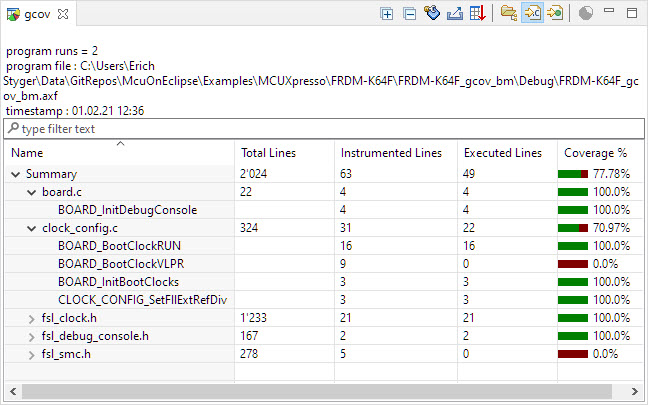
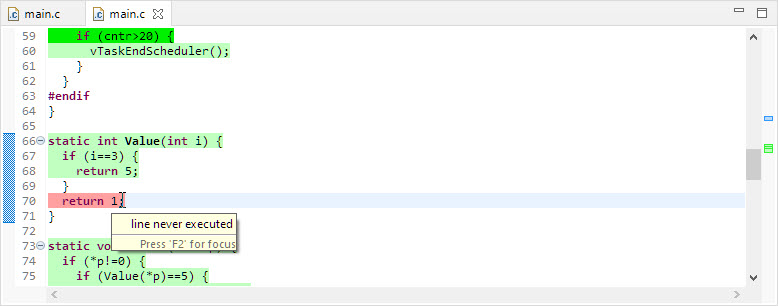
If you are developing Linux or desktop applications with GNU tools, you  very likely are familiar with gcov: the GNU coverage tool. It collects data what parts of the code gets executed and represents that in different formats, great to check what is really used in the application code or what has been covered during multiple test runs.

Coverage Information with gcov

Coverage Information with gcov

line never executed

line never executed

GNU coverage is possible for resource constraint embedded systems too: it still needs some extra RAM and code space, but very well spent for gathering metrics and improves the firmware quality. As I wrote in “MCUXpresso IDE V11.3.0 for 2021” things are now easier to use, so here is a short tutorial how to use it.

Continue reading

NXP published MCUXpresso SDK 2.9.0 on GitHub

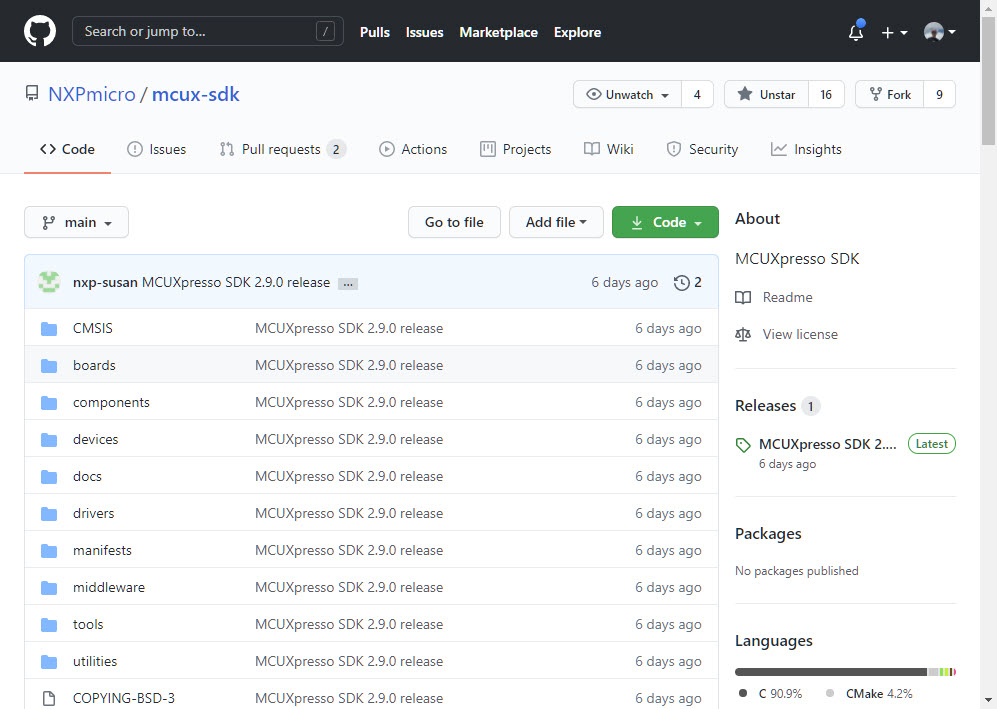
There are many different aspects of Open Source projects: It is not only about the fact if the sources are available (‘open’). It is about the licensing terms (how permissible is it, what can I do with it), maintenance and continuous development (what has changed between releases), how and where is it delivered (Sourceforge, dedicated distribution, packaging) up to collaboration (how can I contribute or submit issues).

NXP has now published the MCUXpresso SDK on Github:

MCUXpresso SDK on GitHub

MCUXpresso SDK on GitHub

Something I was waiting for a long time.

Continue reading