First tinyK22 Board with NXP K22FN512 ARM Cortex-M4F

The NXP Freedom boards are very popular. Many of them are inexpensive (less than $20), include a debug interface and can be easily extended with extra shields or boards. Especially the FRDM-KL25Z is very popular: I’m getting told because of Processor Expert and tutorials available on web sites like this one ;-).

Unfortunately there are no small or breadboard friendly Kinetis boards available. There is the NXP LPC800-DIP but with no onboard debugger and without Processor Expert support. We have the tinyK20, but projects tend to use more CPU power, FLASH and RAM space than what the tinyK20 board (50 MHz, 128 KByte FLASH, 16 KByte RAM) can provide. So we ended up designing the big brother of the first tinyK20: the tinyK22 with 120 MHz, 512 KByte of FLASH and 128 KByte of RAM.
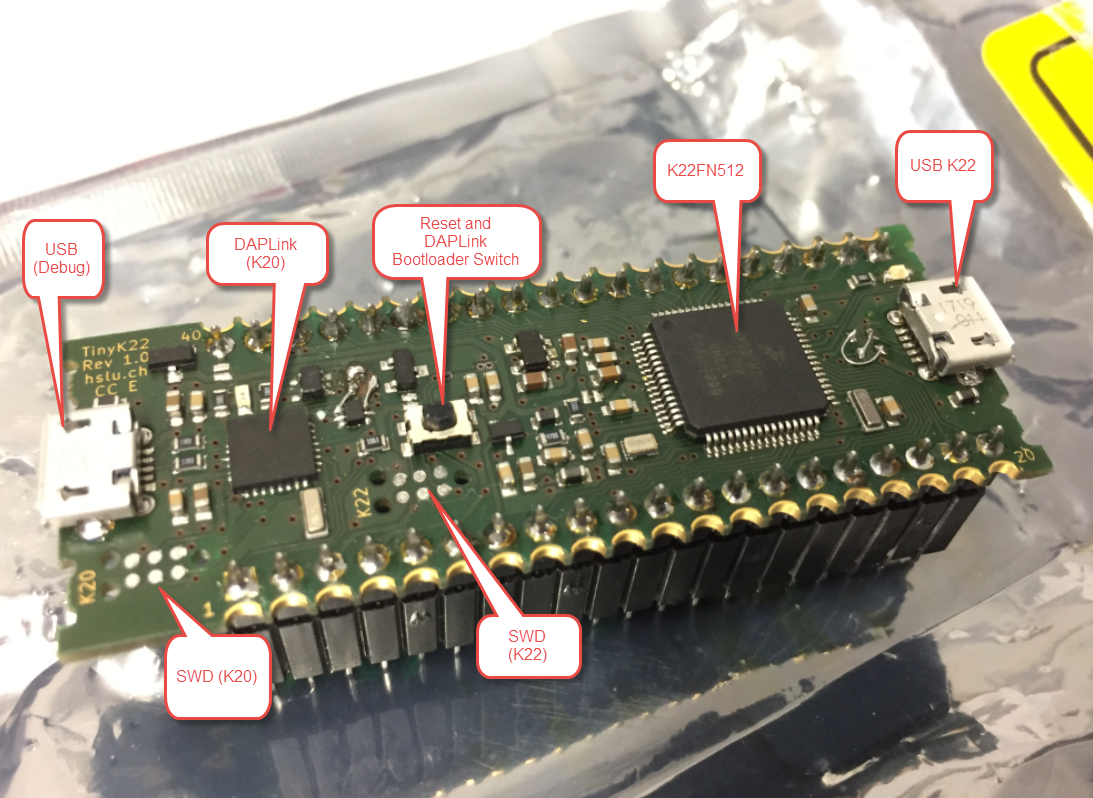
tinyK22 Overview

tinyK22 Overview

Continue reading

Using Multiple Memory Regions with the FreeRTOS Heap

ARM Cortex-M microcontrollers can have multiple memory controllers. This is a good thing as it allows the hardware to do multiple parallel memory read/writes. However this makes the memory map more complicated for the software: it divides the memory into different regions and memory segments.  This article is about how to enable FreeRTOS to use multiple memory blocks for a virtual combined memory heap:

FreeRTOS with Segmented Heap Memory

FreeRTOS with Segmented Heap Memory

Continue reading

Recovering and Updating the NXP OpenSDA Bootloader with P&E Multilink and MCUXpresso IDE

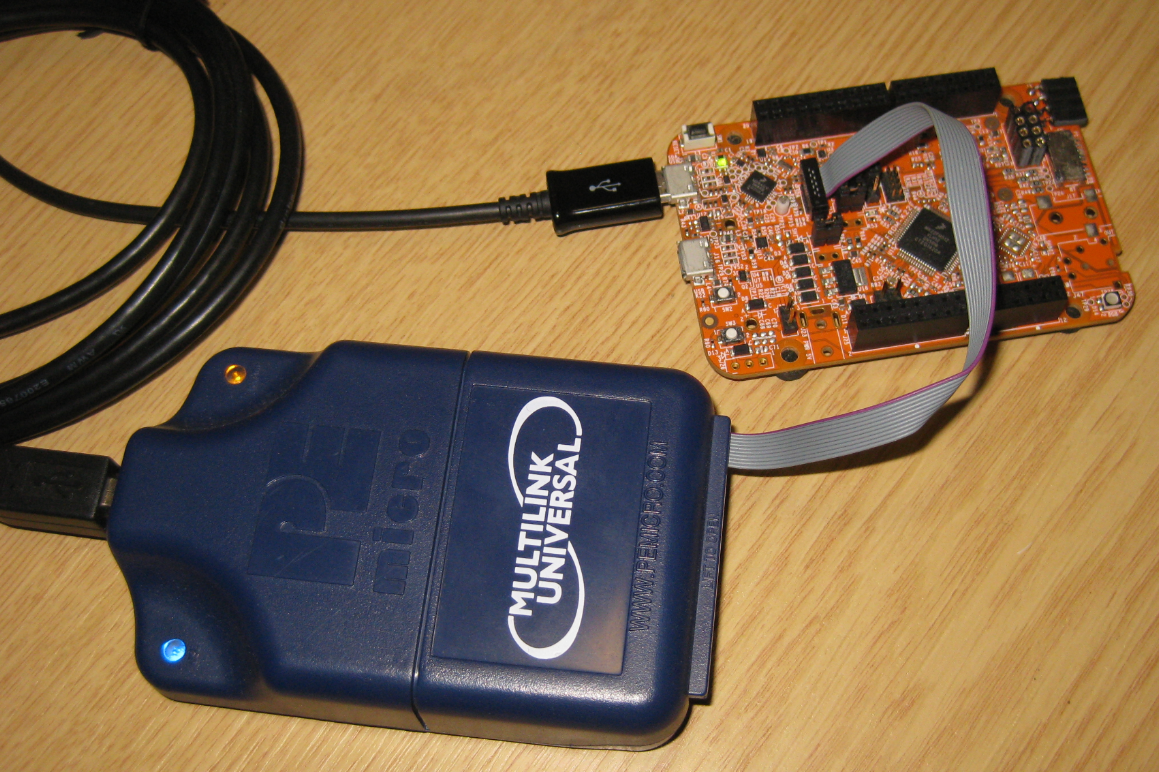
Many of the NXP OpenSDA boot loaders are vulnerable to Windows 8.x or Windows 10: write accesses of Windows can confuse the factory bootloader and make the debug firmware and bootloader useless. In this post I show how to recover the bootloader using MCUXpresso IDE and the P&E Universal Multilink.

Using P&E Multilink Universal to restore the OpenSDA Bootloader on NXP FRDM-K22F Board

Using P&E Multilink Universal to restore the OpenSDA Bootloader on NXP FRDM-K22F Board

Continue reading

Adding CMSIS-SVD Files to EmbSysRegView 0.2.6.r192 and Eclipse

In “EmbSysRegView 0.2.6 for Eclipse Neon and Oxygen” I have described how to add CMSIS-SVD register detail files to Eclipse using the EmbSysRegView plugin.

But what I need to add vendor or any other SVD files to it? Here is how:

EmbSys Registers View

EmbSys Registers View

Continue reading

Troubleshooting Tips for FreeRTOS Thread Aware Debugging in Eclipse

FreeRTOS seems to get more and more popular, and I think as well because more and more debugger and Eclipse IDE vendors add dedicated debugging support for it.

FreeRTOS Threads in Eclipse

FreeRTOS Threads in Eclipse

Continue reading

Getting Started: ROM Bootloader on the NXP FRDM-KL03Z Board

A bootloader on a microcontroller is a very useful thing. It allows me to update the firmware in the field if necessary. There are many ways to use and make a bootloader (see “Serial Bootloader for the Freedom Board with Processor Expert“). But such a bootloader needs some space in FLASH, plus it needs to be programmed first on a blank device, so a JTAG programmer is needed. That’s why vendors have started including a ROM bootloader into their devices: the microcontroller comes out of the factory with a bootloader in FLASH. So instead writing my bootloader, I can use the one in the ROM.

FRDM-KL03Z with ROM Bootloader

FRDM-KL03Z with ROM Bootloader

And as with everything, there are pros and cons of that approach.

Continue reading

McuOnEclipse Components: 09-July-2017 Release

I’m pleased to announce that a new release of the McuOnEclipse components is available in SourceForge, with the following major changes and updates:

  • Complete refactoring for 1-Wire stack and DS18B20 temperature sensor components
  • Added HID Joystick device class to the FSL_USB_Stack
  • New SDK_Timer component to work with Kinetis SDK
  • New ST756P LCD driver component
  • New TSL2561 digitial temperature sensor driver
  • Added ReadByte() and WriteByte() GenericI2C functions
  • Added 64bit mapping functions to Utility
  • added configUSE_NEWLIB_REENTRANT and newlib reentrancy support to FreeRTOS
  • Pull resistor support for SDK_BitIO
  • Many smaller bug fixes and enhancements
SourceForge

SourceForge

Continue reading

Using FreeRTOS with newlib and newlib-nano

For reliable applications, I avoid using functions of the standard libraries. They are banned for most safety related applications anyway. I do not use or avoid malloc(), printf() and all the other variants, for many reasons including the ones listed in “Why I don’t like printf()“. Instead, I’m using smaller variants (see “XFormat“). Or I’m using only the thread-safe FreeRTOS heap memory allocation which exist for many good reasons.

Things get problematic if malloc() still is pulled in, either because it is used by a middleware (e.g. TCP/IP stack) or if using C++. Dave Nadler posted a detailed article (http://www.nadler.com/embedded/newlibAndFreeRTOS.html) about how to use newlib and newlib-nano with FreeRTOS.

FreeRTOS Newlib Memory Allocation Scheme

FreeRTOS Newlib Memory Allocation Scheme

Continue reading

DIY USB HID Joystick Device and Game Controller

For many projects it would be cool to build a custom USB Joystick device, either as custom game controller for Windows or any USB host which can be used with a USB Joystick. Instead buying one, why not build my version? All what I need is a USB capable board, some kind of input (potentiometer, push buttons) and some software, and I have my USB Joystick:

DIY USB HID Joystick Device

DIY USB HID Joystick Device

Continue reading

MCUXpresso IDE: Terminate and Disconnect a Debug Session

Eclipse for C/C++ (CDT) offers two different ways to get out of a debug session: Terminate and Disconnect:

Terminate and Disconnect

Terminate and Disconnect

The terminate and disconnect behaviour is not standardized, and varies between Eclipse distributions and debug connection. This article is about how things are handled in MCUXpresso IDE, and how I can influence the behaviour.

Continue reading