World Stepper Clock with NXP LPC845

I really love clocks. I think this is I am living here in Switzerland. Beside of that: clock projects are just fun :-). After I have completed a single clock using stepper motors (see “DIY Stepper Motor Clock with NXP LPC845-BRK“), I wanted to build a special one which is able to show up to four different time zones: Below an example with London (UK), New York (USA), Beijing (China) and Lucerne (Switzerland):

Stepper Clock

Stepper Clock

Continue reading

Open Source LittlevGL GUI Library on Adafruit Touch LCDs with NXP LPC55S69-EVK

The NXP LPC55S69-EVK is a versatile board. In this article I show how it can be used with Adafruit TFT LCD boards, both with resistive and capacitive touch. For the software I’m using the open source LittlevGL GUI.

LPC55S69-EVK with Adafruit Touch LCD

LPC55S69-EVK with Adafruit Touch LCD

Continue reading

Investigating ARM Cortex® M33 core with TrustZone® – In-Application Programming Tutorial

Last week I investigated the In-System Programming feature in the boot ROM of the LPC55S69. Using the command-line program blhost I was able to erase the flash and download simple LED blinky programs. Of course, the functions that erase and program the flash are present in the boot ROM.

Wouldn’t it be great if we could call those program and erase functions from our own software running on the LPC55S69?

Of course, we can. This is the NXP feature In-Application Programming, and this week I’ll show you how to interface to the Flash Driver in the boot ROM from software. Since the program and erase functions are running from ROM, this avoids the normal considerations about using flash for non-volatile storage.

Continue reading

Investigating ARM Cortex® M33 core with TrustZone® – running TrustZone® example projects in MCUXpresso IDE

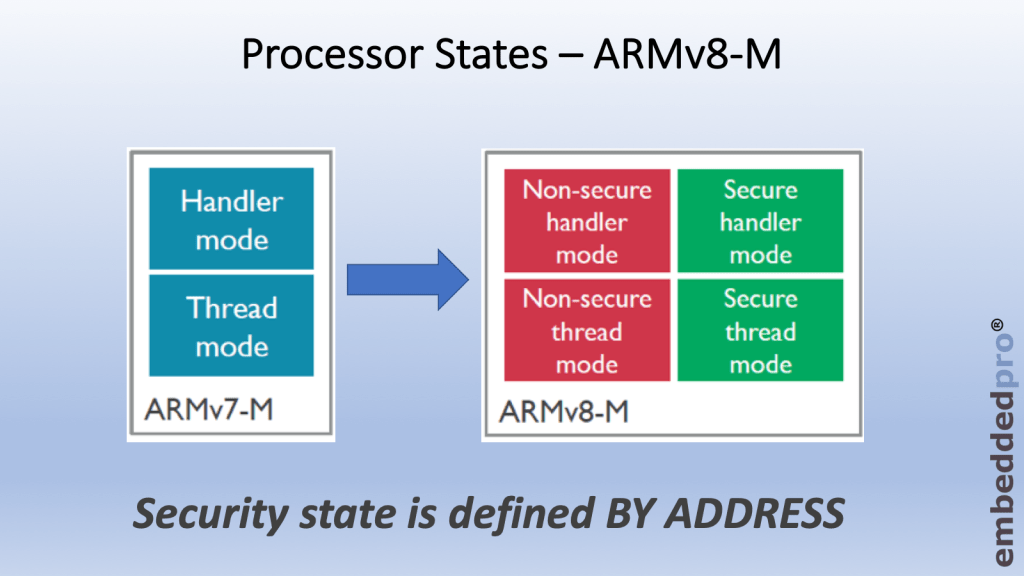
Last week I wrote about why we need the TrustZone® security extension for ARMv8-M. There are software use-cases where it can be very helpful to partition the software into 2 separate worlds, secure and non-secure. TrustZone® acts as the gatekeeper between these two worlds and manages how the core transitions between the worlds. The ARMv8-M architecture introduces two new States for the core – secure and non-secure. Cortex® M33 core (and M23 core also) is implemented to ARMv8-M standard and of course supports the two new states.

ARMv8-M architecture introduces 2 states for the core – secure and Non-secure
Continue reading

Linking Bootloader Applications with Eclipse and FreeMarker Scripts

Bootloaders are a fine thing: With this I can load any applications I like. Power comes with some complexity, and a bootloader alone is a complex thing already. But this applies to the application part too: I need to link the application to a certain offset in the memory space so it can be loaded by the bootloader, plus the application typically needs to add some extra information to be used by the bootloader. This article describes how to build a bootloader application with Eclipse (MCUXpresso IDE) using the MCUXpresso SDK.

Build Configuration for Bootloader Application

Continue reading

Stack Canaries with GCC: Checking for Stack Overflow at Runtime

Stack overflows are probably the number 1 enemy of embedded applications: a call to a a printf() monster likely will use too much stack space, resulting in overwritten memory and crashing applications. But stack memory is limited and expensive on these devices, so you don’t want to spend too much space for it. But for sure not to little too. Or bad things will happen.

The Eclipse based MCUXpresso IDE has a ‘Heap and Stack Usage’ view which can be used to monitor the stack usage and shows that a stack overflow happened:

Heap and Stack Usage

Heap and Stack Usage

But this is using the help of the debugger: how to catch stack overflows at runtime without the need of a debugger? There is an option in the GNU gcc compiler to help with this kind of situation, even if it was not originally intended for something different. Continue reading

Investigating ARM Cortex® M33 core with TrustZone® – Setting up your environment and creating your first project with MCUXpresso IDE

This is the second of my 17-part video tutorial series investigating the ARM Cortex® M33 core with TrustZone® security extension. My preferred platform for this investigation is the LPC55S69 from NXP, and of course it is necessary to have a development board and IDE. So I’m using the LPC55S69-EVK with NXP’s MCUXpresso IDE and the MCUXpresso Software Development Kit (SDK).

This week the video is really low on theory, but high on practical, step-by-step information to get started with these tools. Maybe you are similar to me, and make the same mistake every time?? I get the self-assembly furniture home from the store, or open the box containing the new development board and just get started. At some point it doesn’t work properly and that’s the time I must read the supporting information.

Well, with this video I show you beginning-to-end in just over 10 minutes, and you won’t need to refer to any other material.

During the video I show you the following steps:

Continue reading

NXP MCUXpresso IDE 11.0.1 available

NXP has released an update of the Eclipse based V11 IDE. This is right on time for the new semester starting mid of September where this IDE will be used in several labs.

MCUXpresso IDE V11.0.1

MCUXpresso IDE V11.0.1

Continue reading

Programming the ESP32 with an ARM Cortex-M USB CDC Gateway

The Espressif ESP32 devices are getting everywhere: they are inexpensive, readily available and Espressif IDF environment and build system actually is pretty good and working well for me including Eclipse (see “Building and Flashing ESP32 Applications with Eclipse“). The default way to program an ESP32 is to a) enter UART bootloader by pressing some push buttons and b) flash the application with ESP-IDF using a USB cable.

That works fine if the ESP32 is directly connected to the host PC. But in my case it is is behind an NXP Kinetis K22FX512 ARM Cortex-M4F microcontroller and not directly accessible by the host PC. So I had to find a way how to allow boot loading the ESP32 through the ARM Cortex-M which is the topic of this article.

TTGO ESP32 MICRO-D4 Module

TTGO ESP32 MICRO-D4 Module

Continue reading

DIY Stepper Motor Clock with NXP LPC845-BRK

This project is about building a stepper motor clock around the NXP LPC845-BRK board. The design is using a combination of 3D printed and laser cut parts and costs below $15.

Stepper Clock Acrylic Face White Hands

Stepper Clock Acrylic Face White Hands

Continue reading