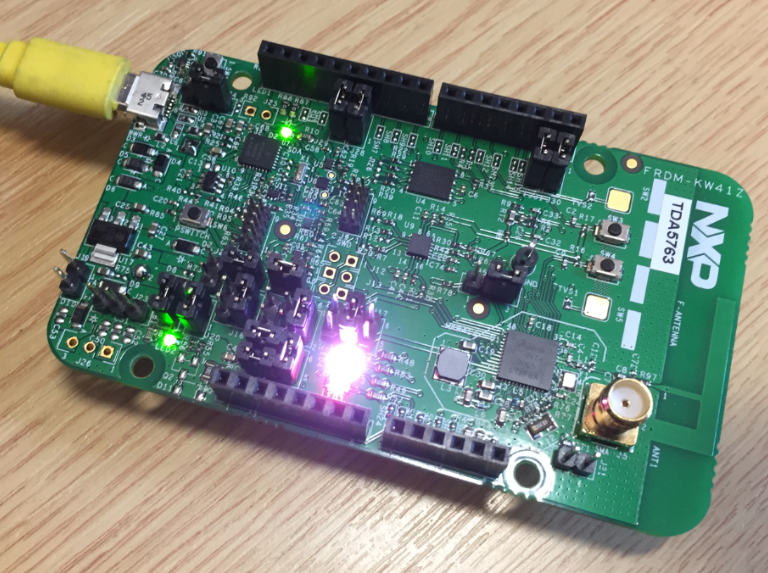
I’m pleased to announce that a new release of the McuOnEclipse components is available in SourceForge. In this release more ARM Cortex devices/vendors are supported with different SDKs, plus it comes with several FreeRTOS enhancements for debugging highly optimized code.
Category Archives: MCUXpresso
Using Multiple Memory Regions with the FreeRTOS Heap
ARM Cortex-M microcontrollers can have multiple memory controllers. This is a good thing as it allows the hardware to do multiple parallel memory read/writes. However this makes the memory map more complicated for the software: it divides the memory into different regions and memory segments. This article is about how to enable FreeRTOS to use multiple memory blocks for a virtual combined memory heap:
Tutorial: Porting BLE+NRF Kinetis Design Studio Project to MCUXpresso IDE
The tools and IDE market is constantly changing. Not only there is every year at least one new major Eclipse IDE release, the commercial tool chain and IDE vendors are constantly changing the environment too. For any ARM Cortex-M development, the combination of Eclipse with the GNU tool chain provided by ARM Inc. is the golden standard. But this does not mean that things can be easily moved from one IDE package to another.
While moving between Eclipse versions and GNU versions is usually not a big deal at all, moving between the Eclipse build tool integration is usually not simple. While the GNU MCU Eclipse plugins are widely used (see Breathing with Oxygen: DIY ARM Cortex-M C/C++ IDE and Toolchain with Eclipse Oxygen), the Eclipse based IDEs from the silicon vendors or commercial Eclipse toolchain vendors are using their own GNU toolchain integration. Which means the project files are not compatible :-(.
Building Eclipse and MCUXpresso IDE Projects from the Command Line
Eclipse as IDE takes care about compiling and building all my source files. But in an automated build system I would like to build it from the command line too. While using make files (see “Tutorial: Makefile Projects with Eclipse“) is an option, there is another easy way to build Eclipse projects from the command line:
Troubleshooting Tips for FreeRTOS Thread Aware Debugging in Eclipse
FreeRTOS seems to get more and more popular, and I think as well because more and more debugger and Eclipse IDE vendors add dedicated debugging support for it.
How to use Custom Library Names with GNU Linker and Eclipse
By default, the GNU Linker expects a very special naming scheme for the libraries: the library name has to be surrounded by “lib” and the “.a” extension:
lib<NAME>.a
But what if the library I want to use does not conform to that naming standard?
MCUXpresso IDE v10.0.2 – Updated Eclipse based IDE for LPC and Kinetis
NXP has released an updated of their Eclipse based IDE for ARM Cortex-M (Kinetis and LPC) microcontroller: the version v10.0.2 build 411:
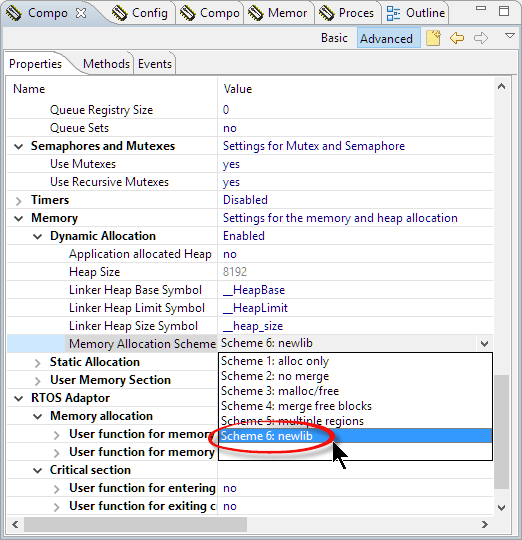
Using FreeRTOS with newlib and newlib-nano
For reliable applications, I avoid using functions of the standard libraries. They are banned for most safety related applications anyway. I do not use or avoid malloc(), printf() and all the other variants, for many reasons including the ones listed in “Why I don’t like printf()“. Instead, I’m using smaller variants (see “XFormat“). Or I’m using only the thread-safe FreeRTOS heap memory allocation which exist for many good reasons.
Things get problematic if malloc() still is pulled in, either because it is used by a middleware (e.g. TCP/IP stack) or if using C++. Dave Nadler posted a detailed article (http://www.nadler.com/embedded/newlibAndFreeRTOS.html) about how to use newlib and newlib-nano with FreeRTOS.
GNU Code Coverage on Embedded Target with Eclipse Neon and ARM gcc 5
For a research project, we are going to send a satellite with an embedded ARM Cortex microcontroller into space early next year. Naturally, it has to work the first time. As part of all the ESA paperwork, we have to prove that we tested the hardware and software thoroughly. One piece of the that is to collect and give test coverage evidence. And there is no need for expensive tools: Free-of-charge Eclipse and GNU tools can do the job for a space mission 🙂
ARM SWO Performance Counters
In “Cycle Counting on ARM Cortex-M with DWT” I have used the ARM DWT register to count the executed cycles. With the MCUXpresso IDE comes with a very useful feature: it can capture the ARM SWO (Single Wire Output) trace data. One special kind of trace data is the ‘cycle counter’ information which is sent through SWO.