Tutorial: IAR + FreeRTOS + Freedom Board

Maybe Eclipse is ‘too much’, and you are looking for something different? The cool thing with Processor Expert is that while this is Eclipse based, you can use it easily with other tool chains like IAR Embedded Workbench. So you have the choice, and I have explored things a little with porting FreeRTOS for Cortex-M0+ to IAR :-).

IAR Embedded Workbench with FreeRTOS

IAR Embedded Workbench with FreeRTOS

In this tutorial I’m showing how use IAR with FreeRTOS and the Freedom FRDM-KL25Z Board, using Processor Expert components.

Continue reading

Live View for Variables and Memory

Debugging is usually a ‘stop-inspect-continue’ process. That does not work very well for watching a system which continuously changes its state. For this usually I toggle an LED, or write things to the console to watch with a human eye what is going on. But there is something very powerful in the CodeWarrior debugger too: to display variables and memory content while the target is running.

Variable Live View

Variable Live View

Continue reading

Debugging ARM Cortex-M0+ Hard Fault with MTB Trace

And here it is again: a Hard Fault exception raised by the ARM Cortex-M0+ on my Freedom board:

Hard Fault in Debug View

Hard Fault in Debug View

A reason for hard faults are for example dereferencing a NULL pointer. The issue with the ARM Cortex hard fault exception stack is: it is not easy to find out where in the code the problem is.I have created a Processor Expert component to help me to find the location of such an exception. With the Eclipse based CodeWarrior for MCU10.3 there is another way: Trace with the MTB (Micro Trace Buffer)!

Continue reading

A Processor Expert Component to Help with Hard Faults

Ahrg! Again my ARM application crashed somewhere and I ended up in a HardFault exception :-(. In my earlier post I used a handler to get information from the processor what happened. But it is painful to add this handler again and again. So I decided to make things easier for me: with a special HardFault Processor Expert component :-).

After adding this HardFault component to my project, it automatically adds an entry to the vector table. So no manual steps are needed: having the component in the project and enabled will do the needed steps.

Continue reading

Adding Symbols to the CodeWarrior Debugger

On the TWR-LCD, I’m using a USB MSD bootloader. In Programming part of flash I showed how to download and debug the application on top of the bootloader. But how to debug both the bootloader and the application? At the same time with CodeWarrior for MCU? The magic key is tell CodeWarrior to use ‘Other Executables’.

Continue reading

KL25Z and I2C: Missing Repeated Start Condition

I really hate this kind of stuff: I know it should work, but it does not. I’m loosing a lot of time (hours, days, even weeks) to track it down to the root cause. Yes, I create my own bugs. Yes, there are bugs in tools, sources, libraries and components. But what many might not believe: there are bugs in silicon too :-(. If you do not believe, here is one: there is a hardware I2C problem on the KL25Z used on the Freedom board. It worked in one project, but not in another.

❗ The silicon bug described here is present on many Kinetis devices, not only the KL25Z!

Logic Analyzer attached to the FRDM-KL25Z board

Logic Analyzer attached to the FRDM-KL25Z board

So if you are facing a problem where you read 0xFF or wrong values from the I2C bus with the KL25Z, here is probably why (and how to workaround it). The problem showed up with a modified version of the Freedom Accelerometer tutorial….

Continue reading

SWD Debugging with the FRDM-KL25Z Board

The OpenSDA on the FRDM-KL25Z board is a cool feature: I do not need any external debugging device to program and debug my board :-). But my KL25Z custom board will not have that OpenSDA on it: first because it would add additional costs, and I do not see a way how I could use it for my board. I better start using a SWD/JTAG debugger for my Freedom board to have everything in place.

What I need to add to the black Freedom board is the SWD header:

SWD J6 (populated) and J11 (unpopulated)

SWD J6 (populated) and J11 (unpopulated)

Continue reading

How (not) to Secure my Microcontroller

There are several reports in the Freescale forums around having ‘secured’ the Freedom board. But what does ‘securing’ a board mean? And what does it mean if I get that ‘Device is Secure’ dialog?

Device is Secure. Erase to unsecure?

Device is Secure. Erase to unsecure?

There are different levels of protection you can find in many embedded microprocessors, and the terms might vary from vendor to vendor:

  1. Protect
  2. Secure
  3. Disable Mass Erase

Continue reading

Speeding up the Debug Launch in CodeWarrior

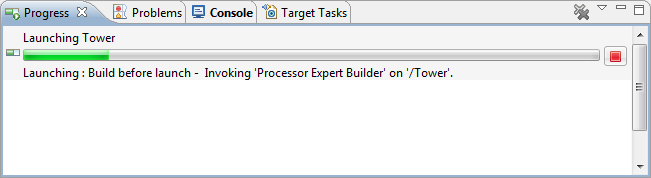
Whenever I do a debug launch in the Eclipse based CodeWarrior, it takes some time until actually I’m ready to step through my code on the target. Yes, a good part of that is by Eclipse. But another part is that Eclipse helps me to do stupid things (which is a good thing). But say if I know what I’m doing, I could remove some of that safety belts and still doing fine. But only if I know what I’m doing.

A good indicator where Eclipse is spending time is to have a look in the Progress View:

Progress information during launch

Progress information during launch

It shows an interesting information: ‘Build before Launch’….

Continue reading

Copy my CodeWarrior Project

I have a project working, and then I want to do a copy. Unfortunately, this is not as simple as it should be :-(. In order to copy a project with all the settings, some knowledge about the internals of the project structure is required, which is the topic of this post.

In “Copy my Project” I was using a ColdFire V2 project which is not an easy case, as is using a Target Task to flash the microcontroller. Fortunately, all other targets in CodeWarrior for MCU are *not* using target tasks :-). With little help and preparation, a copy a project is not that difficult to do.  I’m showing how to do this with the FRDM-KL25Z project I have created in this post.

Continue reading