A sunrise which reminds me that nature creates the most beautiful pictures:

Mythen Sunrise
Scene created by the Föhn wind moving clouds over the Swiss Alps, and the sun rising behind the Mythen mountains.
Happy Sunrising 🙂


A sunrise which reminds me that nature creates the most beautiful pictures:
Mythen Sunrise
Scene created by the Föhn wind moving clouds over the Swiss Alps, and the sun rising behind the Mythen mountains.
Happy Sunrising 🙂
For a research project we are using Hexiwear to measure the effectiveness of teaching and learning. The Hexiwear is used as a networking sensor device in that project. For that project we needed a docking station with wireless capabilities:
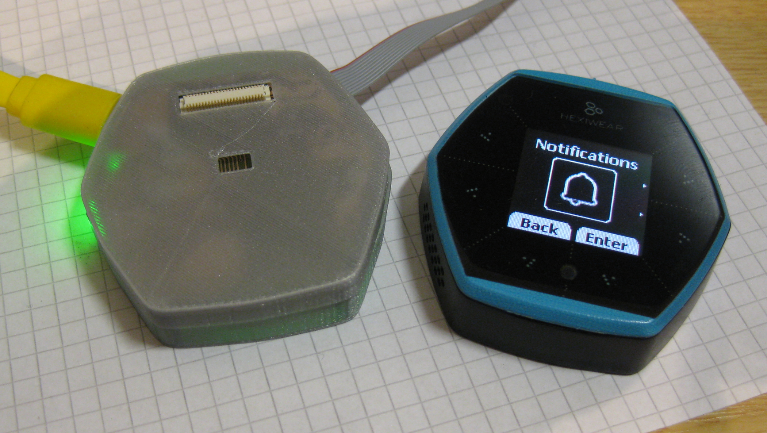
Mini Docking Station for Hexiwear
Mother nature offered an interesting puzzle this morning: a sunrise with beautiful light sculptures. But where is the sun?

Morning sunlight without the Sun?
For many of my applications I need to measure a distance. I have used ultrasonic sensors, but there view angle (beam) is not able to detect smaller objects, it very much depends on the object surface and angle, it is slow and not very precise. I have used infrared sensors, but here again it depends on the infrared reflection of the object in range, it depends the amount of reflected light is not really telling much about the distance, and yet IR reflection is subject of material and object targeted.
But there is yet another sensor type to consider: ToF! ToF (or Time-of-Flight) sensors have a built-in LIDAR: The sensor is sending out light pulses and measures how much time it takes for the light to come back. Similar to ultrasonic sensors (see “Tutorial: Ultrasonic Ranging with the Freedom Board“), but instead of ultrasonic it uses an infrared laser light. Or think about a radar system using an infrared laser light.

Vl6180x Breakout Board with tinyK20 (NXP Kinetis K20) Microcontroller-board
About a year ago, on December 7th 2015, Freescale and NXP have announced the completion of their merger. Now it is Qualcomm which wants to acquire NXP? It looks like these mergers are happening faster and faster. The reality is that merging products take more time than anticipated, and nearly one year later I can see the outcome of what comes out of the marriage between Freescale and NXP or between Kinetis and LPC: NXP has announced the MCUXpresso software and tools for Kinetis and LPC microcontroller:

Introducing MCUXpresso (Source: NXP video)
The year is coming to an end, the Holiday season is approaching. In case you are looking for a nice present: I have completed my version of a sand clock: a clock writing the time into sand:

Sandclock
If you are interested to build your own version, I have documented the different steps with tips and tricks…
The good thing with failure is: it is an opportunity to learn :-).
So here is a case: For a STEM roadshow (see “MINTomat: World’s Most Complicated Bubble Gum Automata?“), we have produced in a rush an autonomous robot with a shiny printed 3D cover:
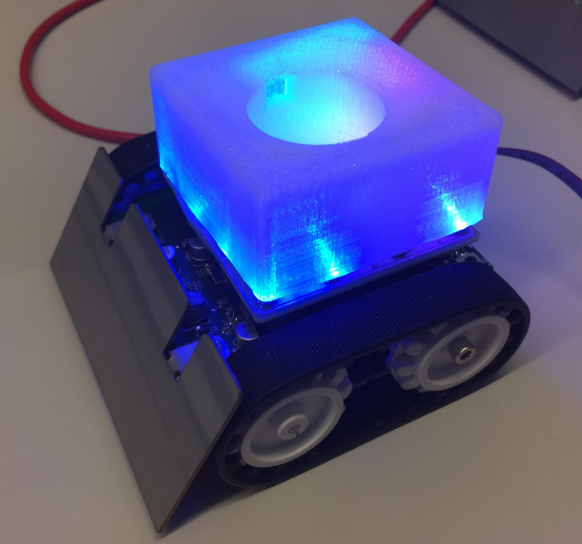
Prototyp with LED Effects
How to fascinate kids for technology? Show them that engineering is fun :-). At the Lucerne University of Applied Sciences and Arts we have created the ‘MINTomat’: a robotics system for STEM activities rewarding interaction with bubble gums:
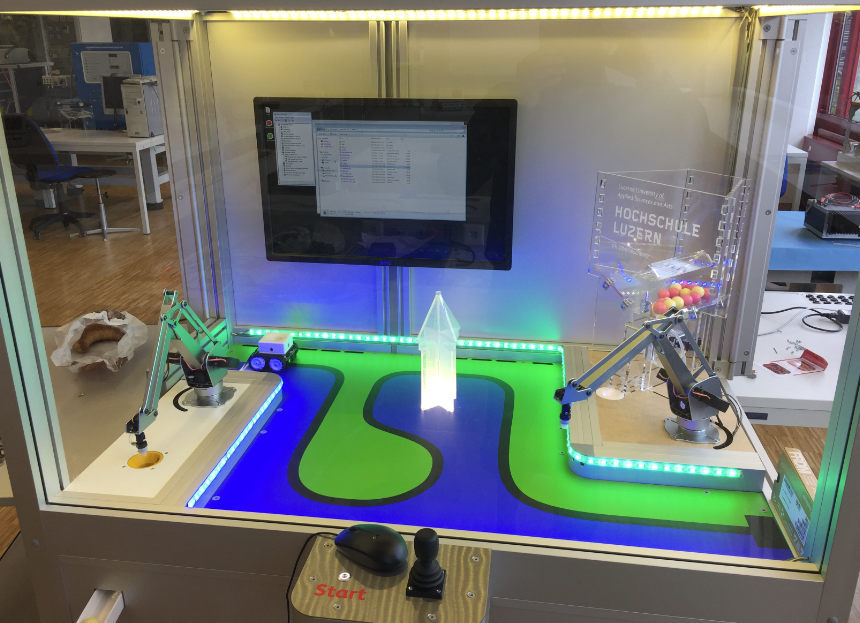
MINTomat
Yes, pretty over engineered compared to a normal bubble gum automata, but that’s part of the fun :-).
This post is a bit off-topic. No, this is not one of my deep technical tutorials. It is not about all the muddy bits in hardware, and it is not about shiny and great tools. This post is about you all: WordPress counted 15’000 comments for McuOnEclipse!

15000 Comments on McuOnEclipse
I highly appreciate your thoughts, questions, requests, ‘likes’ and feedback you give. Please keep them coming!
Happy Commenting 🙂
PS: special thanks to Kevin P. and Jim T.: this blog would not exist without you!
It seems to me that not many developers use hardware trace? ARM indicates that maybe only <5% of developers are using trace. Too bad! Why are all the ARM Cortex microcontroller vendors putting a powerful hardware (and complicated!) trace engine into their devices, if only few developers are using it? Seems like a waste of silicon and an unnecessary price adder? Well, hardware trace can be a life saver: Because only with hardware trace the most complicated bugs and problems can be solved. And maybe because only the best are using it ;-).
In this article I proudly present my research how to get instruction trace out of the ARM Cortex-M4 microcontroller on a NXP TWR-K64F120M board with a Segger J-Trace for ARM:

J-TRACE tracing NXP TWR-K64F Board
 MCU on Eclipse