The Quotation Problem

Maybe this article gets the attention of a local optometrist or eye shop: I have a business opportunity for you! ;-).

I ran into a weird problem: I received an ARM GNU gcc project which failed during the generation of the S19 file in strange way:

'Executing target #80 Freedom_Zumo.siz'
'Invoking: ARM Ltd Windows GNU Create Flash Image'
“C:/Freescale/CW MCU v10.3\eclipse\../Cross_Tools/arm-none-eabi-gcc-4_7_3/bin/arm-none-eabi-objcopy”  -O srec Freedom_Zumo.elf "Freedom_Zumo.hex"
' '
Der Befehl "“C:" ist entweder falsch geschrieben oder
konnte nicht gefunden werden.
mingw32-make: *** [Freedom_Zumo.hex] Error 1

Continue reading

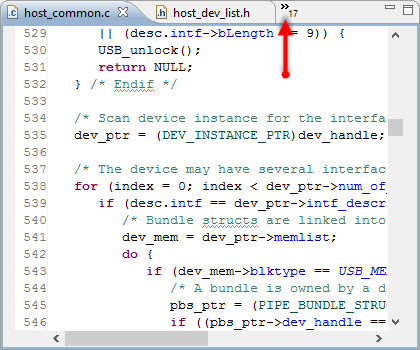
Quick Switch Editor in Eclipse

Probably I need to add 3rd monitor to my laptop system, or maybe I’m not organized enough. But as a matter of fact: I want to have as many source files as possible open in Eclipse. But there is simply not enough screen real estate to show them all:

Many source files open

Many source files open

With that many source files open, I need an effective way to switch between the files.

Continue reading

Editor Templates in Eclipse

Eclipse is a good IDE. At a first glance, it does the job. Good enough. At least for myself, I was not that much excited when I used it the first time. I came from the Microsoft Visual Studio world, and have used many other proprietary IDE’s. So Eclipse was just ‘yet another one’. But what Eclipse makes really great is the incredible wealth of functionality which is not visible right away. Yes, this is the same for any other software tool: it takes time to explore, and once you know things well, you do not want to switch or even consider something different. Same for me.

The other thing is: after some time, I get used to things, and I do not appreciate it that much any more. Only until someone reminds me that maybe things are not that well-known? This is what happened to me two days ago: I did some editing in Eclipse, while a colleague was watching me doing this. Then he said something like this

“Hey, what did you do? What was that?!? How did you do that?”

I do not remember his exact words, as I was surprised as well. I did not do anything special? Kinda standard Eclipse thing. Well, maybe not.

Continue reading

Search in Processor Expert Component Properties

Sometimes I’m looking for a functionality, and I cannot find it. But this does not mean that it does not exist ;-).

The Eclipse preference pages have a great filter text field: If I want to change a setting which has something to do with ‘color’, I can enter that text and it will show me all setting pages having something to do with ‘color’:

Eclipse Preference Filter

Eclipse Preference Filter

Continue reading

Switching Processor Package in Processor Expert

When I create a new project for the KL05Z with Processor Expert, then it shows up as 48 pin LQFP package in the project:

48pin LQFP Package in Components View

48pin LQFP Package in Components View

However, when I look at my board, it has a KL05Z32 in a LQFP package with 32 pins:

FRDM-KL05Z Board

FRDM-KL05Z Board

Continue reading

Skipping Breakpoints

The challenge with small microcontroller like the ARM-Cortex-M0+ is that they have very limited debugging resources. As such, the number of hardware break points is very limited (see this post). For example for the KL25Z on the Freedom board, I only have 2 break points available if I want to do stepping:

No more hardware breakpoints available

No more hardware break points available

Continue reading

Be Aware of the Baud Problem

I’m using serial communication in different flavors for my project: with the shell, with OpenSDA USB CDC, to use printf(), and with the Bluetooth module. Processor Expert is a big helper, but as for any software, it is not bug free. And there is a problem with Processor Expert in CodeWarrior for MCU10.3 in respect with Baud settings for a serial interface.

Probing the Bluetooth Module Serial Connection

Probing the Bluetooth Module Serial Connection

Continue reading

Processor Expert Configuration Registers View

In “Using the Reset Button on the Freedom Board as User Button”, I had the problem to find out why a setting did not make it into my generated code. There is the fundamental question: “How does a setting impact my microcontroller register settings?”. There is an answer to that question: The Configuration Registers view:

Configuration Registers View

Configuration Registers View

Continue reading

Using the Reset Button on the Freedom Board as User Button

Processor Expert is a great tool: it lets me configure all the complexities of that ARM Cortex-M0+ core. But today it has fooled me and I lost several hours of my week-end time :-(. I need a user interface like push button for my project. Yes, the FRDM-KL25Z has touch area, but honestly: that kind of stuff never worked out well for me. It is probably just me having it not properly set up. The touch slider is working as in my earlier simple example, but in my other project with more hardware around it, it is working sometimes, sometimes not. Ahrg! I can blame my ignorance, my lack of understand how to configure it properly, or the extra noise by the hardware around it. Result is: I wasted a lot of time, and I give up :-(.

SW1 on the FRDM-KL25Z Board

Reset button on the FRDM-KL25Z Board

Continue reading

Tutorial: Using the ARM CMSIS Library

One of the great advantage of using an ARM core as on my FRDM-KL25Z board is that I can leverage a lot of things from the community. And one big thing around ARM is CMSIS (Cortex Microcontroller Software Interface Standard). It is an industry wide software library for the ARM Cortex microcontroller. Using the CMSIS libraries and interfaces will make it easier to port applications within the ARM Cortex family.

CMSIS Version 3 Block Diagram (Source: Arm.com)

CMSIS Version 3 Block Diagram (Source: Arm.com)

Continue reading