CodeRed Debug Perspective in Kinetis Design Studio

I very much liked the CodeRed Eclipse based IDE (see “Red Suite 5: Eclipse Juno, Processor Expert and unlimited FRDM-KL25Z“). But back in May 2013 CodeRed was acquired by NXP. I have not used much NXP devices for my projects, and as CodeRed was focusing on the NXP parts, CodeRed was not running daily on my desk any more :-(. Well, things might make a full back circle, as NXP announced back March 1st 2015 to acquire Freescale :-). And maybe as a taste how things might come out, the GNU ARM Eclipse plugin release from March 22nd 2015 includes a CodeRed debug view šŸ™‚ šŸ™‚

CodeRed Debug Perspective in KDS

CodeRed Debug Perspective in KDS

That debug perspective mimics a CodeRed debug perspective. The advantage of this Eclipse perspective is that it works very well with small screens. This post is about adding this perspective to the recently release Kinetis Design Studio v3.0.0.

Continue reading →

Breadcrumbing Mother’s Day: Minimized Debugging View with Eclipse

What I love with Eclipse: it has lots of small and useful features, either built-in or available as plug-in. Recently I started to use a feature which is present in Eclipse for some time: the ability to save screen real estate during debugging with the ‘breadcrumb’ view option:

Expanded Breadcrumb View

Expanded Breadcrumb View

Continue reading →

Editing Compiler Include (or other) Settings in Eclipse

So now I have carefully set up my compiler include paths in Eclipse to tell the GNU compiler where to find my header files:

Include Paths

Include Paths

The question is: how can I apply these settings to another project?

Continue reading →

CRC Checksum Generation with ‘SRecord’ Tools for GNU and Eclipse

One of the things missing for Embedded in the GNU linker is that it cannot generate a CRC checksum. Luckily, there is the solution of using SRecord:

SRecord 1.64 Web Page
Continue reading →

Semihosting with GNU ARM Embedded (Launchpad) and Kinetis Design Studio

A while back I wrote two articles about Semihosting: “Semihosting with GNU ARM Embedded (LaunchPad) and GNU ARM Eclipse Debug Plugins” and Semihosting with Kinetis Design Studio. With using the GNU ARM Embedded (lauchpad) in my Kinetis Design Studio, time for a ‘summary’ post :-).

Semihosting Output in Console

Semihosting Output in Console

Continue reading →

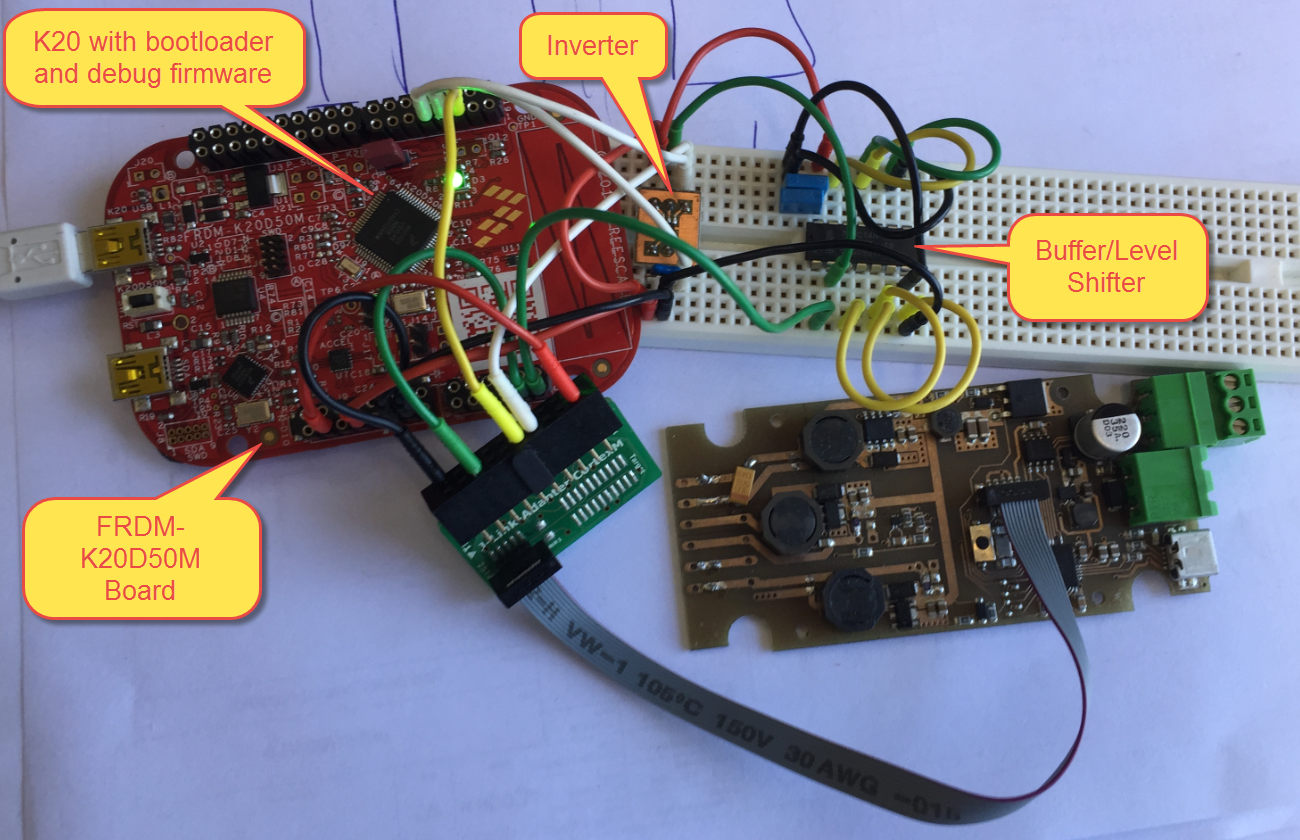
Proof of Concept: Open Source ARM SWD Debug and General Purpose Board

The Teensy is a great and tiny board (see “USB CDC with the Teensy 3.1 Board“), but it lacks real SWD/JTAG debugging capabilities (see “Hacking the Teensy V3.1 for SWD Debugging“). The Freescale Freedom boards are great, but for many applications too big, and have potentially too many components on it. So what about building a breadboard friendly tiny board which *has* SWD debugging ability *and* can be used to debug another boards?

So here is a working prototype based on the FRDM-K20D50M:

FRDM-K20D50M used as debug probe

FRDM-K20D50M used as debug probe

Continue reading →

Serial Terminal View in Eclipse Luna

If you have read my article “Serial Terminal View with Eclipse Kepler“, then you are aware that using a Terminal view to a serial connection (COM port) under Eclipse Kepler is pretty much broken. I’m moving some of my projects to the more recent Eclipse Luna release, and the good news is that support is back šŸ™‚

Terminal View with connection to board

Terminal View with connection to board

Continue reading →

Freescale Processor Expert Survey

Frequent readers of this blog know: I’m using Processor Expert in most of my projects with CodeWarrior, Driver Suite or Kinetis Design Studio. With the move of Freescale to Kinetis Design Studio and the Kinetis SDK with Processor Expert, there is an opportunity for our voice to be heard in a survey Freescale now runs about configuration tools and Processor Expert.

Processor Expert

Processor Expert

Happy Surveying šŸ™‚

Sensirion SHT11 Temperature and Humidity Sensor on a MikroElektronika Click Board

In one of my earlier posts (“Using the DHT11/DHT22 Temperature/Humidity Sensor with a FRDM Board“) I’m using the DHT11/DHT22 temperature/humidity sensors with the FRDM-KL25Z board. These sensors are very inexpensive, but have limited measurement range and accuracy. As pointed out by a reader of that article, Sensirion (a Swiss company :-)) has good sensors too, and I decided I would like to try the SHT11 sensor:

  • 0-100% Relative Humidity
  • +/- 3% Relative Humidity accuracy
  • -40 – +125°C
  • 2.4 – 5.5V supply voltage

SHT11 Sensor

SHT11 Sensor

Continue reading →

Poor Man’s Trace: Free-of-Charge Function Entry/Exit Trace with GNU Tools

There are cases where my application runs find for days, weeks or even months, but then from time to time there is an application crash. Yes, the watchdog will recover it, but still it would be good to know what happened? One solution would be to hook up a trace probe (like the one I have described in this post: “First Steps with the P&E Tracelink“). But having such a trace probe attached all the time is first not cheap and second not always possible. So what if the application would leave ‘breadcrumbs’ behind which would tell me the flow of the program leading to the problem? I have found a functionality in the GNU tools which seems not be widely known or use, but is incredibly helpful in such cases.

So what if I could get a log like this telling me which functions get called by whom?

{ 00000E88->00000DA0 ???->DEMO_Init
} 00000E88<-00000DA0 ???<-DEMO_Init
{ 00000E8C->00000D40 ???->DEMO_Run
Ā { 00000D62->00000CE8Ā  DEMO_Run:0x0022->decide
Ā  { 00000D0E->00000C60Ā  decide:0x0026->calcValue
Ā  } 00000D0E<-00000C60Ā  decide:0x0026<-calcValue
Ā  { 00000D16->00000CA0Ā  decide:0x002E->getValue
Ā Ā  { 00000CC6->00000C60Ā  getValue:0x0026->calcValue
Ā Ā  } 00000CC6<-00000C60Ā  getValue:0x0026<-calcValue
Ā  } 00000D16<-00000CA0Ā  decide:0x002E<-getValue
Ā } 00000D62<-00000CE8Ā  DEMO_Run:0x0022<-decide
Ā { 00000D62->00000CE8Ā  DEMO_Run:0x0022->decide

Continue reading →