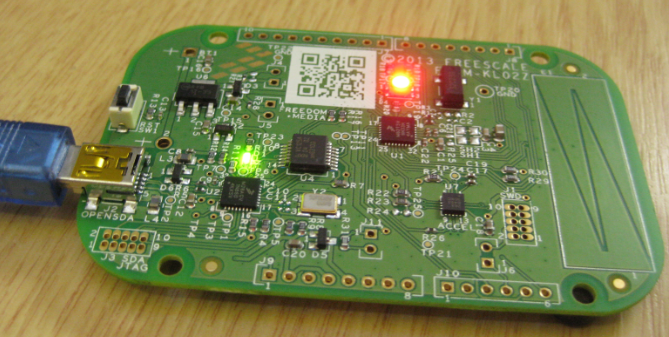
In my classes I’m mainly using the Freescale FRDM-KL25Z board, as it provides the best value for the money, and 128 kByte FLASH with 16 kByte of RAM is enough for many smaller projects. I do have as well the FRDM-KL02Z Board (32 KByte FLASH, 4 KByte of RAM) which is an inexpensive board to evaluate the smaller KL02Z microcontroller. Because someone reported a problem not being able to use the UART over OpenSDA/USB-to-CDC bridge, I have created a demo project which communicates with a console on the host.
Tag Archives: arm gcc
Poor Man’s Trace: Free-of-Charge Function Entry/Exit Trace with GNU Tools
There are cases where my application runs find for days, weeks or even months, but then from time to time there is an application crash. Yes, the watchdog will recover it, but still it would be good to know what happened? One solution would be to hook up a trace probe (like the one I have described in this post: “First Steps with the P&E Tracelink“). But having such a trace probe attached all the time is first not cheap and second not always possible. So what if the application would leave ‘breadcrumbs’ behind which would tell me the flow of the program leading to the problem? I have found a functionality in the GNU tools which seems not be widely known or use, but is incredibly helpful in such cases.
So what if I could get a log like this telling me which functions get called by whom?
{ 00000E88->00000DA0 ???->DEMO_Init
} 00000E88<-00000DA0 ???<-DEMO_Init
{ 00000E8C->00000D40 ???->DEMO_Run
{ 00000D62->00000CE8 DEMO_Run:0x0022->decide
{ 00000D0E->00000C60 decide:0x0026->calcValue
} 00000D0E<-00000C60 decide:0x0026<-calcValue
{ 00000D16->00000CA0 decide:0x002E->getValue
{ 00000CC6->00000C60 getValue:0x0026->calcValue
} 00000CC6<-00000C60 getValue:0x0026<-calcValue
} 00000D16<-00000CA0 decide:0x002E<-getValue
} 00000D62<-00000CE8 DEMO_Run:0x0022<-decide
{ 00000D62->00000CE8 DEMO_Run:0x0022->decide
Solving the 8192 Character Command Line Limit on Windows
There is a really annoying issue with using command line tools on Windows: the maximum length of the command line passed to cmd.exe is 8192 characters (see http://blogs.msdn.com/b/oldnewthing/archive/2003/12/10/56028.aspx). So you think this is not a problem for you, as you would not pass such a long command line to cmd.exe (the DOS shell under Windows)? Well, if you are using Eclipse (as I do) which generates make files (which is the normal way), then the cmd.exe very likely is involved to call the compiler/linker/etc, indirectly with the usage of make.exe. Compiling files is usually not a problem as it does not hit that 8192 limit. However, it is likely that link phase will end up with an error:
If you have such a problem, there is a solution ….
Using the DHT11/DHT22 Temperature/Humidity Sensor with a FRDM Board
For a home automation project I need to know the room temperature and humidity percentage of the room air. Adafruit has an inexpensive DHT11 sensor from http://www.aosong.com which I decided to use for that project.
Continue reading
Command Line Programming and Debugging with GDB
Eclipse with GDB is great: it comes with a graphical front end for debugging. But sometimes it is all about to download a program. Is it really necessary to launch an IDE like Eclipse to program or quickly debug a board? With the GNU Debugger (GDB), the answer is ‘no’: GDB comes with a command line debugger which is designed exactly for this: providing a command line interface for programming/downloading and debugging, bypassing any GUI (Graphical User Interface).
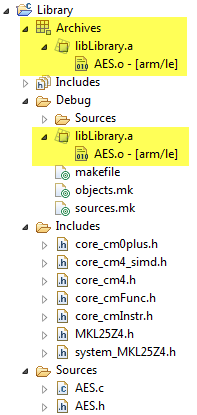
Creating a Library with Kinetis Design Studio
There is no special option in Kinetis Design Studio ‘New Project Wizard’ (NPW) to create a library (or archive). But it is really easy to create a library project.
Updated Percepio Tracealyzer and Trace Library to Version V2.7.0
Percepio has recently released the v2.7 version of Tracealyzer. This is a major upgrade from the v2.6 version which I have used so far: time to upgrade my Trace component for FreeRTOS to the latest and greatest v2.7!
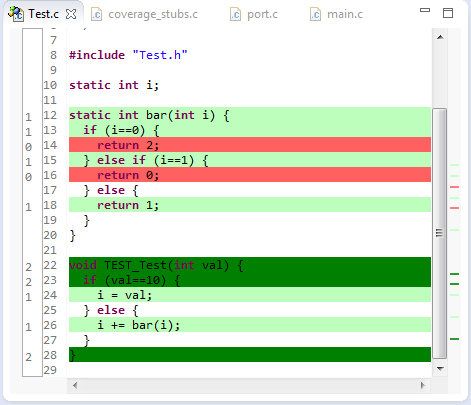
Code Coverage for Embedded Target with Eclipse, gcc and gcov
The great thing with open source tools like Eclipse and GNU (gcc, gdb) is that there is a wealth of excellent tools: one thing I had in mind to explore for a while is how to generate code coverage of my embedded application. Yes, GNU and Eclipse comes with code profiling and code coverage tools, all for free! The only downside seems to be that these tools seems to be rarely used for embedded targets. Maybe that knowledge is not widely available? So here is my attempt to change this :-).
Or: How cool is it to see in Eclipse how many times a line in my sources has been executed?
And best of all, it does not stop here….
Adding Multiple Include Paths to Build Settings in Eclipse
In Eclipse and CDT, I need to tell the compiler where it has to search for the header files. The normal way is to go to the compiler settings (menu Project > Properties > C/C++ Build > Settings) and then add the include paths, one by one, using the ‘+’ icon:
But for many include paths, this is a time-consuming process. But there is another way.
Tutorial: Playing MP3 Files with VS1053B and FRDM Board
I want to make some noise with this post!!! This tutorial is about adding music and sound capabilities to the Freescale Freedom board, and to have a lot of fun with it :-). I need this ability for a larger project working on for a while. But I thought I share that sub-part how to play sound files. So with this tutorial I can turn my Freescale Freedom board into a music or sound player :-). And adding sounds is a cool way for any project, and as the music is stored on an SD card it fits easily hours of music or sounds.