Tutorial: Makefile Projects with Eclipse

The benefit of an IDE like Eclipse is: it makes working with projects very easy, as generates make files and it takes and automatically manages the make file(s). But sometimes this might not be what I want because I need greater flexibility and control, or I want to use the same make files for my continues integration and automated testing system. In that case a hand crafted make file is the way to go.

One thing does not exclude the other: This article explains how to use make files with Eclipse with similar comfort as the managed build system in Eclipse, but with the unlimited power of make files:

Makefile Project with Eclipse

Makefile Project with Eclipse

Continue reading

MCUXpresso IDE v10.0.2 – Updated Eclipse based IDE for LPC and Kinetis

NXP has released an updated of their Eclipse based IDE for ARM Cortex-M (Kinetis and LPC) microcontroller: the version v10.0.2 build 411:

MCUXpresso v10.0.2 build 411

MCUXpresso v10.0.2 build 411

Continue reading

Getting Started: ROM Bootloader on the NXP FRDM-KL03Z Board

A bootloader on a microcontroller is a very useful thing. It allows me to update the firmware in the field if necessary. There are many ways to use and make a bootloader (see “Serial Bootloader for the Freedom Board with Processor Expert“). But such a bootloader needs some space in FLASH, plus it needs to be programmed first on a blank device, so a JTAG programmer is needed. That’s why vendors have started including a ROM bootloader into their devices: the microcontroller comes out of the factory with a bootloader in FLASH. So instead writing my bootloader, I can use the one in the ROM.

FRDM-KL03Z with ROM Bootloader

FRDM-KL03Z with ROM Bootloader

And as with everything, there are pros and cons of that approach.

Continue reading

Compiler Explorer

If you are like me – someone who always wants to know what the compiler generates for a piece of source code – then have a look at the Compiler Explorer: A web-based compiler code comparison tool:

Compiler Comparison

Compiler Comparison

Thanks to Matt Godbolt, I can select different compilers and compare their output for a given source code. Very useful to see the impact of a compiler optimization or to compare different GCC compiler versions.

Happy Comparing 🙂

Using FreeRTOS with newlib and newlib-nano

For reliable applications, I avoid using functions of the standard libraries. They are banned for most safety related applications anyway. I do not use or avoid malloc(), printf() and all the other variants, for many reasons including the ones listed in “Why I don’t like printf()“. Instead, I’m using smaller variants (see “XFormat“). Or I’m using only the thread-safe FreeRTOS heap memory allocation which exist for many good reasons.

Things get problematic if malloc() still is pulled in, either because it is used by a middleware (e.g. TCP/IP stack) or if using C++. Dave Nadler posted a detailed article (http://www.nadler.com/embedded/newlibAndFreeRTOS.html) about how to use newlib and newlib-nano with FreeRTOS.

FreeRTOS Newlib Memory Allocation Scheme

FreeRTOS Newlib Memory Allocation Scheme

Continue reading

GNU Code Coverage on Embedded Target with Eclipse Neon and ARM gcc 5

For a research project, we are going to send a satellite with an embedded ARM Cortex microcontroller into space early next year. Naturally, it has to work the first time. As part of all the ESA paperwork, we have to prove that we tested the hardware and software thoroughly. One piece of the that is to collect and give test coverage evidence. And there is no need for expensive tools: Free-of-charge Eclipse and GNU tools can do the job for a space mission 🙂

Eclipse with Coverage Views

Eclipse with Coverage Views

Continue reading

Adding GNU Coverage Tools to Eclipse

The GNU tools include powerful utilities to collect coverage information. With coverage I know which lines of my code have been executed, which is a very useful test metric. The GNU coverage tools are commonly used for Linux applications. But to my surprise not much for embedded application development, mostly because it requires a few extra steps to have it available? Why not using free and powerful tools for improving software quality? This article explains how to install the GNU gcov tools into the Eclipse IDE.

gcov with Embedded Target

gcov with Embedded Target

Continue reading

ARM SWO Performance Counters

In “Cycle Counting on ARM Cortex-M with DWT” I have used the ARM DWT register to count the executed cycles. With the MCUXpresso IDE comes with a very useful feature: it can capture the ARM SWO (Single Wire Output) trace data. One special kind of trace data is the ‘cycle counter’ information which is sent through SWO.

SWO Counters

SWO Counters

Continue reading

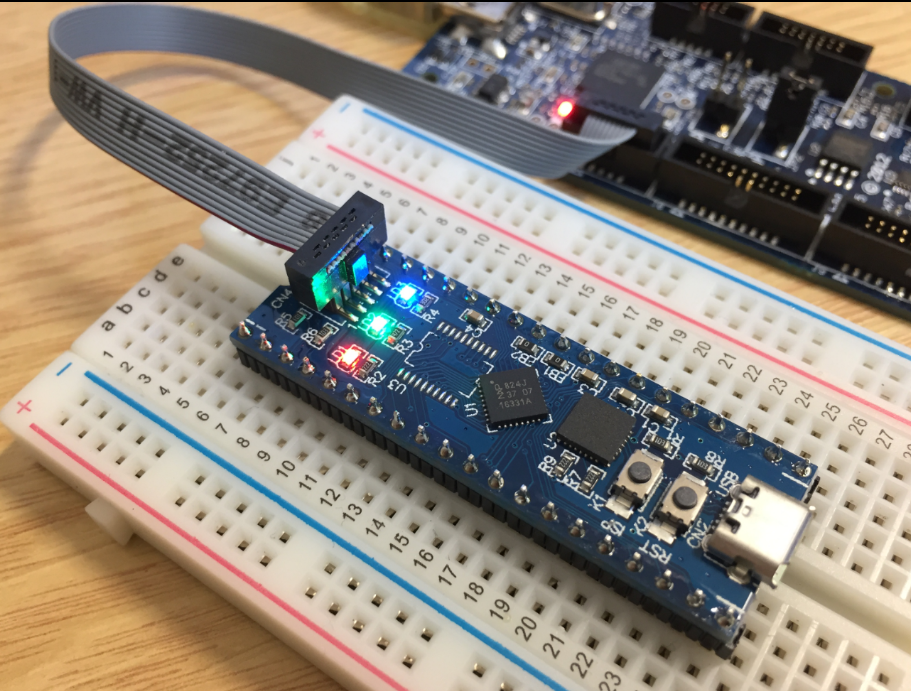
MCUXpresso IDE: Blinky the NXP LPC800-DIP Board

During Embedded World 2017 in Nürnberg I was lucky to get a handful LPC800-DIP boards. To get all students who were lucky to get one, here is a tutorial to make that very exciting ‘blinky’ application on that board:

Blinky on the NXP LPC800-DIP

Blinky on the NXP LPC800-DIP

Continue reading

Tutorial: Secure TLS Communication with MQTT using mbedTLS on top of lwip

One of the most important aspects of the ‘IoT’ world is having a secure communication. Running MQTT on lwip (see “MQTT with lwip and NXP FRDM-K64F Board“) is no exception. Despite of the popularity of MQTT and lwip, I have not been able to find an example using a secure TLS connection over raw/native lwip TCP :-(. Could it be that such an example exists, and I have not found it? Or that someone implemented it, but has not published it? Only what I have found on the internet are many others asking for the same kind of thing “running MQTT on lwip with TLS”, but there was no answer? So I have to answer my question, which seems to be a good thing anyway: I can learn new things the hard way :-).

Blockdiagram MQTT Application with TLS using lwip

Block diagram MQTT Application with TLS using lwip

Continue reading