As promised I’m going to share more details about the “60 Billion Lights” project. It is about a project to build a piece of electronics behind a 100×50 cm canvas to show animations or to display information like temperature, humidity, weather, time or just any arbitrary text.
Hike around the Engelstock
Image
The ‘Engelstock’ is located in the Canton Schwyz, Switzerland, with an elevation of 1287 m. A hike around it reveals stunning views to mountains and lakes.
McuLog: Logging Framework for small Embedded Microcontroller Systems
An essential tool especially developing larger applications or distributed firmware is to use logging. This article presents an open source logging framework I’m using. It is small and easy to use and can log to a console, to a file on the host or even to a file on an embedded file system as FatFS.
Tutorial: Adding FreeRTOS to where there is no FreeRTOS
FreeRTOS is pretty much everywhere because it is so simple and universal, and it runs from the smallest to the biggest systems. But it still might be that for the microcontroller device you have selected there is no example or SDK support for it from your vendor of choice. In that case: no problem: I show how you could easily add FreeRTOS plus many more goodies to it.
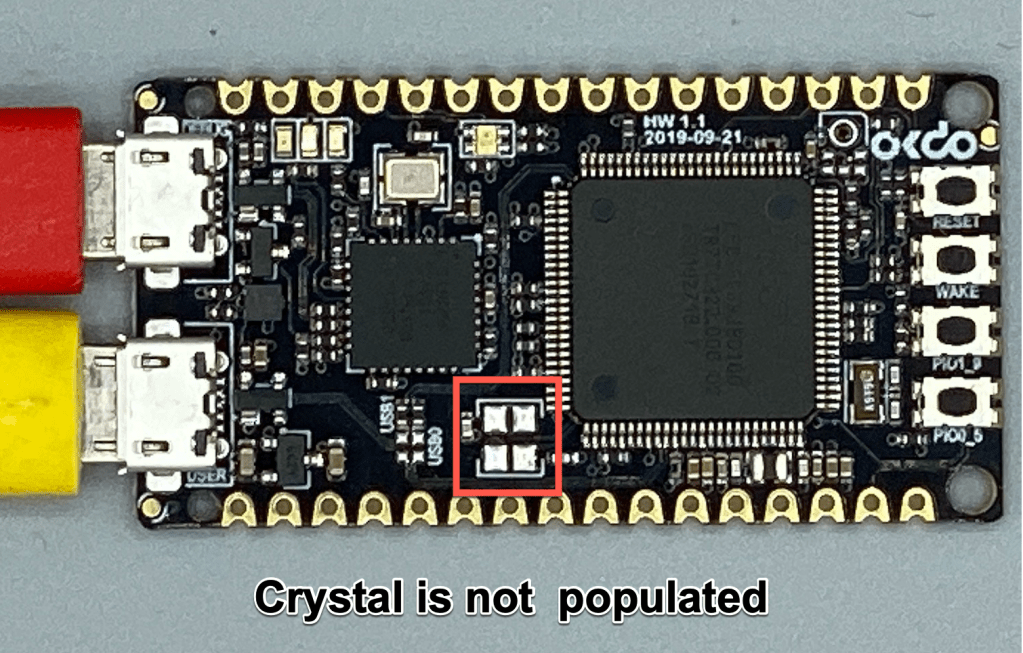
Help! My OKdo E1 board hangs up [solved]
Or… MCUXpresso Clocks Configuration tutorial using OKdo E1 board.

“60 Billion Lights”: 2400 RGB LEDs and 120 Stepper Motors hiding behind Canvas Art
It is one thing to create something ‘cool’ or technically interesting. But it is a completely different story to convince your girlfriend, partner, wife, family (or whatever you can name it) to hang something on a wall in our house or office. Then it is not about technology: it is more about design and art. So here is my attempt to solve that challenge:
Copper Wire Tree
Image
At the university we collect and recycle: bottles, batteries, glass, electronics and metal. Somebody did not have any use for a bunch of copper wires. I thought: there must be a better second live for it. This is how it looks:
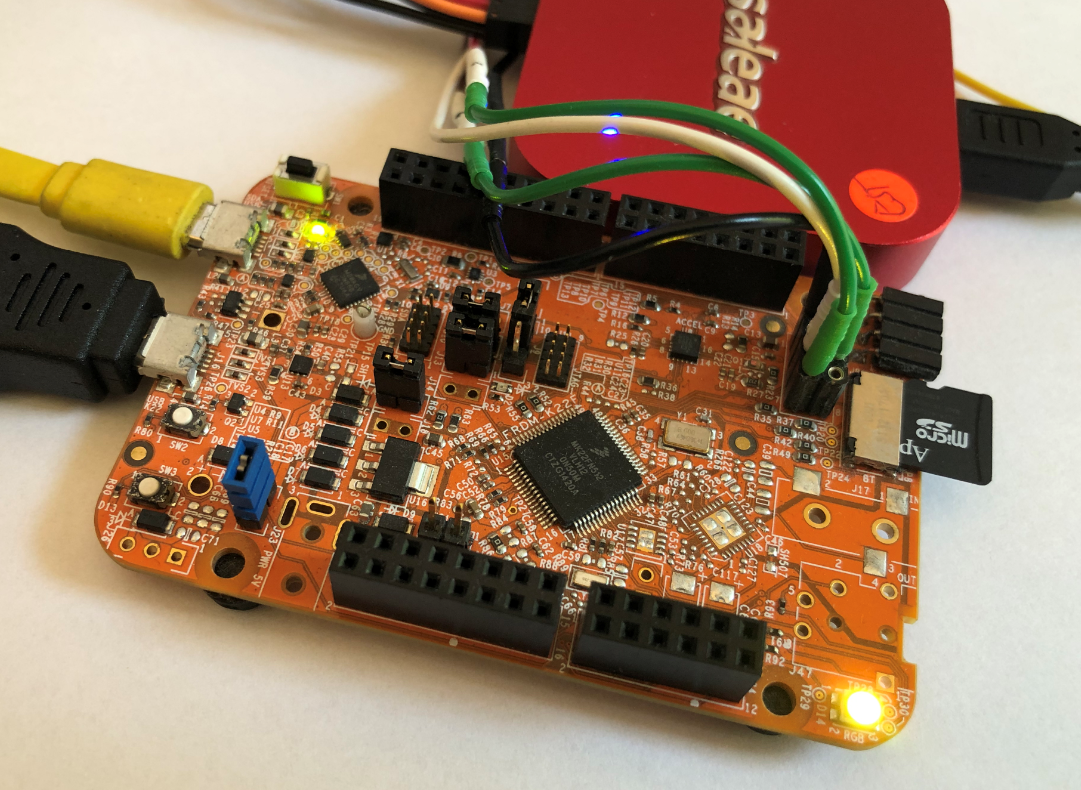
FatFS, MinIni, Shell and FreeRTOS for the NXP K22FN512
I’m using the NXP Kinetis K22FN512 in many projects, either with the FRDM-K22F or on the tinyK22: with 120 MHz, 512 KByte FLASH and 128 KByte it has plenty of horsepower for many projects. The other positive thing is that it is supported by the NXP MCUXpresso IDE and SDK. I have now created an example which can be used as base for your own project, featuring FreeRTOS, FatFS, MinIni and a command line shell.
Fast. Easy. Tiny. Introducing OKdo’s E1 board
I spend a lot of my time writing software to run on manufacturers’ evaluation (or development) boards. Here on Erich’s site, my blogs have been based on Cortex M33, using NXP’s LPC55S69-EVK and LPC55S16-EVK. Development boards are great – firstly you know that the suppliers’ software should run without issues, and secondly: many of the pin functions are brought out to headers, transceivers, codecs, switches and LEDs. So, whilst it is easy to get started, by definition the boards can be large physically, power hungry, and expensive.
What do you do if you need to embed a high performance microcontroller into your prototype or small production run and don’t have time (or the inclination) to spin out a PCB?
The answer is the OKdo E1 board, based on NXP’s LPC55S69 Cortex-M33 microcontroller.
Continue readingRetrofitting a Charmhigh CHM-T36VA Machine with OpenPnP
OpenPnP is a great open source framework for building a DIY SMT Pick&Place machine. But it does not stop there: It is possible to use OpenPnP with a commercial pick & place machine, for example the Charmhigh CHM-T36VA. This Chinese machine comes with its own controller software which works but is not that great. The good news is that it is possible to hack and retrofit the machine so it can run the much more powerful OpenPnP.