I apologize: I have not been blogging much in the past weeks :-(. One reason is that I’m working on a DIY SMT/SMD Pick&Place machine which keeps me busy most of my spare time :-). I admit that this project is not finished yet, but now is the time I can give a sneak preview: a SMD/SMT pick and place machine:
Category Archives: ARM
Upgrading a Laser Cutter with Cohesion3D Mini and LCD
I’m very happy with my 50W Laser Cutter (see “Getting Control over a 50 Watt CO2 Laser Cutter from China“). My main decision factors were (and still are): Software, software, tools and again software, and down in the list finally the hardware. Same thing for that laser cutter. After several upgrades (see “50W Laser Cutter Upgrades“), it was time replace the stock controller hardware with a new one including LCD display:
Debugging ARM Cores with IP based Debug Probes and Eclipse
Using IP (Ethernet) based debug probes is a very handy thing: I don’t have to be directly connected to the debug probe (e.g. with the USB cable). This article explains how to use an IP-based Segger or P&E probe with the Eclipse based MCUXpresso IDE.
Recovering OpenSDA Boards with Windows 10
Windows 8 and 10 have added a ‘feature’ to scan and index devices attached to the host machine. This means that bootloaders or MSD (Mass Storage Device) programming implementations on evaluation boards developed in the Windows 7 age might not be prepared for that. Up to the point that it can impact the bootloader as outlined in “Bricking and Recovering OpenSDA Boards in Windows 8 and 10“. So far one of the easiest way to get out that situation was to use a Windows 7 machine. But if you only have a Windows 10 machine available, this article describes the needed steps to update the bootloader with Windows 10 host machines.
Listing Code and Data Size with GNU nm in Eclipse
The map file produced by the GNU linker includes lots of information, however it is very cryptic to read. In “Listing Code and Data Size for each Source File with GNU and Eclipse” I showed how the GNU size utility can be used to report the code and data size for each object file. The Eclipse based MCUXpresso IDE comes with another nice view which shows detailed information about code and data allocation:
McuOnEclipse Components: 1-Apr-2018 Release
It’s April Fool’s Day, but be assured this is not a joke ;-): I’m pleased to announce that a new release of the McuOnEclipse components is available in SourceForge. This release includes several smaller bug fixes and components have been upgraded for FreeRTOS V10.0.1.
Continue reading
Tutorial: CRC32 Checksum with the KBOOT Bootloader
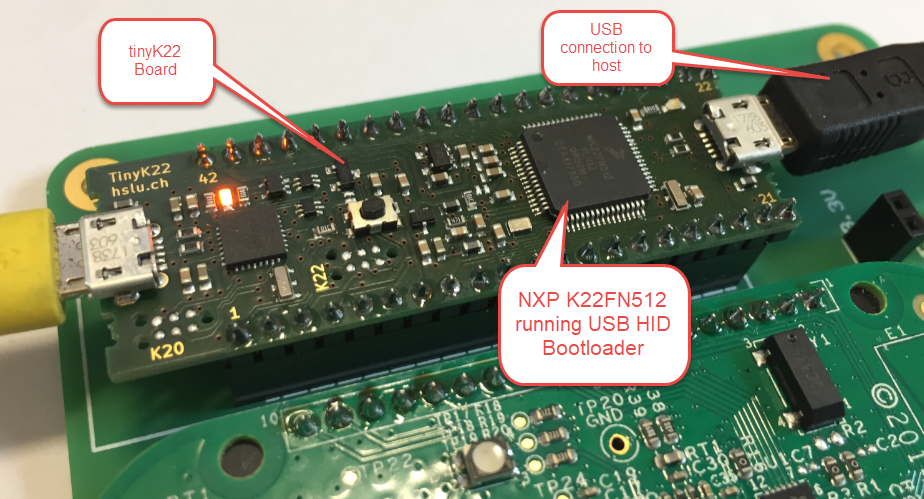
In “Flash-Resident USB-HID Bootloader with the NXP Kinetis K22 Microcontroller” I presented how I’m using the tinyK22 (or FRDM-K22F) with a flash resident USB HID bootloader. To make sure that the loaded application is not corrupted somehow, it is important to verify it with a Cyclic redundancy Checksum (CRC). The NXP KBOOT Bootloader can verify such a CRC, but how to generate one and how to use it is not really obvious (at least to me), so this article explains how to generate that CRC.
Flash-Resident USB-HID Bootloader with the NXP Kinetis K22 Microcontroller
The tinyK22 board (see “tinyK22 Boards arrived“) gets rolled out at the Lucerne University of Applied Sciences and Arts, so I thought I write-up an article this weekend how to use that board with a Flash Resident Bootloader.
Performance and Runtime Analysis with FreeRTOS
One of the great things with the FreeRTOS operating system is that it comes with free performance analysis: It shows me how much time is spent in each task. Best of all: it shows it in a graphical way inside Eclipse too:
Faster FreeRTOS Percepio Tracealyzer Streaming with Segger RTT
To solve the real hard problem of Embedded Systems development, I usually need all the data I can get from the target. The Percepio Tracealizer is such a tool which can stream application and FreeRTOS trace from the target over a Segger J-Link connection using the Segger RTT protocol. I’m using that combination a lot.
Streaming trace data that way does not need a dedicated hardware like ETM Trace. Using RTT is usually not much intrusive and affects the performance of the target in the 1-2% range (of course depending on the amount of data).
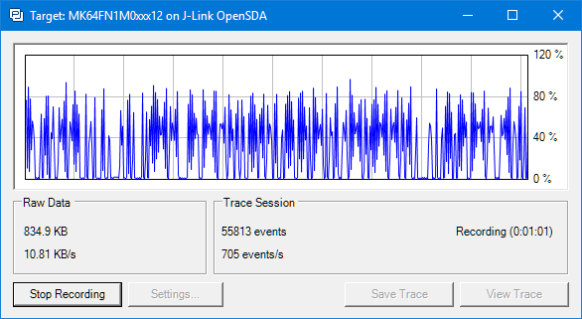
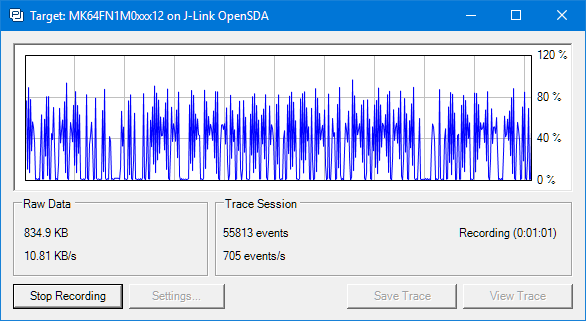
But what worried me for several weeks is that after moving to FreeRTOS V10.0.0 and the same time updating the Segger libraries, the target performance was heavily affected: