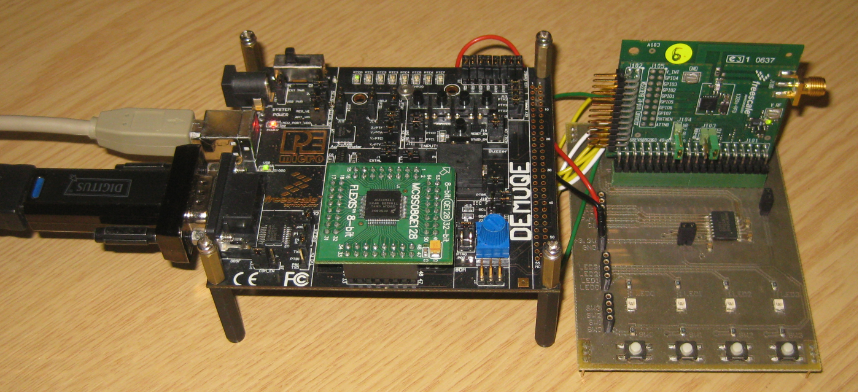
Tired by the tool chains provided by your silicon vendor? Do you want to use a free and open tool chain? Then you probably followed by “DIY Free Toolchain” series already. In “DIY Free Toolchain for Kinetis: Part 2 – Eclipse IDE” I used the standard GNU Eclipse plugins. As mentioned in above post, there is an even better and more powerful plugin available: the GNU ARM Eclipse plug-ins. There is a dedicated blog site which provides excellent documentation and direct access to new and frequent releases. And these days there is a true a Christmas gift for every Eclipse lover: the version 1.1.7 with the addition of J-Link debugger plugin :-).
Category Archives: Boards
RNet: optional ACK, Dynamic Payload and Extended nRF24L01+ Driver
Time to write an update about the RNet Wireless Stack. The stack has been successfully used for the Sumo Robots as wireless controller. In the last week, there has been a lot smaller and larger extensions for it. And because the nRF24L01+ modules are so inexpensive, I bunkered more than 50, with 20 still left to be deployed:
INTRO Mini Sumo Tournament 2013: Lots of Fun!
It was Friday the 13th, and it was Sumo Battle Day :-). After 3 months of tinkering, hacking and creatively improving the Mini Sumo Bots, finally the the course tournament took place.
Get Ready
With using a different room, every team had a chance to warm up and recalibrate the sensors for the new environment.
The time was used to apply last-minute changes and improvements too, plus to record the last Robo Portraits.
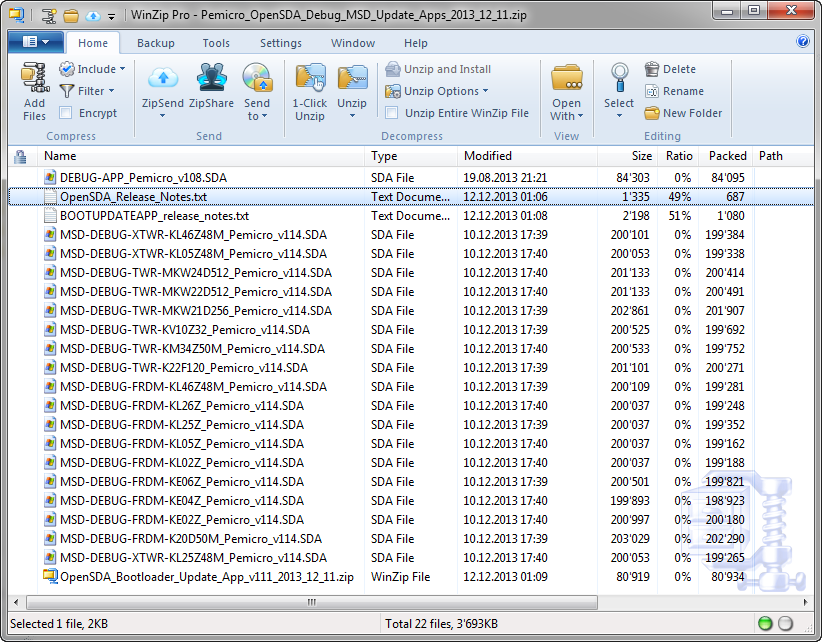
New P&E OpenSDA Firmware v114
Good news for everyone having Windows 8.1: P&E has released Dec 11th 2013 a new FRDM board firmware which solves the bootloader issue found with Windows 8.1. The new firmware can download from https://www.pemicro.com/opensda/.
Sumo Robot Portraits
If you are familiar with battle games, then typically there is portrait of the machinery you can use. Or if you have every watched ‘competitive’ sports, then every player can have an opportunity to present himself to the audience. So here we go…
Zumo Robot Last Tuning Tips
Tomorrow will the STD (Sumo Tournament Day)! Here are a few last tips and tricks to be prepared for that Sumo Tournament using the Pololu Zumo Robot chassis:
Battery Inertia
If two robots crash into each other, there can be quite some force. What I have observed is that it can be strong enough to temporarily disconnects the batteries from their spring contacts. I use pieces of plastic parts to keep the batteries tight and in place.
Continue reading
Sumo Robots, one Week until Tournament
There is one week left until all the Sumo robots of the Infotronic course at the Lucerne University of Applied Sciences and Arts will enter a tournament. The robots have to pass a simple tests before they can enter the tournament: to push a ‘dummy’ robot outside the ring. This simple test is used at tournaments to avoid ‘passive’ robots just sitting in the middle of the ring ;-).
Sumo Robots, Sensors and everything else….
The semester is approaching its end, and students are making great progress: with added infrared and ultrasonic sensors, the robots are able to detect the other robot (more or less 😉 ). Additionally the RNet stack adds extra remote control capabilities.
Things are very much in the testing phase, and some robot (or operator?) failures are really funny 🙂 For sure much more advanced moves compared to previous week. Including extra benefits like a robot bringing a bottle of water! The following video hopefully gives an impression:
Happy Roboting 🙂
Kinetis Unique Identification Register
For my RNet stack I need a way to identify nodes in the network using a unique address. What I need is Media-Access (MAC) address. Base on such a unique address I can assign short addresses (e.g. with a DHCP or similar protocol to automatically assign shorter network addresses). So how to uniquely identify my network nodes?
The Freescale Kinetis microcontroller have nice feature: they have a Unique Identification Register (UID) which would be a perfect fit for a MAC address :-).
Sumo Robot with Accelerometer Remote Controller
Usually, there are two flavors of Sumo robot competition:
- Autonomous: no communication to the robot permitted after the start.
- Remote-controlled: there is a wireless remote controller driving the robot.
Just for fun, I have implemented a wireless remote controller application for my Zumo Robot using the Freescale SRB (MC13123) board. I’m using the Freescale MMA7260Q accelerometer on the SRB board to control the robot.