Just before the long Easter break, NXP has released an update of the MCUXpresso IDE, the version 11.5.1.
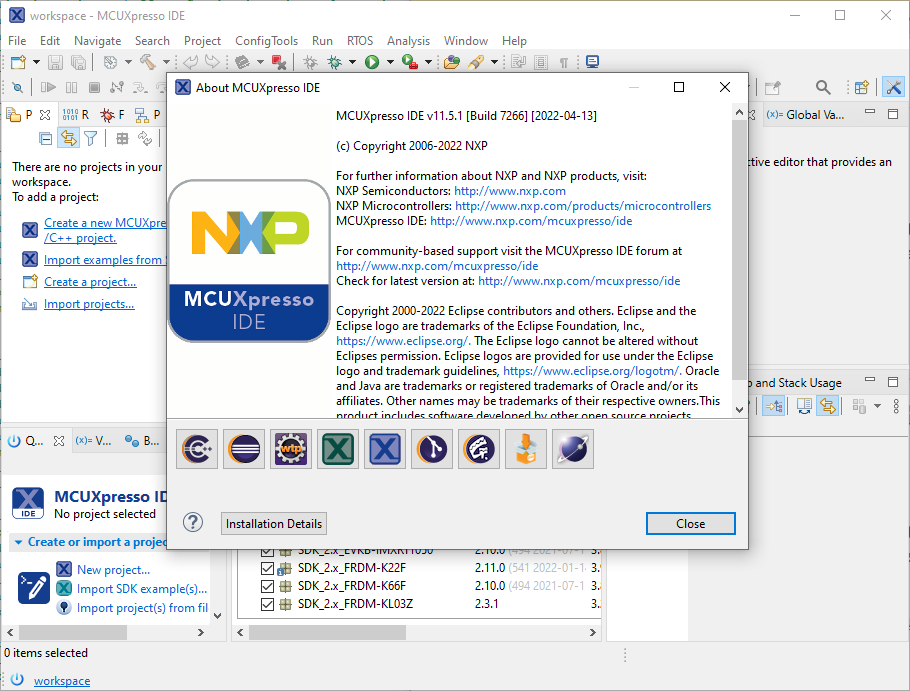


Just before the long Easter break, NXP has released an update of the MCUXpresso IDE, the version 11.5.1.
The open-source GNU tools provide a rich set of tools to help developing software. Some are clearly more for the high-end application development. But many of the tools are applicable for the more restricted embedded software development process as well. One is gcov, or the GNU Coverage Tool. Coverage is essential for the testing phase, as it tells you what part of code have been used and ‘covered’. This article describes how GNU coverage can be added the NXP S32 Design Studio IDE.

While developing applications, it can happen that things go wrong. And in my case I ended up with two LPC55Sxx EVK boards on my desk, which seemed not to be usable any more. The issue: the boards were not accessible with the debug probe, because right after main they muxed the pins in a wrong way :-(.

The standard GDB debug connections (both on-board and off-board) were not able to regain access of the board, because the MCU was running into the fault condition pretty much right out of reset.
Luckily, after a lot of trial-and-error, I have found a way to recover them.
Continue readingOne great thing with the Eclipse Gnu Make Builder (aka ‘auto make’ or ‘auto build’) feature: just add source files (*.c, *.cpp, …), and with kind of magic, they all get compiled and linked properly.
But for something easy and convenient: is it hard to use custom file extensions? So what if I want to use a different file extension for my source files, different from the standard ones? Actually Eclipse CDT can do this too, it just takes two settings to recognize, compile and link source files with custom extension.

I’m not a big fan of using printf() in embedded applications, but I have to admit that in some cases it is very useful. One problem in debugging embedded systems debugging is getting values or information off the target: because of the limited resources this can be very challenging.
So why not doing this with the debugger in an automated way? And here dynamic printf breakpoints can help: it adds printf()-style output on-the-fly to your program without the need to recompile or restart your program, without the need to run printf() on the target:

The silicon shortage is still going on. While the NXP Kinetis KE devices might not be my first choice, they still seem to be available, in at least in lower quantities. This has been recognized by others, as I’m getting more and more questions and requests for the KE and KV family. This is why I un-dusted my old FRDM-KE02Z to be used with the latest MCUXpresso SDK and IDE.

And in case you want to use that board or device with semihosting, I have you covered.
Continue readingI’m now in the middle of the university fall semester exam season with writing exams and grading student work, and the same time the new semester courses need to be prepared. With the global silicon and board shortage, this will be again a challenge to equip all the labs with the needed infrastructure. The good thing is that there is no shortage on software and tools side of the infrastructure: NXP released last week their new flagship Eclipse based IDE: the MCUXpresso IDE 11.5.0. Time to check it out for the upcoming lectures and classes….

Continue readingSpoiler Alert: It has a new view for FreeRTOS lovers, plus new features for energy/power measurements!
Split-flap displays are electromechanical display devices, which were common in airports or railway stations a few years ago.Unfortunately, most of them are gone and replaced by LED displays. Why not create a DIY version of it?

In Spilling the Beans: C/C++ Header Files, I touched on interfaces and the difference between external and internal linkage. This article has a focus on internal linkage with using the static keyword in C.

So this might be a programming language refresher, in case you are clear about the difference between declaration and definition, or if you are wondering about internal or external linkage in C.
Continue readingLoRaWAN is getting more an more popular, both for terrestrial and increasingly with low-orbit satellite systems. The ‘Long Range’ in ‘LoRa’ makes it an ideal solution for low-power and low data rate applications. For a university research project we selected the Semtech SX1261/62 transceiver together with the NXP LPC55S16 mikrocontroller. Because the board used for that project is not available for the public (yet), I share here how you can run the LoRaWAN stack with the NXP LPC55S16-EVK.

 MCU on Eclipse