First experience with OKdo E1 board

This week I’m sharing my experience “getting started” with the OKdo E1 board. This board, featuring the NXP LPC55S69 150 MHz, dual Cortex M33 core microcontroller was a joy to use. OKdo have provided an online Getting Started guide, and I’ve field-tested this for you. My video tutorial recorded as I follow the guide is less than 7 minutes long… it may take you a little longer if you need to download MCUXpresso IDE or the lpcxpresso55s69 Software Development Kit (SDK) but I am confident that you will quickly have the board up-and-running.

Continue reading

Fast. Easy. Tiny. Introducing OKdo’s E1 board

I spend a lot of my time writing software to run on manufacturers’ evaluation (or development) boards. Here on Erich’s site, my blogs have been based on Cortex M33, using NXP’s LPC55S69-EVK and LPC55S16-EVK. Development boards are great – firstly you know that the suppliers’ software should run without issues, and secondly: many of the pin functions are brought out to headers, transceivers, codecs, switches and LEDs. So, whilst it is easy to get started, by definition the boards can be large physically, power hungry, and expensive.

What do you do if you need to embed a high performance microcontroller into your prototype or small production run and don’t have time (or the inclination) to spin out a PCB?

The answer is the OKdo E1 board, based on NXP’s LPC55S69 Cortex-M33 microcontroller.

Continue reading

Retrofitting a Charmhigh CHM-T36VA Machine with OpenPnP

OpenPnP is a great open source framework for building a DIY SMT Pick&Place machine. But it does not stop there: It is possible to use OpenPnP with a commercial pick & place machine, for example the Charmhigh CHM-T36VA. This Chinese machine comes with its own controller software which works but is not that great. The good news is that it is possible to hack and retrofit the machine so it can run the much more powerful OpenPnP.

Retrofitted CHM-T36VA

Retrofitted CHM-T36VA

Continue reading

LPC55S16-EVK: how fast does it go? How much current does it take?

I will always take the same approach when I receive a new embedded board: firstly I want to see how quickly I can get it up-and-running, then I want to see what it does “out-of-the-box” and finally I want to find out if the board is “useful”. Does it have some features that will inspire me for new projects??

The NXP LPC55S16-EVK has some great features – CAN-FD, dual USB and a high performance Cortex M33 microcontroller, running at 150 MHz. I have an idea to use the LPC55xx series as the basis for a Weather Station. But this is only feasible if the chip has a low power consumption and can run for weeks on a small battery.

Time to run some test code and get my digital multimeter out…

Continue reading

NXP LPC55S16-EVK: unboxing and first impressions

Hi, this is Mark from embeddedpro in the United Kingdom and I’m back with more videos and blogs. In the next few weeks there are two new Cortex M33 development boards becoming available. I’ll blog about my first impressions of the boards, and what I’ve been doing with them. I want my blogs give you some tips, hints and ideas about things that you can do: let me know in the Comments below.

Board photograph: LPC55S16-EVK
Continue reading

FreeRTOS Task Runtime Statistics for NXP i.MX RT1064

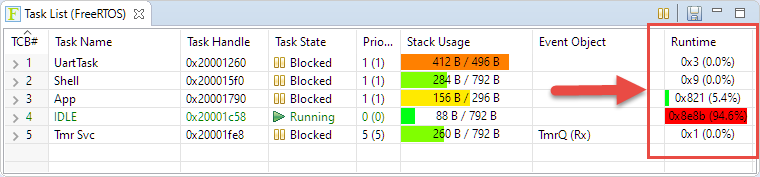
FreeRTOS has many cool features, and one is that it can report the CPU percentage spent in each task. The downside is that to get this kind of information some extra work is needed. In this article I show how to do this for the NXP i.MX1064.

FreeRTOS Runtime Information

FreeRTOS Runtime Information

Continue reading

Dumping Variables and Arrays with GDB in Eclipse

Using the debugger to inspect the application data is a very convenient thing. But if the data grows and if the data set is large, it makes more sense to dump the data to the host and process it offline. GDB is the de-facto debugger engine and includes a powerful command line and scripting engine which can be used in Eclipse too.

GDB Debugger Console in Eclipse

GDB Debugger Console in Eclipse

Continue reading

Easter Blooming in the Time of COVID-19

Image

It is the 4th week: Stores, school and universities are closed. Everyone should stay at home if possible. It is really a special situation, and there is no Easter traffic jam to the South.

For nature it means less pollution, there is much less traffic, and ideal to enjoy nature. But we should stay at home. I’m very happy that I live in a rural area and that I can enjoy this beautiful blooming tree behind the house.

Blooming Pear Tree

Blooming Pear Tree

Continue reading

Tutorial: Rename, Copy or Clone Eclipse Projects with MCUXpresso

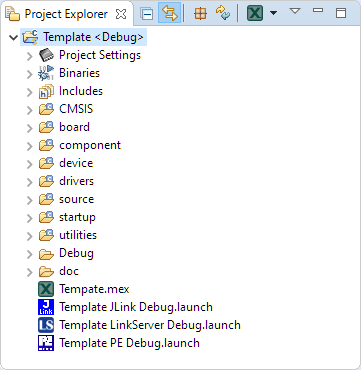
Especially in a lab or classroom environment it is convenient to start with a template project, and then explore different ways to shape the project for different needs. As for any IDE of this world, this requires an understanding of the inner workings to get it right. So in this article I show how to copy, clone or rename properly an Eclipse ‘template’ project in the MCUXpresso IDE.

Template Project

Template Project

Continue reading

Optimized and Easy-to-Use Eclipse Toolbars and Menus

I love Eclipse because as an IDE it can do pretty much everything. Up to the point that some call it an ‘Eierlegende Wollmilchsau‘: something which can do anything. But with all the tools, menus and features, it can be daunting for a someone new to Eclipse. But the good news is: Eclipse is very versatile and can be customized to make it easier and simpler to use too. In this article I show how I’m tweaking it the way I want it, with just the menus and buttons I need:

Eclipse Optimized Menus and Toolbars

Eclipse Optimized Menus and Toolbars

Continue reading