MCUXpresso IDE V11.1.0

Right before Christmas 2019, NXP has released a new version of the MCUXpresso IDE, the version 11.1.0. This gave me time to explore it over the Christmas/New-Year break and evaluate it for the next university semester. There are several new features which will make my labs using it easier, so I plan to get the course material updated for it.

MCUXpresso IDE V11.1.0 Welcome Screen

MCUXpresso IDE V11.1.0 Welcome Screen

After the break you will find the highlights …

Continue reading

Implementing FreeRTOS Performance Counters on ARM Cortex-M

When using an RTOS like FreeRTOS, sooner or later you have to ask the question: how much time is spent in each task? The Eclipse based MCUXpresso IDE has a nice view showing exactly this kind of information:

FreeRTOS Runtime Information

FreeRTOS Runtime Information

For FreeRTOS (or that Task List view) to show that very useful information, the developer has to provide a helping hand so the RTOS can collect this information. This article shows how this can be done on an ARM Cortex-M.

Continue reading

DIY ‘Meta Clock’ with 24 Analog Clocks

Human since 1982 claims

“Human since 1982 have the copyright to works displaying digital time using a grid arrangement of analog clocks…”

I’m not a lawyer, but without obligations (imho) I have removed the content.

You can read more of the details here: Copyright Law for Makers and Educators

Thanks for understanding,

Erich

Investigating ARM Cortex® M33 core – NXP LPC55S69 has *two* M33 cores.

Throughout this series I’ve been using the LPC55S69 microcontroller from NXP as a platform to investigate the ARM Cortex® M33 core. NXP designed the LPC55S69 with two Cortex M33 cores and so this week I’m investigating these in more detail.

You’ll remember that when ARM launch a processor core it will have a number of optional features. This is shown very clearly on the LPC55S69. The 150 MHz primary core – cpu0 – is a full implementation of Cortex® M33 and includes the optional components FPU, MPU, DSP, ITM and the TrustZone® features.

Continue reading

Investigating ARM Cortex® M33 core – DSP Acceleration 3 (PowerQuad FFT Tutorial)

I’ve always felt that the Fourier Transform (and in particular the embedded implementation Fast Fourier Transform) is the GOAT* of the DSP algorithms. The ability to convert a time-domain signal into a frequency-domain signal is invaluable in applications as diverse as audio processing, medical electrocardiographs (ECGs) and speech recognition.

So this week I’ll show you how to use the Transform engine in the PowerQuad on LPC55S69 to calculate a 512-point FFT. All of the difficult steps are very easily managed and the PowerQuad does all of the very heavy lifting.

Data from PowerQuad – 512-point real FFT on 400 Hz input signal with 1200 Hz harmonic
Continue reading

World Stepper Clock with NXP LPC845

I really love clocks. I think this is I am living here in Switzerland. Beside of that: clock projects are just fun :-). After I have completed a single clock using stepper motors (see “DIY Stepper Motor Clock with NXP LPC845-BRK“), I wanted to build a special one which is able to show up to four different time zones: Below an example with London (UK), New York (USA), Beijing (China) and Lucerne (Switzerland):

Stepper Clock

Stepper Clock

Continue reading

Open Source LittlevGL GUI Library on Adafruit Touch LCDs with NXP LPC55S69-EVK

The NXP LPC55S69-EVK is a versatile board. In this article I show how it can be used with Adafruit TFT LCD boards, both with resistive and capacitive touch. For the software I’m using the open source LittlevGL GUI.

LPC55S69-EVK with Adafruit Touch LCD

LPC55S69-EVK with Adafruit Touch LCD

Continue reading

TrustZone® vs HeartBleed

During my research about the TrustZone® security extension over the last weeks I’ve had the HeartBleed exploit from 2014 in my mind. How would TrustZone® help us manage that type of ‘no bounds check’ exploit? Of course, TrustZone® was first widely available when NXP introduced the Cortex® M33 family LPC55S69 in 1Q2019 and wasn’t available back in 2014, but I wanted to put it to the test.

Continue reading

Investigating ARM Cortex® M33 core with TrustZone® – transition from non-secure to secure world

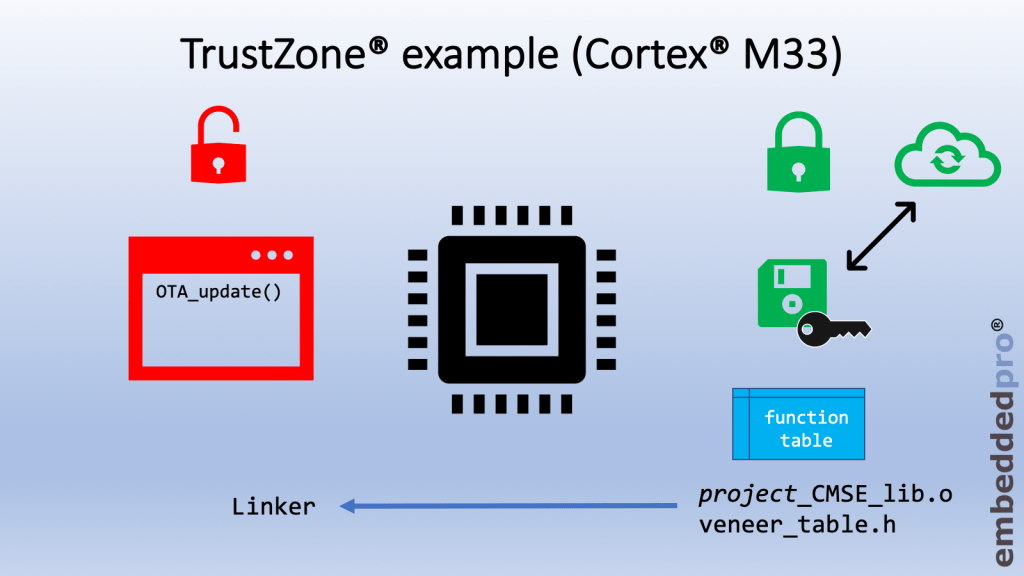
You might purchase a Cortex® M33 microcontroller with TrustZone® where the supplier has installed a secure ROM. Or you might be an IOT developer using LPC55S69 in your own application where you have partitioned the code into secure and non-secure partitions. At some point with Cortex® M33 core with the TrustZone® security extension you’ll want to transition from non-secure into the secure world. Or (put more elegantly), you’ll want to call one of the secure functions supported when the Cortex® M33 core is in the Secure state.

That’s the topic for this week’s video.

How will you know what secure functions are available? And what parameters are necessary to call these functions? You’ll be provided with a header file veneer_table.h and a secure object library named project_name_CMSE_lib.o. Together these 2 modules describe everything that you need to know to call a secure function and transition from the Non-Secure to the Secure state.

Just two objects – *.o and *.h define resources available in the Secure world
Continue reading

Stack Canaries with GCC: Checking for Stack Overflow at Runtime

Stack overflows are probably the number 1 enemy of embedded applications: a call to a a printf() monster likely will use too much stack space, resulting in overwritten memory and crashing applications. But stack memory is limited and expensive on these devices, so you don’t want to spend too much space for it. But for sure not to little too. Or bad things will happen.

The Eclipse based MCUXpresso IDE has a ‘Heap and Stack Usage’ view which can be used to monitor the stack usage and shows that a stack overflow happened:

Heap and Stack Usage

Heap and Stack Usage

But this is using the help of the debugger: how to catch stack overflows at runtime without the need of a debugger? There is an option in the GNU gcc compiler to help with this kind of situation, even if it was not originally intended for something different. Continue reading