FRDM-KL25Z RevE Board arrived

About a year ago I started to use the FRDM-KL25Z board (RevD). Finally, I had it in my hands: the RevE board from Mouser 🙂 Using the RevD board, I faced several problems:

  1. 3.3V supply voltage drop because of low-cost diode D1 (see this post)
  2. Hard to use USB host mode, as no 5V supplied to the USB bus (see this post)
  3. No 5V generated from V_IN (see this post)

The good news: all of them have been improved 🙂 in the FRDM-KL25Z RevE Schematics:

FRDM-KL25Z RevE Board

FRDM-KL25Z RevE Board

Continue reading

Tutorial: Arduino Motor/Stepper/Servo Shield – Part 1: Servos

This post starts a small (or larger?) series of tutorials using the Arduino Motor/Stepper/Servo Shield with the FRDM-KL25Z board. That motor shield is probably one of the most versatile on the market, and features 2 servo and 4 motor connectors for DC or stepper motors. That makes it a great shield for any robotic project :-).

Arduino Motor Stepper Servo Shield with FRDM-KL25Z

Arduino Motor Stepper Servo Shield with FRDM-KL25Z

Continue reading

How to use MCUonEclipse GitHub without Git

Not everyone is familiar with Git, and not everyone wants to use it. Although I think using Git or SVN is something every software engineer today needs to master 😉 To make it easier for the ‘non-Gitter’ to use the Processor Expert components, they are available now as *.PEupd files as described here. However, the *.PEupd files are just a snapshot, and not the latest and greatest. So how to use the latest component sources and example projects without Git?

gits in a box

gits in a box

Continue reading

CMSIS-DAP with IAR and the KL25Z Freedom Board

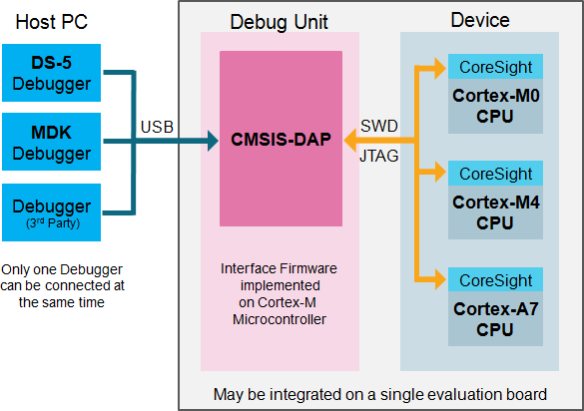
Beside of USBDM, there is another Open Source implementation of a debug interface for the Freedom Board OpenSDA: CMSIS-DAP.

CMSIS-DAP stands for ‘Cortex Microcontroller Software Interface Standard – Debug Access Port’) has been published by ARM Inc. With this, there is an open source alternative to proprietary implementation (e.g. P&E OpenSDA or Segger OpenSDA).
Beside of the ARM MDK IDE, CMSIS-DAP is supported by Coocox and IAR. And IAR is what I’m using in this post.

Continue reading

Freedom Board with Segger OpenSDA Debug Firmware

Looks like there is some movement on the ‘OpenSDA Front’: After CodeRed has released their RedProbe OpenSDA firmware, now Segger has released an OpenSDA firmware.

With this, I get a low-cost debugging solution similar to the well-known J-Link run control devices. The OpenSDA Segger Firmware is something like a J-Link-lite.

FRDM-KL25Z with Segger OpenSDA Debug Firmware

FRDM-KL25Z with Segger OpenSDA Debug Firmware

Continue reading

Fix for 3.3V Voltage Drop on FRDM-KL25Z Board

With my Pololu line following robot I had strange problems with the sensor array: the sensor values were very unreliable. Until I have found the problem: Instead of the expected 3.3V, my FRDM-KL25Z RevD board provided 2.8V instead 3.3V on the P3V3 Arduino header pin:

Measured 2.8V on P3V3

Measured 2.8V on P3V3

And that voltage even was lower the more current I needed :-(. Luckily there is an easy hardware fix for this.

Continue reading

Low-Level Coding with PDD (Physical Device Driver)

As with any software drivers: they are never perfect. The same applies to the Processor Expert components delivered in CodeWarrior for MCU10 or the DriverSuite too. That’s why I have created many more components which are available on GitHub here. All these components are using other components to reach the hardware. But what if a functionality is not exposed through the low-level component? Or what if I want direct access to the hardware? Up to now I had to choose either the Processor Expert way, or to do it in the ‘traditional’ way using an SDK like CMSIS or vendor supplied header files.

With MCU10.4, I noticed that there is another way: PDD (Physical Device Driver).

PDD in the Components View

PDD in the Components View

Continue reading

USBDM 4.10.5 supports now MCU10.4

Wow, that was fast! The SourceForge USBDM project has added support for MCU10.4 (see as well this post) in release 4.10.5 available here, announced in the Freescale Forum.

USBDM 4.10.5 Installer

USBDM 4.10.5 Installer

Continue reading

Adding/Removing Floating Point Format for S08 Projects

Usually I do *not* use floating point numbers in my projects. For this, I select ‘None’ during the project creation in CodeWarrior for MCU:

No Floating Point Selected

No Floating Point Selected

But what if I need to change my mind later? How to change such a ‘no-floating-point-needed’ project to one with floating point format support?

Continue reading

Adding USBDM to CodeWarrior for MCU10.4

If you are following my recent posts, then you know I started using USBDM on OpenSDA as an alternative run control solution. Now with the advent of MCU10.4, the question is: how to use USBDM with it, because the USBDM installer obviously only knows the version up to MCU10.3?

USBDM 4.10.4a Installer

USBDM 4.10.4a Installer

Continue reading