How to use Eclipse CDT Environment Variables in C/C++ Code

When using a logging framework it is useful to use the current file name or line number. The ANSI C/C++ standard defines the __LINE__ and __FILE_ preprocessor macros for this.

But what about the project name, if it is a release or debug build, the microcontroller used or other things like the operating system which was used to build the binary?

Target Chip Name

Target Chip Name

This (and even more) can be easily provided by Eclipse to the C/C++ application being built with CDT.

Continue reading

MicroTick (UTICK) Timer Tutorial with OKdo E1 board

I want to share with you a little embedded trick that I use to improve the reliability of my code. And in addition to improving reliability, the technique can be used to schedule any event to occur ‘sometime in the future’. It uses the MicroTick (UTICK) timer found on the NXP LPC55S69 microcontroller, and could be applied to any device with a simple timer.

The MicroTick timer is an elegant, thing of beauty. But there is not a driver example built into the lpcxpresso55s69 SDK, and I believe that the timer is not widely used. That means we need a tutorial!

Continue reading

How to get Data off an Embedded System: FatFS with USB MSD Host and FreeRTOS Direct Task Notification

This is a follow-up article of my earlier project presented in “FatFS, MinIni, Shell and FreeRTOS for the NXP K22FN512“. I wanted to extend it with a USB MSD (memory stick) device: The USB storage device gets automatically mounted, and depending on a configuration (.ini) file on the memory device I can perform various actions, for example automatically copy data from the SD card to the USB device. For example the system logs data, and to get the data I insert the memory stick, it copies the data on it and automatically unmounts it, and I can remove the memory stick.

FRDM-K22F USB Host Mode with Memory Sticks

FRDM-K22F USB Host Mode with Memory Sticks

Continue reading

Disabling NMI (Non Maskable Interrupt) Pin

The NMI is a special interrupt on ARM Cortex-M architecture: as the name indicates, it cannot be ‘masked’ by the usual ‘disable interrupts’ flags (PRIMASK, BASEPRI), similar to the Reset signal.

cortex-m-vector-table

cortex-m-vector-table (Source: adapted from arm.com)

Dealing with the reset signal is kind of obvious, and most designs and boards have it routed to a reset button or similar. The NMI is less obvious if you don’t pay attention to it: most ARM-Cortex implementations and boards have the NMI signal routed to a pin and are ‘hiding’ it in the schematics behind a normal GPIO pin or port: if you don’t pay attention to the NMI functionality, the board might not work as intended.

Continue reading

Behind the Canvas: Making of “60 Billion Lights”

As promised I’m going to share more details about the “60 Billion Lights” project. It is about a project to build a piece of electronics behind a 100×50 cm canvas to show animations or to display information like temperature, humidity, weather, time or just any arbitrary text.

Make it

Writing text

Continue reading

McuLog: Logging Framework for small Embedded Microcontroller Systems

An essential tool especially developing larger applications or distributed firmware is to use logging. This article presents an open source logging framework I’m using. It is small and easy to use and can log to a console, to a file on the host or even to a file on an embedded file system as FatFS.

Log Output

Log Output

Continue reading

Retrofitting a Charmhigh CHM-T36VA Machine with OpenPnP

OpenPnP is a great open source framework for building a DIY SMT Pick&Place machine. But it does not stop there: It is possible to use OpenPnP with a commercial pick & place machine, for example the Charmhigh CHM-T36VA. This Chinese machine comes with its own controller software which works but is not that great. The good news is that it is possible to hack and retrofit the machine so it can run the much more powerful OpenPnP.

Retrofitted CHM-T36VA

Retrofitted CHM-T36VA

Continue reading

FreeRTOS Task Runtime Statistics for NXP i.MX RT1064

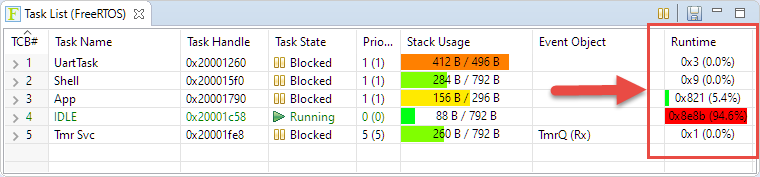
FreeRTOS has many cool features, and one is that it can report the CPU percentage spent in each task. The downside is that to get this kind of information some extra work is needed. In this article I show how to do this for the NXP i.MX1064.

FreeRTOS Runtime Information

FreeRTOS Runtime Information

Continue reading

Dumping Variables and Arrays with GDB in Eclipse

Using the debugger to inspect the application data is a very convenient thing. But if the data grows and if the data set is large, it makes more sense to dump the data to the host and process it offline. GDB is the de-facto debugger engine and includes a powerful command line and scripting engine which can be used in Eclipse too.

GDB Debugger Console in Eclipse

GDB Debugger Console in Eclipse

Continue reading