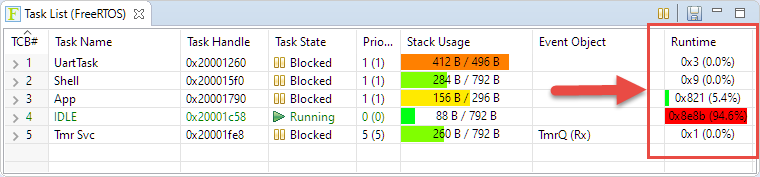
FreeRTOS has many cool features, and one is that it can report the CPU percentage spent in each task. The downside is that to get this kind of information some extra work is needed. In this article I show how to do this for the NXP i.MX1064.
Category Archives: Building
Tutorial: Rename, Copy or Clone Eclipse Projects with MCUXpresso
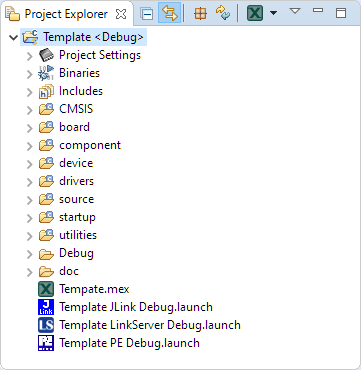
Especially in a lab or classroom environment it is convenient to start with a template project, and then explore different ways to shape the project for different needs. As for any IDE of this world, this requires an understanding of the inner workings to get it right. So in this article I show how to copy, clone or rename properly an Eclipse ‘template’ project in the MCUXpresso IDE.
Copyright Law for Makers and Educators
Maker spaces and ‘FabLabs’ are popular and accessible in many areas. 3D printers are on the cheap, and powerful laser cutters are in the range of the fearless hobbyist. You can get dirty-cheap PCBs from China in less than a week (ok, probably not right now because of Corona virus) and it is easy to SMD solder parts these days with a DIY SMD PnP machine and OpenPnP. With the right equipment and skill set it is possible to build many cool projects. It is very rewarding and a great learning thing. Blog about it so other can learn too. And it even could get featured on Hackaday.
But: The risk is that someone might send you letter about a ‘Copyright Infringement’. Sadly, this is what happened to me for one of my recent projects. I don’t think that ‘take down’ letter was justified, but I learned a great deal what I should have done differently to avoid that situation. So in the end, it was a learning opportunity, which I believe is worth to share. In essence: what can a maker or educator do?
Tutorial: Maximum Clock Frequency for Kinetis using MCUXpresso Clock Tools
The tinyK22 board with the NXP K22FN512 is a bread-board-friendly small board with a 8 MHz external oscillator:
This tutorial is about how to use the NXP MCUXpresso Clock configuration and configure the board to the maximum clock frequency of 120 MHz. The same steps apply to many other boards, including the FRDM-K22F one.
Listing Code and Data Size for all Files with the GNU size Utility in a Post-Build Action
The GNU size utility which is part of the GNU build tools shows code and data size for archive or object files. It is usually used as a post-build step in Eclipse CDT to show text, data and bss at the end of the build:
MCUXpresso IDE V11.1.0
Right before Christmas 2019, NXP has released a new version of the MCUXpresso IDE, the version 11.1.0. This gave me time to explore it over the Christmas/New-Year break and evaluate it for the next university semester. There are several new features which will make my labs using it easier, so I plan to get the course material updated for it.
After the break you will find the highlights …
Implementing FreeRTOS Performance Counters on ARM Cortex-M
When using an RTOS like FreeRTOS, sooner or later you have to ask the question: how much time is spent in each task? The Eclipse based MCUXpresso IDE has a nice view showing exactly this kind of information:
For FreeRTOS (or that Task List view) to show that very useful information, the developer has to provide a helping hand so the RTOS can collect this information. This article shows how this can be done on an ARM Cortex-M.
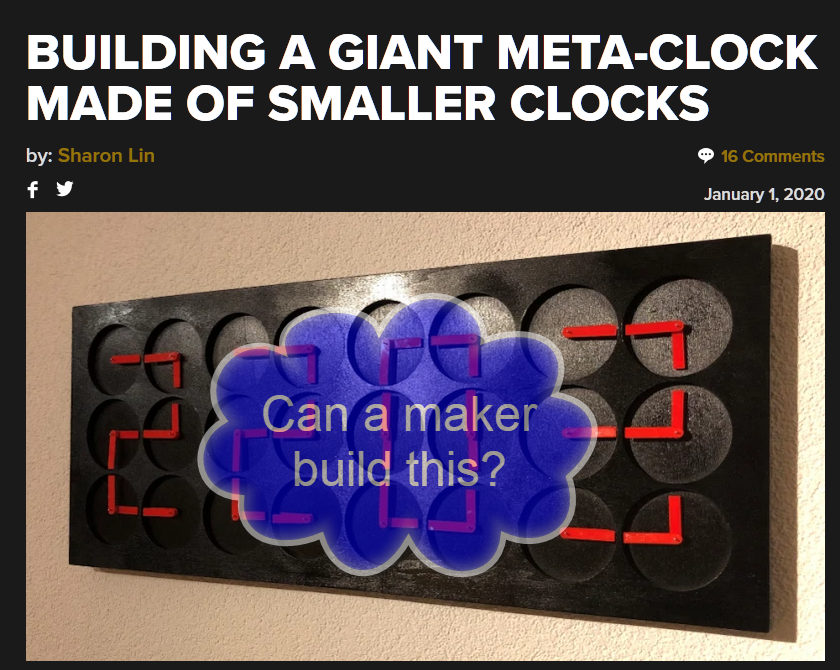
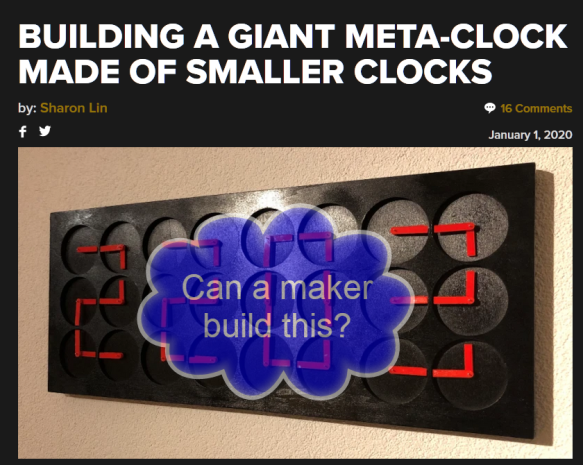
DIY ‘Meta Clock’ with 24 Analog Clocks
Human since 1982 claims
“Human since 1982 have the copyright to works displaying digital time using a grid arrangement of analog clocks…”
I’m not a lawyer, but without obligations (imho) I have removed the content.
You can read more of the details here: Copyright Law for Makers and Educators
Thanks for understanding,
Erich
OpenPnP Solder Paste Dispensing Video
OpenPnP (see “Building a DIY SMT Pick&Place Machine with OpenPnP and Smoothieboard (NXP LPC1769)“) is a cool open source framework to run Pick&Place machines. I have mentored and supported Tobias Mailänder who extended the PnP machine with the ability to dispense solder past on PCBs. Below a video (courtesy of Tobias Mailänder) which shows the machine in action:
It is still a prototype, but things are working very well.
World Stepper Clock with NXP LPC845
I really love clocks. I think this is I am living here in Switzerland. Beside of that: clock projects are just fun :-). After I have completed a single clock using stepper motors (see “DIY Stepper Motor Clock with NXP LPC845-BRK“), I wanted to build a special one which is able to show up to four different time zones: Below an example with London (UK), New York (USA), Beijing (China) and Lucerne (Switzerland):