In many sources I have ‘inactive’ code: source code which is disabled by some macros or defines. Eclipse is great to ‘gray’ out the inactive parts using its Indexer, but they still need screen real estate:

inactive Code in Eclipse Source View
In many sources I have ‘inactive’ code: source code which is disabled by some macros or defines. Eclipse is great to ‘gray’ out the inactive parts using its Indexer, but they still need screen real estate:
inactive Code in Eclipse Source View
Don’t get me wrong. I love a good slow-smoked and true BBQ pulled pork shoulder just as probably everyone else out there. And I love the babysitting (aka beer drinking 🙂 ) while the shoulder gets that incredible taste inside the smoker. But my workload for this weekend is insane high with all the university exam and grading work. My family loves that pulled pork too, and I knew upfront that I would not have the time to check and handle the smoking process for 12-18 hours (see “Easter Weekend Apple Juice Brined Pulled Pork Smoked on Beech Wood“). So I decided to prepare pulled pork the ‘easy’ way: Using a Sous Vide cooker and then use a normal oven to finish it. So it was an experiment, and the result is interesting:

Pulled Pork on Toast
For a next-gen course I’m evaluating different platforms, and one of it are modules based on the NXP i.MX ARM architectures. In this article I have a look a the Variscite DART-6UL development kit which includes the NXP i.MX6Ultralite ARM Cortex-A7 plus a 7″ capacitive touch LCD:

Variscite VAR-DVK-6UL_LO Kit
I like to have as many lines of source code visible on my notebook or desktop monitor. And I think I have found a good balance between font size and readability.
On the other side: I’m getting older and my eyes are not getting any better. At the same time I noticed that students start using these ‘high-resolution-retina-displays’. They are great, but result in tiny default system fonts, so I have a hard time to read the source code on their machines.
Another challenge I noticed are the high-resolution projectors in class rooms or conferences. They are not well suited to show source code or text files because of the tiny fonts. Starting with Eclipse Neon there is an awesome feature which I can use to dynamically increase and decrease the font size which solves that problem:

Eclipse with Large Font Size
For a research project, we are going to send a satellite with an embedded ARM Cortex microcontroller into space early next year. Naturally, it has to work the first time. As part of all the ESA paperwork, we have to prove that we tested the hardware and software thoroughly. One piece of the that is to collect and give test coverage evidence. And there is no need for expensive tools: Free-of-charge Eclipse and GNU tools can do the job for a space mission 🙂

Eclipse with Coverage Views
To celebrate the end of that sunny weekend, we smoked tuna and salmon with a simple soy-based brine:
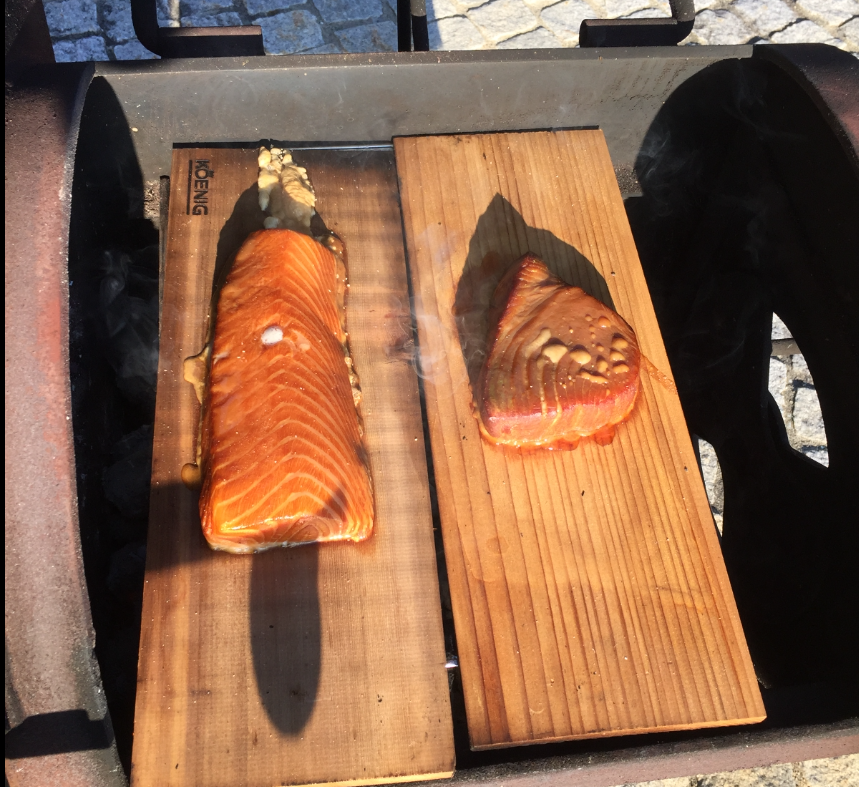
Salmon and Tuna in the Fire Box
The GNU tools include powerful utilities to collect coverage information. With coverage I know which lines of my code have been executed, which is a very useful test metric. The GNU coverage tools are commonly used for Linux applications. But to my surprise not much for embedded application development, mostly because it requires a few extra steps to have it available? Why not using free and powerful tools for improving software quality? This article explains how to install the GNU gcov tools into the Eclipse IDE.

gcov with Embedded Target
The Enzian belongs to the gentian family (Gentianaceae). This one shows the Clusius-Enzian which can be found up to 2800 m in limestone areas. The deep blue makes it a special flower. It is protected by law, but can be found in many places in the Alps.

Enzian
BLE (Bluetooth Low Energy) sensor devices like the Hexiwear are great, but they cannot store a large amount of data. For a research project I have to collect data from many BLE devices for later processing. What I’m using is a Python script running on the Raspberry Pi which collects the data and stores it on a file:

Raspberry Pi with Python controlling a set of Hexiwear BLE Devices
For many projects it would be cool to build a custom USB Joystick device, either as custom game controller for Windows or any USB host which can be used with a USB Joystick. Instead buying one, why not build my version? All what I need is a USB capable board, some kind of input (potentiometer, push buttons) and some software, and I have my USB Joystick:

DIY USB HID Joystick Device
 MCU on Eclipse