Bricking and Recovering OpenSDA Boards in Windows 8 and 10

Getting a board from a distributor like Farnell/Element14/Mouser (add your own distributor) means that chances are high that the default firmware on it is written years from now because the inventory has not been updated, or because boards are still produced with that original firmware (because of testing?). So what happens if I use board with a firmware developed pre-Windows 8/10 area?

Freshly Unboxed NXP FRDM-KL25Z Board

Freshly Unboxed NXP FRDM-KL25Z Board

It might work, but chances are high that the bootloader and firmware is not ready for the ‘modern age’, and as a result the board might be bricked. If you still have a Windows 7 machine around (I do!), you are lucky. If not, then you need to read this article….

Continue reading

McuOnEclipse Components: 31-July-2016 Release

Time for a new major update of the McuOnEclipse components, with the fillowing main features and changes:

  • FatFS component updated to R0.12 with patch 3 and exFAT support
  • Extended support for Cortex-M7
  • Extended support for Kinetis SDK V2.0
  • USB component support for Kinetis SDK V1.3
  • Improved FreeRTOS for NXP FreeRTOS TAD plugin
  • Added C++ wrappers to multiple components
  • Many smaller fixes and improvements

    SourceForge

    SourceForge

Continue reading

impulse: Segger SystemView in Eclipse

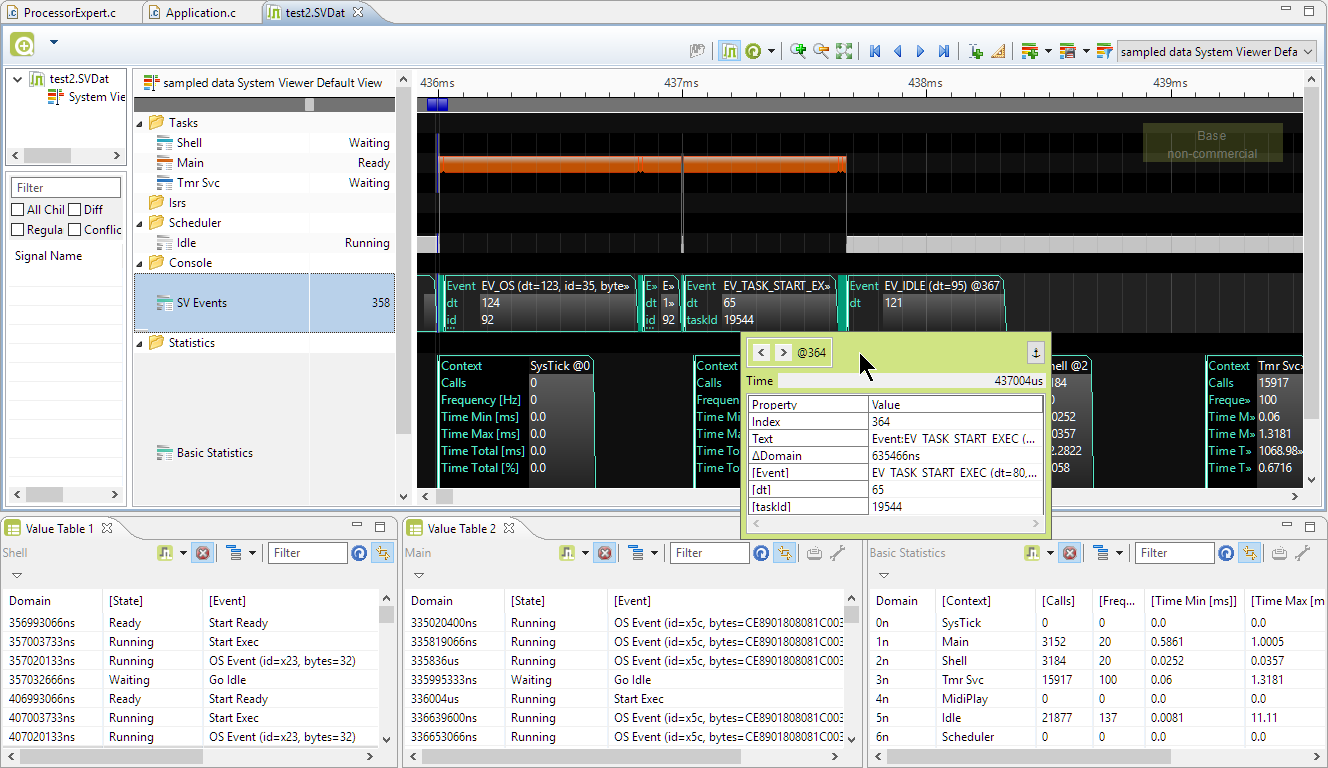
I’m using the Segger SystemView in many of my applications to get insights of the running application. A reader of my blog pointed me to the company ‘toem’ (http://toem.de/) based in Germany which offers powerful data viewer (‘impulse’) for Eclipse. I have tried this out, and it is really an amazing piece of technology with lots of potential. It allows me to view Segger SystemView data 🙂

Segger SystemView Data in Eclipse

Segger SystemView Data in Eclipse

Continue reading

Hexiwear: Teardown of the Hackable ‘Do-Anything’ Device

Smartwatches are around for a while now. To me it is still questionable how useful the ‘big’ ones for iOS and Android are. But there are definitely the crowd funded smartwatch projects which caught my attention. Maybe it is about the ‘do-anything’ with connectivity?  One of these gadgets is Hexiwear: a hackable open source device

Hexiwear Device

Hexiwear Device

While it *could* be a kind of smartwatch, the value of this thing is more that it includes a plethora of sensors with two microcontroller, and I can use Eclipse with GNU tools to build my firmware :-).

Alert: Hackster.io is giving away 100 Hexiwears, but you need to hurry up (submission until July 15th 2016)!

Continue reading

Board Bring-Up Tips, GDB Logs and Traces in Eclipse

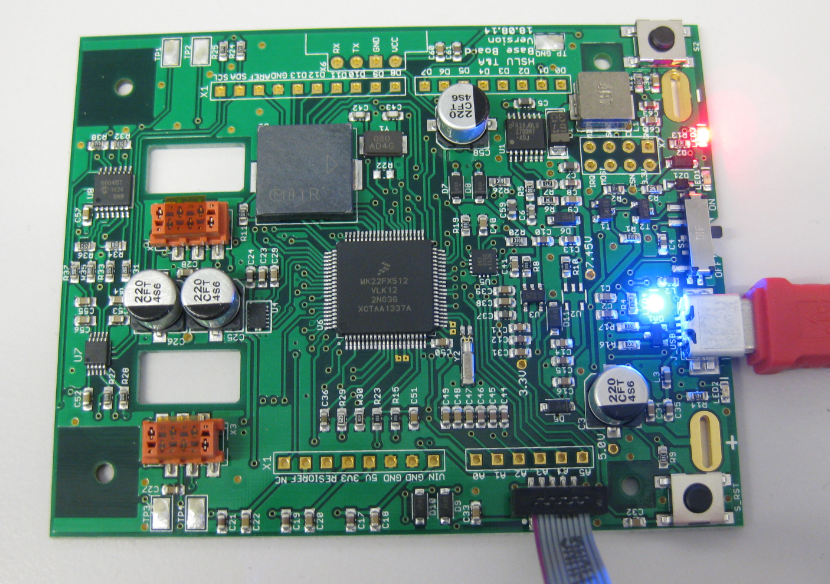
Sometimes things don’t go well, especially with bringing up a new board design. I always sweat blood that first minute when I try to connect with the debugger to a new design: Will it work? After the optical inspection, performing electrical tests (no shortcuts? voltage levels ok?) the inflection point is when I’m connecting the first time with the debugger to the new board: either it will properly connect and program the device (hurrah!) or it will fail and potentially difficult hours of investigations have to follow.

First PCB under Debug

First PCB under Debug

Continue reading

How to Recover the OpenSDA V2.x Bootloader

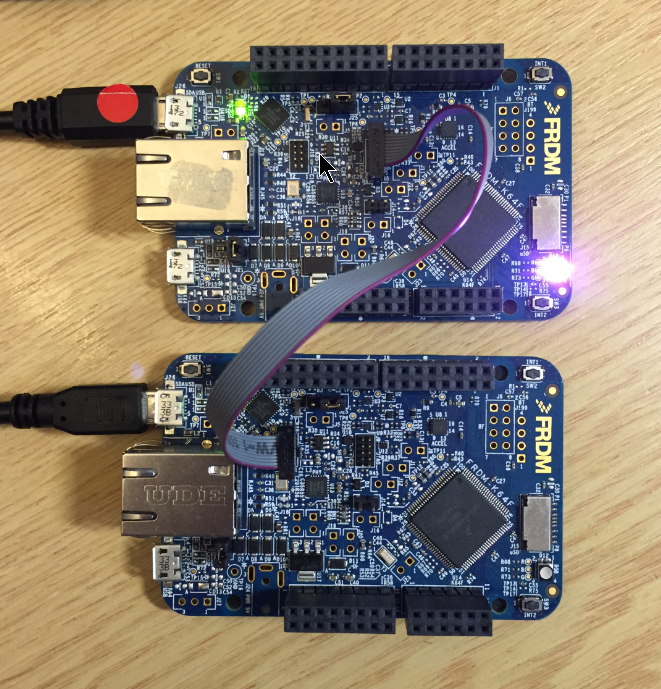
More and more of my students are using Microsoft Windows 10 machines, and my computer has been upgraded to Windows 10 a couple of week ago too. From my work and experience, a new operating system causes always some challenges, and Windows 10 is no difference. And no, this is not about Microsoft vs. Apple vs. Linux, this post is about addressing a potential and painful problem which I have observed with Windows 10 machines, and to my understanding it could happen with any other operating system too. The problem is that somehow on several student machines the bootloader and OpenSDA application on their FRDM boards did not work any more.

FRDM-K64F (top) programming the OpenSDA Bootloader (bottom)

FRDM-K64F (top) programming the OpenSDA Bootloader (bottom)

Continue reading

First steps: ARM Cortex-M7 and FreeRTOS on NXP TWR-KV58F220M

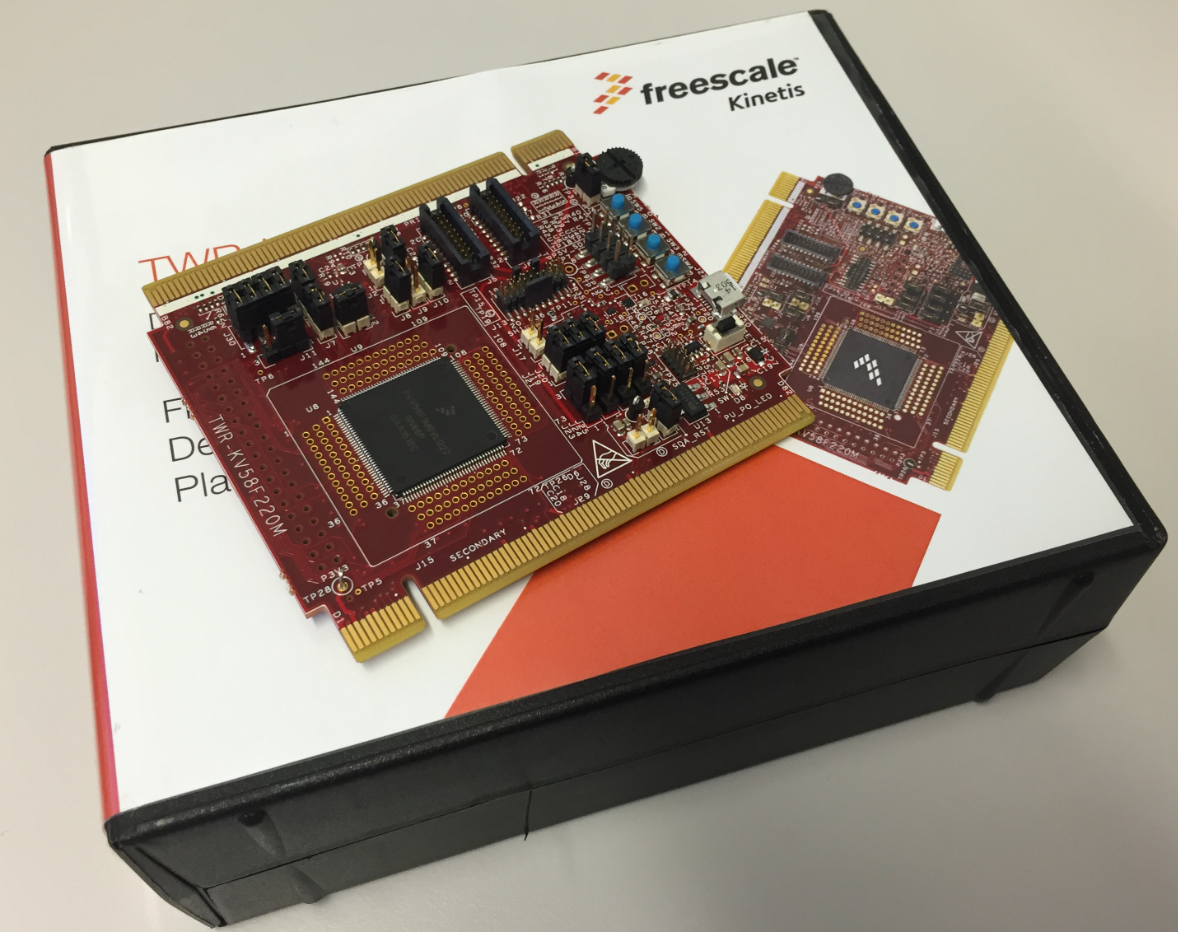
For a university research project I need a fast microcontroller with lots of RAM and FLASH memory. I have ordered a TWR-KV58F220M board from NXP which arrived yesterday. The special thing is that it has on of these new ARM Cortex-M7F on it:

TWR-KV58F220M Box

TWR-KV58F220M Box

Continue reading

Swiss Army Knife of Terminal Program for Serial Bootloaders

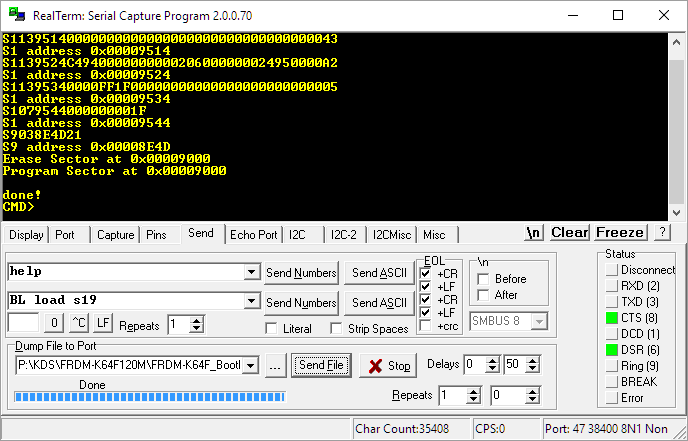
A bootloader shall be small and concise. I very much like bootloaders which do not need a ‘special’ program on the host, so I prefer a simple terminal for this. While porting my serial bootloader to the NXP FRDM-K64F board, I have found RealTerm which offers a lot of cool features:

RealTerm

RealTerm

Continue reading

Segger J-Link OpenSDA Firmware with Virtual MSD

Sometimes it is very convenient to load a new firmware to a board without the need for a hardware debugger. This is usually done with a bootloader. The NXP Freedom and Tower evaluation boards have on-board debug device/microcontroller (OpenSDA) which can load different firmware implementations like CMSIS-DAP/mbed, P&E Multilink or a Segger J-Link OpenSDA applications. Both mbed and P&E implemenations support to program the board with drag&drop: simply send a file to a virtual MSD (Mass Storage Device) to get it programmed. The latest Segger OpenSDA firmware has this ability added now too: Programming the board with a virtual MSD device:

Virtual MSD Device

Virtual MSD Device

Continue reading