Tutorial: Building FreeRTOS Applications for ARM Cortex-M4 on i.MX7 with Eclipse

Command line tools to build applications are great. But productivity goes up if I can use the standard Eclipse environment with GNU tools. This tutorial is about how to use standard and free GNU and Eclipse tools to build my FreeRTOS application for the ARM Cortex-M4 on i.MX7 πŸ™‚ :

Eclipse used to build FreeRTOS applications for M4 on i.MX7

Eclipse used to build FreeRTOS applications for M4 on i.MX7

Continue reading

Tutorial: RFID Tags with the NXP NFC Controller PN7120 and Eclipse

Playing with RFID and NFC is definitely fun :-), and they are everywhere! For a research project I’m exploring different RFID tags and solutions. I several types around for a long time, but never found the time to actually work on it, so last nightI thought I give it a try, and I have it working with GNU ARM and Eclipse, powered by the NXP FRDM-K64F board πŸ™‚

NXP NFC PN7120S

NXP NFC PN7120S with a FRDM-K64F Board

Continue reading

Tutorial: Blinky with Kinetis SDK V1.3 and Processor Expert

This tutorial goes through the steps how to create a blinking LED application, using Kinetis SDK and Processor Expert, using the TWR-KL43Z48M board from Freescale (now NXP):

twr-kl43z48m

twr-kl43z48m

Continue reading

ARM Cortex-M Interrupts and FreeRTOS: Part 3

This is the third part about ARM Cortex-M and how the interrupts are used. In Part 1 I discussed the Cortex-M interrupt system and in Part 2 I showed nested interrupt examples. This part is about FreeRTOS and how it uses the Cortex-M interrupt system.

NXP KV58F ARM Cortex-M7

NXP KV58F ARM Cortex-M7

Continue reading

McuOnEclipse Components: 31-July-2016 Release

Time for a new major update of the McuOnEclipse components, with the fillowing main features and changes:

  • FatFS component updated to R0.12 with patch 3 and exFAT support
  • Extended support for Cortex-M7
  • Extended support for Kinetis SDK V2.0
  • USB component support for Kinetis SDK V1.3
  • Improved FreeRTOS for NXP FreeRTOS TAD plugin
  • Added C++ wrappers to multiple components
  • Many smaller fixes and improvements

    SourceForge

    SourceForge

Continue reading

Hexiwear: Teardown of the Hackable ‘Do-Anything’ Device

Smartwatches are around for a while now. To me it is still questionable how useful the ‘big’ ones for iOS and Android are. But there are definitely the crowd funded smartwatch projects which caught my attention. Maybe it is about the ‘do-anything’ with connectivity?Β  One of these gadgets is Hexiwear: a hackable open source device

Hexiwear Device

Hexiwear Device

While it *could* be a kind of smartwatch, the value of this thing is more that it includes a plethora of sensors with two microcontroller, and I can use Eclipse with GNU tools to build my firmware :-).

Alert: Hackster.io is giving away 100 Hexiwears, but you need to hurry up (submission until July 15th 2016)!

Continue reading

FatFS with Adafruit MicroSD Breakout Board and NXP FRDM-KL25Z

Breakout boards are great: they allow me to explore functions quickly, without to build my custom board: all what I need is some wires and ideally a bread board.

Adadfruit MicroSD Card Breakout Board

Adadfruit MicroSD Card Breakout Board

Continue reading

McuOnEclipse Components: 25-June-2016 Release

SourceForge

SourceForge

A new release is available on SourceForge, with the following main changes:

  • Support for FreeRTOS and Cortex-M7
  • Segger SystemView updated to V2.38
  • Components for NXP Kinetis SDK V1.3
  • Fixed bug in Wait component (register handling for GCC and ARM)
  • FatFS supports FreeRTOS V9.0.0 with static memory allocation
  • FreeRTOS shell and task list with static memory allocation
  • Floating point conversion routines in Utility
  • FreeRTOS component shows NVIC mask bits

Continue reading

Switching the Microcontroller Package, Device and Family

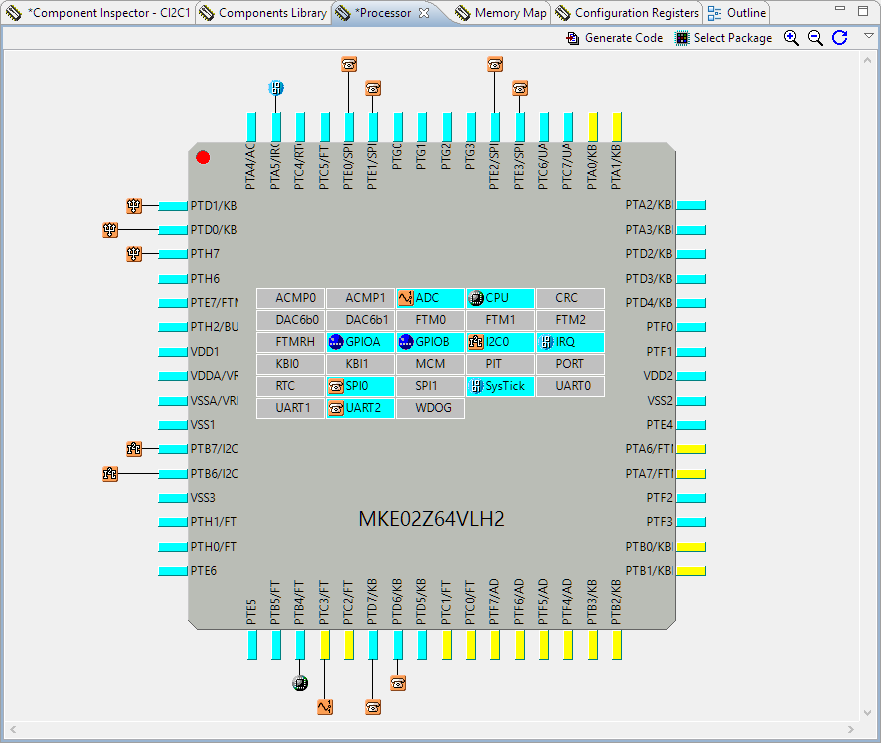
One of the major benefits of Processor Expert is that I can easily switch the device or processor used in a project. For example I can do my concept with a larger device with more FLASH and RAM, and then at the end easily switch to a smaller or even completely different device very quickly. For example I have a project working with the 64KByte FLASH version of the KE02Z (KE02Z68VLH2):

MKE02Z64VLH2

MKE02Z64VLH2

Continue reading