McuOnEclipse Components: 09-July-2017 Release

I’m pleased to announce that a new release of the McuOnEclipse components is available in SourceForge, with the following major changes and updates:

  • Complete refactoring for 1-Wire stack and DS18B20 temperature sensor components
  • Added HID Joystick device class to the FSL_USB_Stack
  • New SDK_Timer component to work with Kinetis SDK
  • New ST756P LCD driver component
  • New TSL2561 digitial temperature sensor driver
  • Added ReadByte() and WriteByte() GenericI2C functions
  • Added 64bit mapping functions to Utility
  • added configUSE_NEWLIB_REENTRANT and newlib reentrancy support to FreeRTOS
  • Pull resistor support for SDK_BitIO
  • Many smaller bug fixes and enhancements
SourceForge

SourceForge

Continue reading

McuOnEclipse Components: 06-May-2017 Release

I’m pleased to announce that a new release of the McuOnEclipse components is available in SourceForge, with the following changes and updates:

  • SEGGER SystemView updated to V2.42
  • More components to work with MCUXpresso SDK: GenericSWSPI, FXO8500 and SimpleEvents
  • SSD1351 display driver supports 128×128 pixel resolution and Adafruit 1.5″ breakout module
  • Extended FreeRTOS debug helper settings
  • GenericI2C: added ReadWordAddress8() and ReadWordAddress8() functions
  • RingBuffer with new Getn() and Update() functions
  • Utility with map(), constrain(), random() and randomSetSeed()
  • XFormat: new xsnprintf(), contributed by Engin Lee
  • OneWire protocol component with Maxim DS18B20 temperature sensor
  • Many smaller bug fixes and enhancements
SourceForge

SourceForge

Continue reading

McuOnEclipse Components: 12-Mar-2017 Release

I’m pleased to announce that a new release of the McuOnEclipse components is available in SourceForge, with the following main features and changes:

  • Wait: Busy-Waiting using ARM DWT cycle counter
  • Percepio FreeRTOS+Trace: Updated to version 3.1.1, simplified usage of streaming and snapshot mode
  • GenericSWI2C: MCUXpresso SDK can be used with the bit-banging I2C driver support
  • FreeRTOS: includes updates of the 9.0.1 release, ‘optimized task selection, enabled MPU support (experimental)
  • Graphical GUI drivers for screens, windows, icons, headers, text widgets and more
  • SSD1351: display driver for Solomon Systech SSD1351 display
  • More components are now supported by the McuLibConfig settings
  • Many other smaller bug fixes and enhancements

Continue reading

Making-Of Sea Shell Sand Clock

The year is coming to an end, the Holiday season is approaching. In case you are looking for a nice present: I have completed my version of a sand clock: a clock writing the time into sand:

Sandclock

Sandclock

If you are interested to build your own version, I have documented the different steps with tips and tricks…

Continue reading

McuOnEclipse Components: 30-Oct-2016 Release

A new McuOnEclipse components release was long overdue, so I’m pleased to announce that a new drop is available with the following major changes:

  • Segger SystemView library with kernel time reporting
  • GenericTimeDate supports different hardware RTC devices
  • Utility with little endian packet handling functions
  • Shell Standard I/O handlers for USB CDC, Segger RTT and Bluetooth
  • FreeRTOS and stack size reporting
  • printf() support in Shell component
  • Various small bug fixes and improvements
SourceForge

SourceForge

Continue reading

McuOnEclipse Components: 17-Oct-2015 Release

On SourceForge I have published an update of the McuOnEclipse software components, with following major changes:

  1. FreeRTOS updated to version V8.2.2 which comes with TLS (Thread Local Storage) support and GDB debug helpers.
  2. Percepio Trace updated to V3.0.2 with the release of Segger Real Time Terminal (RTT) for continuous trace streaming.
  3. FSL_USB_Stack with alternate USB initialization to deal with an issue in combination with the Kinetis SDK v1.3.0
  4. GenericI2C and GenericSWI2C have added support for custom I2C bus handling.

    McuOnEclipse SourceForge Release 2015-10-17

    McuOnEclipse SourceForge Release 2015-10-17

Continue reading

IoT: FreeRTOS Down to the Micro Amps

University research projects can be a lot fun, and are very challenging the same time. The good thing is that there is always someting new to learn :-).

This week-end I was working on my Internet of Things (IoT) project, based on a Freescale KL15Z and a nRF24L01+ transceiver. In essence it is a wireless data logger. For this, I only can afford a few micro amps consumed by the whole board over an extended period of time. I mean 21 micro amps for running a whole board with sensor, EEPROM, wireless transceiver, operating system and an ARM Cortex-M0+ ready to crunch numbers at 20 MHz 🙂

21 micro amps for wireless sensor node

21 micro amps for wireless sensor node (when not sending)

Continue reading

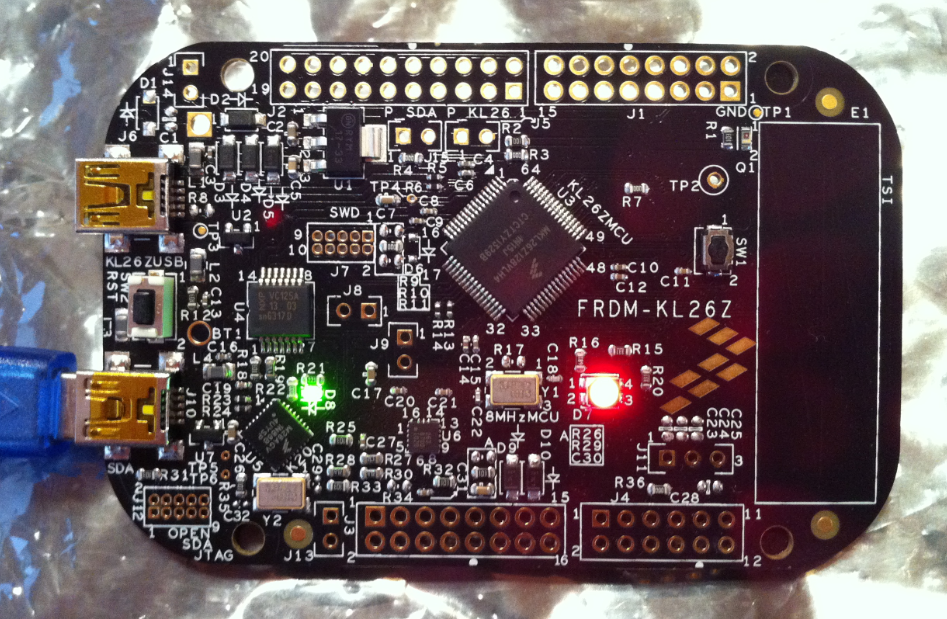
Review: New FRDM-KL26Z Board

I probably would have missed the fact that Freescale has released a new Freedom board, if I would not have visited my local distributor site to order a replacement for one of my first FRDM-KL25Z boards. So surprise, surprise: there is a new Freedom board: the FRDM-KL26Z!

FRDM-KL26Z Board

FRDM-KL26Z Board

So instead ordering again a FRDM-KL25Z, I decided to order that new FRDM-KL26Z instead. And it arrived right before Christmas, and now I had time to check it out. Nope, I did *not* use it as a blinking gadget on a Christmas tree, even if that would have been a nice idea ;-).

Continue reading

Bit-Banging I2C with ResetBus() Functionality

The good thing with the internet is: it allows engineers to collaborate. And here is an example: Marc is a reader of this blog had a problem with the I2C hardware of a Freescale Kinetis ARM microcontroller. In his case, the I2C bus could be stuck, and there seems no way to reset it with the I2C hardware on the microcontroller. So a solution would be to reset it with software instead.

Bit Banging Software I2C Driver

Bit Banging Software I2C Driver

Continue reading

Driver for Microchip 24xx Serial EEPROM

For many projects I need to store configuration or sensor data. For this I’m using either an SD card or program the internal flash memory of the microcontroller. Using the internal flash is a good thing as it does not need an external component. However, the typical number of programming cycles is limited to 10k-50k which is a limiting factor if data has to be recorded over a long time or very often. That’s why I’m using the very popular external 24xx external EEPROM devices from Microchip.

24LC512 connected to FRDM-KL25Z

24LC512 connected to FRDM-KL25Z

Continue reading