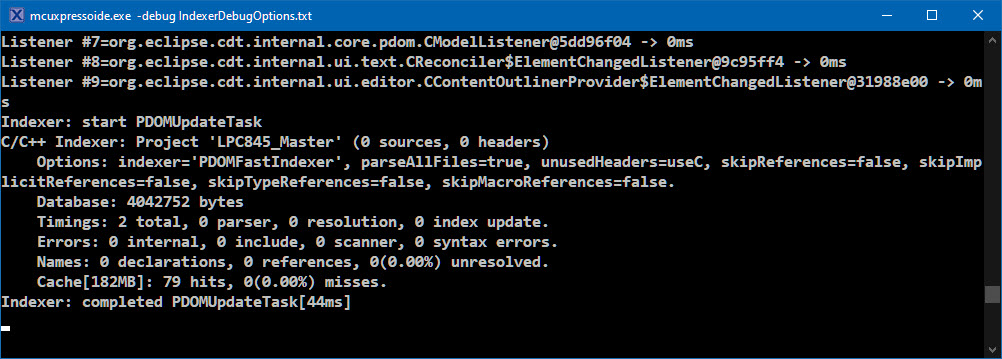
Eclipse includes a background parser called ‘Indexer’ which is used to assist the developer with various kind of information, for example jumping to a variable declaration or definition. Basically it is a parser running in the background collecting information about the sources and building up that ‘index’ data base.
Tag Archives: Tips&Tricks
3D Printed Mounting Bridge for Feller Smart Light Control for Philips Hue
The company Feller sells a wall mountable ‘Smart Light Control’: this provides 4 push buttons compatible with the Philips Hue system (on, off, dimming, etc). Unlike many other remote controls and buttons it is a great design and available in different colors. Feller does have a ‘classic’ wall switch series too, so this one is perfect to replace or augment an existing installation and make it ‘smart’.
Eclipse CODAN (Static Code Analysis) for C/C++
The Eclipse CODAN (Code Analysis) plugin is part of CDT and is a powerful static analysis tool finding all kind of possible bugs and issues. Still to my surprise not many C/C++ developers take advantage of it maybe because they are not aware that it exists?
In this article I show a few tips how to effectively use it, especially with the NXP MCUXpresso SDK.
New MetaClockClock V3 finished with 60 Clocks
The holiday break at the end of the year is always a good time to finish projects started during the year. This one is about my ‘MetaClockClock’ Version 3.
OpenOCD with MCU-Link
The NXP MCU-Link is a powerful $10 debug probe for ARM Cortex-M devices and works with the NXP LinkServer for debugging. The LinkServer does not an implement a gdb server, so it limits its usage e.g. for scripting or command line debugging. But as MCU-Link is also a CMSIS-DAP compatible debug probe, I can use it with OpenOCD which is open source and implements a GDB server. This article shows how I can use it with the MCU-Link.
Standalone and Command Line Programmer with MCUXpresso
The MCU-Link is a $10 CMSIS-DAP capable debug probe which works out-of-the box with the MCUXpresso Eclipse based IDE. This is great for development, but how can I programming with the push of a button or a script? The answer is no: there is an easy way to use the debug probe outside Eclipse from a shell script, and you can use that MCU-Link probe to do the job. This is especially useful as with the example below where I have to program 60 boards this week-end :-).
Configure hidden and internal Shortcuts in Eclipse
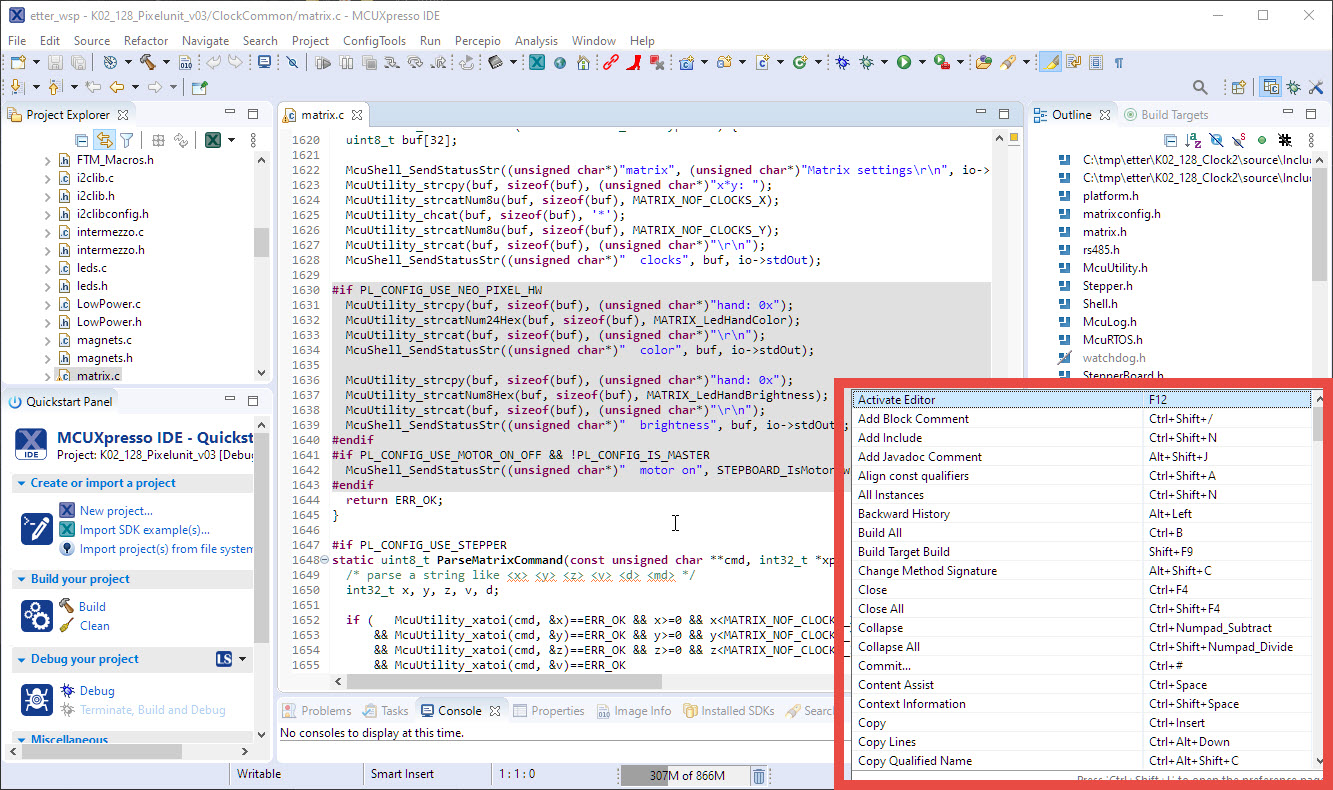
A very useful feature in Eclipse is Ctrl+Shift+L which lists all the available shortcuts:
Pressing Ctrl+Shift-L again will open up a dialog where I can configure them. But what if the shortcut or action is not listed there?
Getting a 96bit Unique ID for each Kinetis Device using MCUXpresso SDK
The NXP Kinetis devices implement a UID (Unique ID) for each device, using the ‘Unique Identification Register) which is part of the SIM (System Integration Module):
While this number should be unique, I was wondering last week why students in the labs reported the same UID for multiple robots in the lab. So maybe this number is not so unique as it should be?
Continue reading
Steps to use FreeRTOS with newlib reentrant Memory Allocation
Reentrancy is an attribute of a piece of code and basically means it can re-entered by another execution flow, for example by an interrupt or by another task or thread. This is an important concept and still a lot of code ‘in the wild’ does violate reentrancy. As a result the application crashes immediately in the best case. Worse it crashes randomly or even worse it behaves incorrectly 😦 .
Reentrancy is always a concern if using standard library functions, including printf() or malloc(). FreeRTOS offers a reentrant wrapper to the standard malloc() and free() (Memory Scheme 3)
Debugging Bootloader and Application with one Debug Session
If having a boot loader running on a micro-controller, it is very useful if both the boot loader and the loaded application can be debugged together: