For me, the available software and tools are the primary key decision factor why I select a particular silicon vendor. Without good software and tools, a microcontroller only ‘sand in plastic case’, even if it is the best microcontroller in the world. I do have several probably excellent microcontroller boards, and they are only getting touched by more durst over the months and years.
Tag Archives: NXP
MCUXpresso IDE: Adding the Eclipse Marketplace Client
One great thing with Eclipse compared to proprietary IDEs are the thousands of available plugins. Yes, not every plugin is probably on the ‘must have’ list (I have listed some in a series starting with “5 Best Eclipse Plugins: #1 (Eclox with Doxygen, Graphviz and Mscgen)“).
The ‘traditional’ approach to install Eclipse plugins is using the menu Help > Install New Software. Using that approach, I have to use or enter an Eclipse update site. An easier way is to use the Eclipse Marketplace plugin which allows me to search and browse for plugins and simplifies installation of it. But as this one does not come installed by default with MCUXpresso. But it is my preferred way to browse and install plugins into Eclipse:
MCUXpresso IDE: S-Record, Intel Hex and Binary Files
This is another article about the NXP MCUXpresso IDE (see “MCUXPresso IDE: Unified Eclipse IDE for NXPs ARM Cortex-M Microcontrollers“), this time it is about Post-build steps. Post-build steps are custom actions which can be executed after the build (or link phase), and are typically used to generate S-Record, Binary or Intel Hex files (see “S-Record, Intel Hex and Binary Files“).
MCUXpresso IDE: Unified Eclipse IDE for NXPs ARM Cortex-M Microcontrollers
There are many mergers going on in the industry, and one of the largest one was in 2016 the integration of Freescale Semiconductor with NXP Semiconductors, with both providing Eclipse based IDE’s to their customer base. Consequently, the company merger triggered a merger of the IDE’s, and last week NXP has released the result: the MCUXpresso IDE.
Tutorial: Using Eclipse with NXP MCUXpresso SDK v2 and Processor Expert
To me, software and tools are by far more important than the microcontroller. Because the silicon is a ‘one time kind of thing’, where the software has to be maintained and working over a longer time. And at least my software usually needs to be ported to a new device, so portability and available software and tools are critical to me.
The combination of MCUXpresso SDK (formerly Kinetis SDK) and Processor Expert is unfortunately not supported by NXP. But I have found a way to get them work together in a nice way, and this article is about making that combination possible :-).
McuOnEclipse Components: 12-Mar-2017 Release
I’m pleased to announce that a new release of the McuOnEclipse components is available in SourceForge, with the following main features and changes:
- Wait: Busy-Waiting using ARM DWT cycle counter
- Percepio FreeRTOS+Trace: Updated to version 3.1.1, simplified usage of streaming and snapshot mode
- GenericSWI2C: MCUXpresso SDK can be used with the bit-banging I2C driver support
- FreeRTOS: includes updates of the 9.0.1 release, ‘optimized task selection, enabled MPU support (experimental)
- Graphical GUI drivers for screens, windows, icons, headers, text widgets and more
- SSD1351: display driver for Solomon Systech SSD1351 display
- More components are now supported by the McuLibConfig settings
- Many other smaller bug fixes and enhancements
Percepio FreeRTOS Tracealyzer Plugin for Eclipse
eSOMiMX6-micro: NXP i.MX6 System on Module
An interesting trend in the industry are SOM (System on Module): a high performance processor typically running Linux, Windows or Android with all the memory and necessary power logic gets put on a small module. The key benefit is that I don’t need to worry about the complex ball grid routing and the DDR memory connections/lines: all these problems are solved on a small module which then I can use in my design. It seems that NXP i.MX application processors are getting popular in this domain, and after looking at the Toradex Colibri modules, I have an i.MX6 module on my desk from e-con Systems:
P&E ARM Cortex-M Debugging with FreeRTOS Thread Awareness and Real Time Expressions for GDB and Eclipse
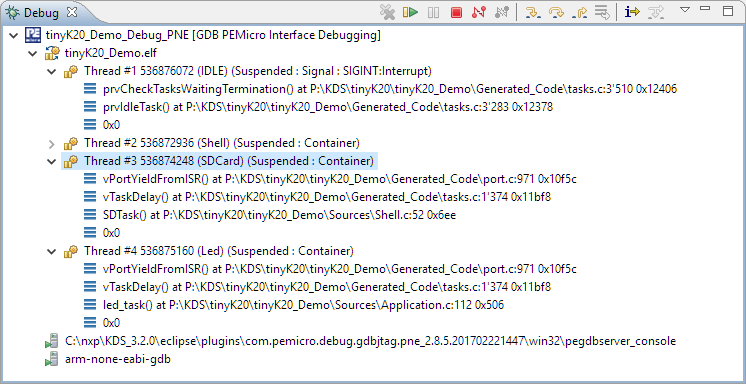
P&E has a new version of their GDB/Eclipse debug plugins available on their Eclipse update site, and it comes with to great features: Real Time Expressions (show variables while target is running) and FreeRTOS thread awareness 🙂
Tips for Making Copy of Eclipse CDT Projects Easier
Instead creating a new project from scratch, often it is simpler to copy an existing Eclipse CDT project, then change it and go on. To copy-past the a project in Eclipse:
- Select the project in the Project Explorer View (CTRL-C on Windows)
- Then paste it in the Project Explorer View (CTRL-V on Windows), and I can specify the new name:
However, to make that process simpler, a few things have to be done right in the ‘source’ project first.