First 3D Printed tinyK20 Board Enclosure

The tinyK20 boards are now used in several projects. Initially I was considering a commercial USB thumb drive enclosure for it. But this needed some tweaking of the enclosure so at the end it was not ideal. 3D printing is probably that hot topic for 2016. So why 3D printing an enclosure for that board?

tinyK20 3D Printed Enclosure

3D Printed Enclosure for the tinyK20 board
Continue reading

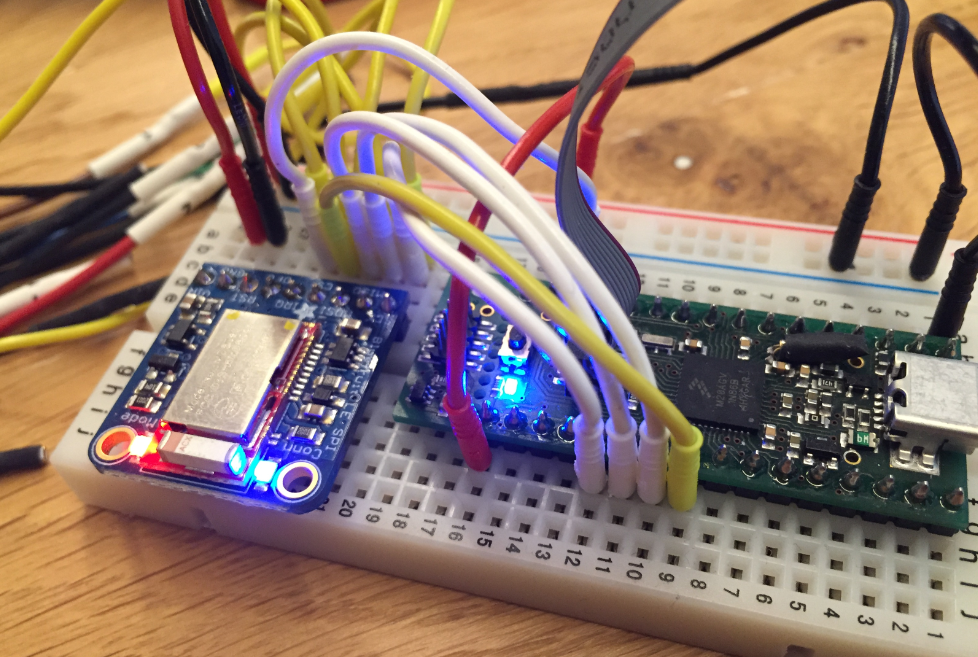
How to Add Bluetooth Low Energy (BLE) Connection to ARM Cortex-M

In many of my embedded projects I’m using successfully the Nordic Semiconductor nRF24L01+ (see “Tutorial: Nordic Semiconductor nRF24L01+ with the Freescale FRDM-K64F Board“) and the HC-06 Bluetooth transceivers (see “Getting Bluetooth Working with JY-MCU BT_BOARD V1.06“) for wireless communication. However, the nRF24L01+ is using a proprietary protocol, and the HC-06 does not work with Apple products (it does very well with Android devices). To close that gap I decided to add Bluetooth Low Energy (BLE, or Bluetooth 4.x). So this post is about how to add Bluetooth Low Energy (BLE) to NXP (formerly Freescale) Kinetis devices:

BLE Enabled Kinetis

BLE Enabled Kinetis

Continue reading

Renaming Eclipse CDT Projects

When I create a project in Eclipse (e.g. in Kinetis Design Studio with the GNU ARM Eclipse plugins), I have to specify the name of the project during creation time:

Project Name in Eclipse

Project Name in Eclipse

But what if I change my mind later on and want to use a different name? How to rename the project?

Continue reading

Fane Alm

This winter in the Alps is very dry and warm. Because there is no snow it is excellent to do some hiking instead. I’m closing the year with the family in the Italian part of the Alps, and we visited today the Fane Alm, a seasonal alpine pasture. The most beautiful small alpine village I ever have seen. It is located at the top end of the valley of Vals, South Tyrol, Italy.

Fane Alm

Fane Alm

Continue reading

USB CDC with the Raspberry Pi

For my home automation project with openHAB I want to attach Freescale (now NXP) FRDM (Freedom) boards so they can take care about the realtime aspects and to act as gateways to my other systems. One way is to use USB CDC (Serial over USB) as communication channel. USB has the advantage that it powers the board, plus I can attach multiple devices: up to four on the Raspberry Pi 2 and even more with using a USB hub. In a standard configuration with a USB WiFi and a USB HID (mouse plus keyboard) dongle I still can attach two Freescale (ahem, NXP) Freedom boards to the Raspberry Pi:

FRDM-K22F and FRDM-K64F attached to Raspberry Pi 2

FRDM-K22F and FRDM-K64F attached to Raspberry Pi 2

Continue reading

Blinky LED with openHAB on Raspberry Pi

In my earlier post I showed how I have installed the open source openHAB home automation system (see “Installing openHAB Home Automation on Raspberry Pi“). In this post I show how to control a local LED on the Raspberry Pi with openHAB home automation system: how to control any GPIO pin on the Raspberry Pi from remote:

Controlling the LED with openHAB

Controlling the LED with openHAB

Continue reading

Autostarting openHAB on Raspberry Pi

In “Installing openHAB Home Automation on Raspberry Pi” I have set up openHAB on a Raspberry Pi 2. But when I reboot it, I need to start openHAB manually. This post is about how to start openHAB automatically after a reboot.

openHAB running

openHAB running

Continue reading

Installing openHAB Home Automation on Raspberry Pi

I’m currently building a home automation project around Raspberry Pi: I want to be able to monitor and control things like the lights, garage doors and the heating system both at home and from remote. I already have added a touch screen to one of my Raspberry Pi 2 computers (see “Adding a Touch LCD to the Raspberry Pi 2“). This article is about how to install the openHAB on that Raspberry so it can be the brain of the automation system.

openHAB Demo House on Pi

openHAB Demo House on Pi

Continue reading