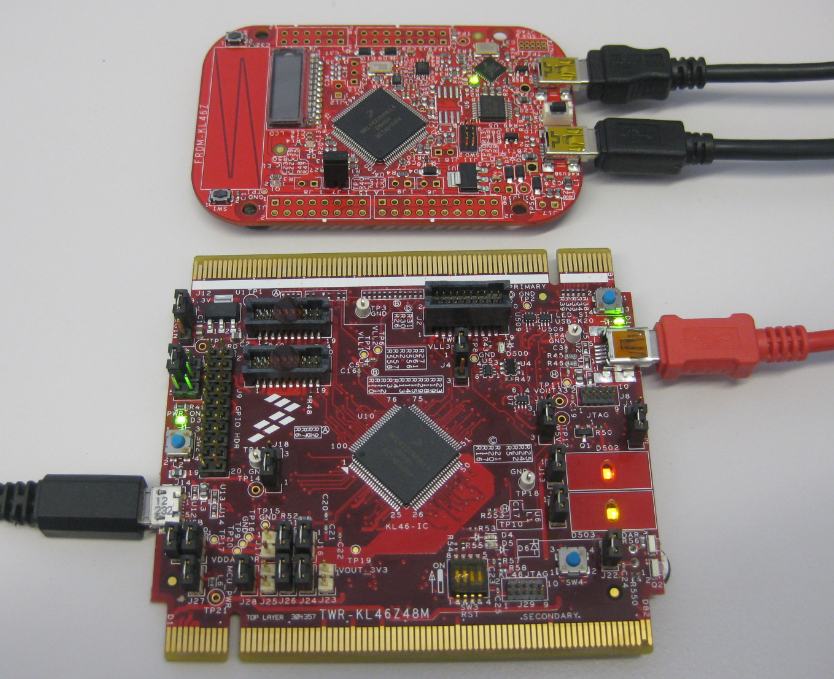
As I was so pleased with the FRDM-KL46Z board, that I have ordered the Tower version of it, the TWR-KL46Z48M:
What I missed so far was USB support for the KL46Z. So time to have a quick look at board(s) and to add USB support for it.
As I was so pleased with the FRDM-KL46Z board, that I have ordered the Tower version of it, the TWR-KL46Z48M:
What I missed so far was USB support for the KL46Z. So time to have a quick look at board(s) and to add USB support for it.
“A picture says more than 1000 words.”
I don’t know the source of that quote, but for sure it is true for every developer and engineer too. Engineers need to work a lot with numbers. But numbers can be transformed into pictures and graphs which can make complex things and relationships easier to understand. Verifying proper functionality of a PID closed loop controller or watching sensor values with a nice plot is definitely something very useful. Would it not be great to watch sensor data changing over time in a chart like the one below?
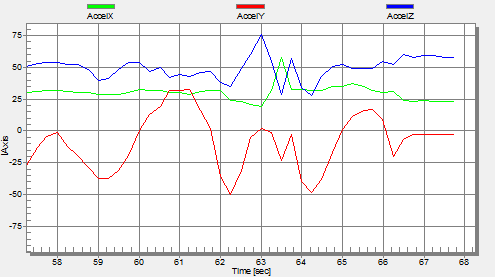
One way is to export data and then show it e.g. in Excel (which has been great chart functions). But even better, if this could be done directly with data provided from the target board? If you think this is hard to do, then I can show you how this can be done in a few steps with the help of a very nice tool: FreeMASTER 🙂
Looks like a flood of new Freedom boards is coming out 🙂 : I have found out about this new one: The FRDM-KE02Z.
For many projects I need to store configuration or sensor data. For this I’m using either an SD card or program the internal flash memory of the microcontroller. Using the internal flash is a good thing as it does not need an external component. However, the typical number of programming cycles is limited to 10k-50k which is a limiting factor if data has to be recorded over a long time or very often. That’s why I’m using the very popular external 24xx external EEPROM devices from Microchip.
What could be wrong with this code:
volatile uint16_t myDelay; void wait(uint16_t time) { myDelay = 0; while (myDelay<time) { /* wait .... */ } } void TimerInterrupt(void) { myDelay++; }?
Git is now my favorite version control system. Git and GitHub are very powerful, it has (nearly) all features I can think about, and best of all: As a distributed version control system, I can work with it, even if disconnected from the network :-).
There are many standalone and IDE integration available for Git. Beside of using TortoiseGit, I’m using the eGit Eclipse integration. This post is about how to install eGit in Eclipse, particularly in CodeWarrior for MCU10.4.
I love the Freedom boards, like the most recent FRDM-KL46Z for about US$15. But if I think that the ‘Freedom’ board is to big, cost too much and has too much on it, then here is one which is built for only US$5 :-): The MC HCK (pronounced “McHack”):

MC HCK Board Assembled (Source: http://mchck.org/blog/2013-08-06-self-built-mchck-for-5-dollars/)
One of the ‘goodies’ of the FRDM-KL46Z is the Freescale MAG3110 magnetometer. The MAG3110 is a tiny 2×2 mm device:
What was missing so far is a Processor Expert component for it. This post is about closing this gap…
Freescale has added a new Freedom board: the FRDM-KL46Z:
My opinion? The best Freedom board so far, I love it!
For everyone who wants to build a Do-It-Yourself toolchain for Kinetis on Linux, I recommend to read the following excellent post by Karibe:
Setting up Linux opensource build and debug tools for freescale freedom board FRDM-KL25Z
He describes how to get OpenOCD with CMSIS-DAP working with Eclipse on Ubuntu to debug the FRDM-KL25Z board.
Happy Linuxing 🙂