I have one rule I try to follow every day: my code shall be warning free. Writing software for multiple compilers gets challenging with this rule, but it avoids the ‘not seeing the forest because of the trees’ problem. This rule extends to writing Processor Expert components with CDE (Component Development Environment). What I have missed (and not used) is a useful option to enable debug output:
Category Archives: Processor Expert
Bit-Banging I2C with ResetBus() Functionality
The good thing with the internet is: it allows engineers to collaborate. And here is an example: Marc is a reader of this blog had a problem with the I2C hardware of a Freescale Kinetis ARM microcontroller. In his case, the I2C bus could be stuck, and there seems no way to reset it with the I2C hardware on the microcontroller. So a solution would be to reset it with software instead.
RNet: A Simple Open Source Radio Network Stack
I was searching the internet for an open source network stack for my nRF24L01+ transceivers. But these stacks were either too heavy or had a restrictive or not really non-open source license behind it. I was very reluctant to start with something I think already should exist. Two weeks ago I decided that I just do it from scratch, and here I am: I have the basics working 🙂
Processor Expert Component not Showing Up?
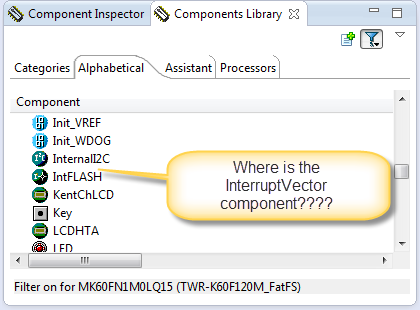
In case you are desperately looking a component in the components library view, but somehow it does not show up? For example I know there is component ‘InterruptVector’, but it is not present in the Components library view?
Tutorial: Using a Terminal Input and Output; *without* printf() and scanf()
So this tutorial is about using a terminal connection between my board and my host (e.g. a notebook) to read and write text:
FreeRTOS for the Freescale DSC 56F8400 Core
Yes, I have been busy with all the different ARM Cortex Mx cores I’m using in my projects. But beside of the ‘ARM domination of the world’, there are other interesting processors out there. While the ARM cores have added DSP (Digital Signal Processing) capabilities blurring the boundaries between pure MCU and DSP processors, there is still a place (or niche?) for specialized DSP processors. The power of such processors is in the domain of fast signal processing, e.g. for intelligent power switches or for advanced motor control.
Review: ThunderBench with the Freescale FRDM Board and Processor Expert
For the Eclipse and Processor Expert lovers of this world: there is another Eclipse based IDE you can use: ThunderBench made by Emprog:
They support a range of ARM based devices, including the Freescale ones I’m using. So I downloaded the v3.24 30 day trial from their download page last week. Finally I have found some time to try it out. Could this be an alternative to use my Freescale FRDM boards with Processor Expert?
IAR ARM v6.7 comes with improved Processor Expert Support
This week I saw on the IAR website that they have released the new IAR Embedded Workbench v6.7 for ARM. I was still on 6.5 using the free code size limited ‘Kickstart’ version), so I thought it would be a good time to upgrade to the v6.7. And there are good reasons as the connection to Processor Expert makes things much easier now.
Workaround for Processor Expert ‘Components’ View Synchronization
CodeWarrior for MCU10.5 comes with a new Eclipse and new Processor Expert. Things are working very well so far. But I have spotted an issue which seems to be related to the new Eclipse Juno used: sometimes the Processor Expert ‘Components’ view is not correctly showing the current project used.
First Set of nRF24L01+ Wireless Sensor Nodes with FRDM-KL25Z
If you were wondering why I am pushing the FRDM-KL25Z boards hard to the micro-amps, then have a look at this:
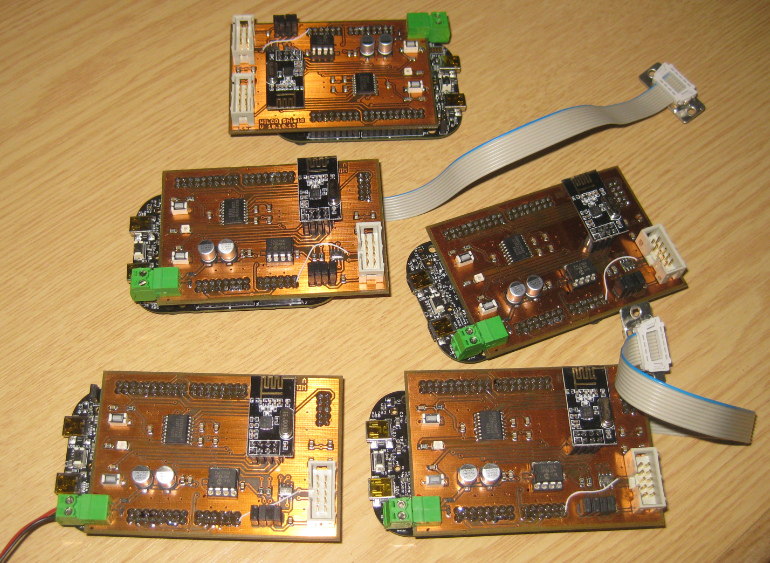
The five boards are the first set of prototypes with a FRDM-KL25Z for a battery operated wireless sensor network based on the nRF24L01+ 2.4GHz transceiver.