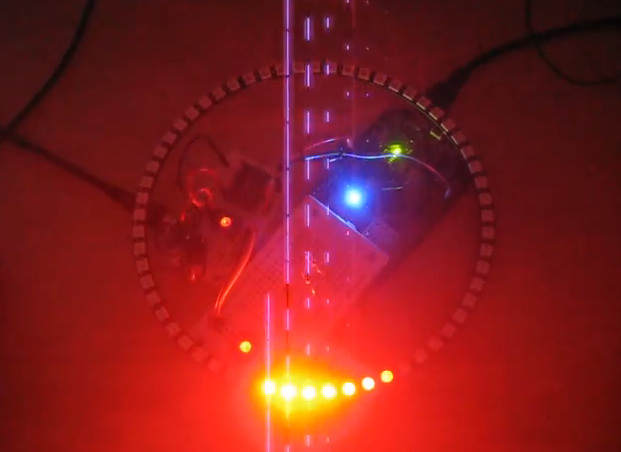
Adafruit NeoPixel Clock with 60 LEDs

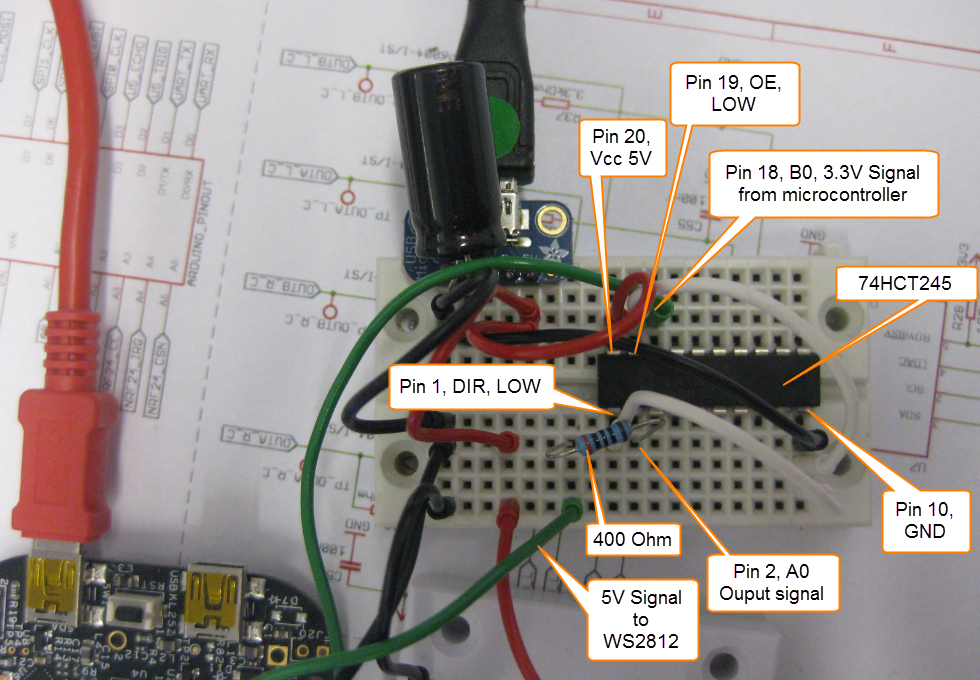
After the problems with level shifters (see “First Adafruit NeoPixel Blinks with the FRDM Board“) I received the ordered 74HCT245N. Put it on a bread board, wired it up, … only to find out that the device gets very hot… turned off power, and realized that had the device put in with a wrong orientation 😦 oh darn! That’s why I always order things like that in quantities of 3 or more :-). Corrected the mistake, and things are running (or blinking) again πŸ™‚

74HCT245 Wiring for WS2812

74HCT245 Wiring for WS2812

Continue reading

Preserving Memory Ranges with Eclipse and P&E GDB Server

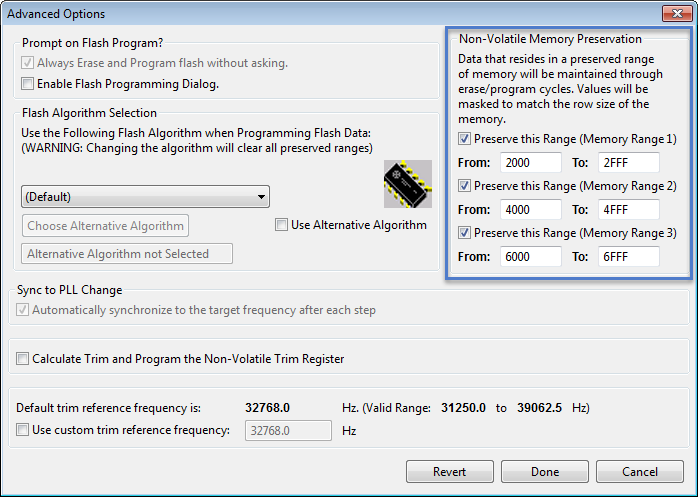
For my boot loaders I need the functionality that I can keep memory ranges from being erased while downloading the rest of the application. P&E provides a GDB server which interfaces with their probes (P&E Universal Multilinks, Tracelinks, …) and as well with the OpenSDA present on many of the Freescale evaluation boards. In CodeWarrior there is an option for ‘Advanced Programming Options’ which allows to preserve memory of the microcontroller FLASH (see “Programming part of flash“). However, that option or button is not present in the Eclipse version of the P&E GDB server (e.g. in Kinetis Design Studio). So how can I preserve some areas of FLASH in Eclipse with GDB?

Preservation of Non-Volatile Memory in CodeWarrior

Preservation of Non-Volatile Memory in CodeWarrior

Continue reading

First Adafruit NeoPixel Blinks with the FRDM Board

LEDs are getting smarter these days. An amazing example are the WS2812(B) or ‘NeoPixels’ from Adafruit: RGB LEDs with a built-in constant current controller and shift register! With a single wire data wire hundreds of RGB LEDs can be controlled. Exactly what I need for a project I had in mind for a very long time. So I ordered a bunch of different LEDs from Adafruit to experiment. Exactly the right thing on dark and rainy week-end. And the result is, well: bright and colorful πŸ™‚

Adafruit NeoPixel LED Ring

Adafruit NeoPixel LED Ring

Continue reading

Listing Code and Data Size for each Source File with GNU and Eclipse

I have used the ‘classic’ CodeWarrior IDE for years, before I moved over to Eclipse some years ago. And as with any IDE or tool switch, things are different in the ‘new world’. In summary, I don’t want to go back anyway, and Eclipse is my development tool of choice now. But from time to time I get challenged about something like “hey, this was possible in the previous tool, so how can I do the same in Eclipse?”. As a fan of Eclipse, this then gets my attention as I feel that Eclipse can do it, and it can do it better. πŸ˜‰

So what about this one: In CodeWarrior the project view lists code and data size for each source file:

Code And Data Size in CodeWarrior

Code And Data Size in CodeWarrior

Continue reading

Multi-Drive Support with FatFS

I admit: I’m sometimes a lazy person. In my projects, I only needed one ‘disk drive’ with the FatFS Processor Expert component: either a SD card or a USB MSD drive. But a reader of this blog wanted to use FatFS with multiple drives: using it with an SD card and a USB MSD drive. And actually FatFS does support this, I just had no need for it, thus I did not add anything special for it. But that reader let me think that I better add Multi-Drive support. Even if I do not need it now, that could be very handy in the future πŸ™‚

FatFS Drive System (Source http://elm-chan.org/fsw/ff/en/appnote.html)

FatFS Drive System (Source http://elm-chan.org/fsw/ff/en/appnote.html)

Continue reading

UART printf() for the FRDM-K64F Board and Kinetis Design Studio

I had great plans for this Saturday: to work on really cool project. But as so many times, things turned out to be different. Maybe you have read my recent posts about printf()? A colleague wanted to use that article to the same thing with the Kinetis Design Studio on the FRDM-K64F board. I used the FRDM-KL25Z board, so I expected this to work out of the box for him too. Well, turned out that I was wrong about this, and my Saturday was used for debugging and googling about a printf() problem 😦

While things work as expected for the FRDM-KL25Z (ARM Cortex-M0+) and using the standard GNU GCC ARM Embedded from the launchpad, the application traps on the K64F (ARM Cortex-M4F) in initialise_monitor_handles() with KDS:

Trap in initialize_monitor_handles()

Trap in initialize_monitor_handles()

Continue reading

Girls for Science!

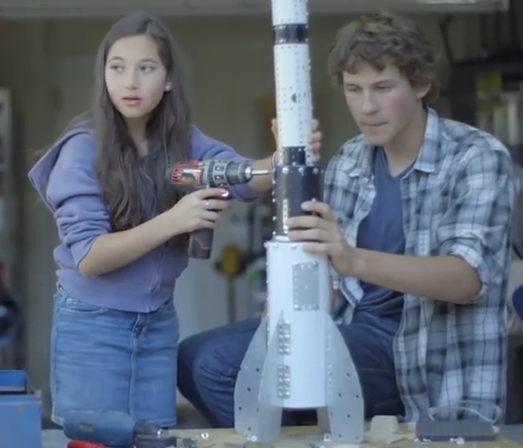
Working in an engineering domain of electrical engineering and computer science, female engineers are clearly the minority, at least in my country. For example the ETH Zurich has less than 30% female students. The US National Science Foundation had published articles on that subject: Interestingly, 70% of young girls are interested in math and science, but they lose that interest afterwards.

Verizon Commercial 2014 (Source: Youtube)

Verizon Commercial 2014 (Source: Youtube)

Continue reading

Switching ARM GNU Tool Chain and Libraries in Kinetis Design Studio

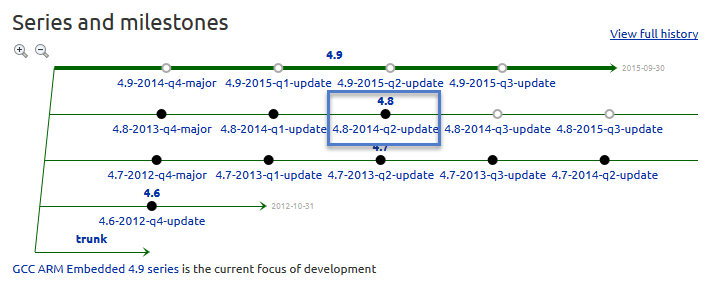
The Freescale Kinetis Design Studio (KDS) V1.0.1 beta is using a different GNU ARM toolchain than the ARM Inc. supported one on launchpad (GCC ARM Embedded). Additionally, KDS is using newlib 1.19 and newlib-nano 1.0, while there just has been a new release of the GCC ARM Embedded a month ago with the 4.8.4 update 2 release in June this year. So how to upgrade KDS to the latest and greatest GCC ARM Embedded?

Continue reading

printf() and scanf() with GNU ARM Libraries

In “Semihosting with Kinetis Design Studio” I’m using the debugger with semihosting to output text with printf(). But how to use a physical serial connection instead?

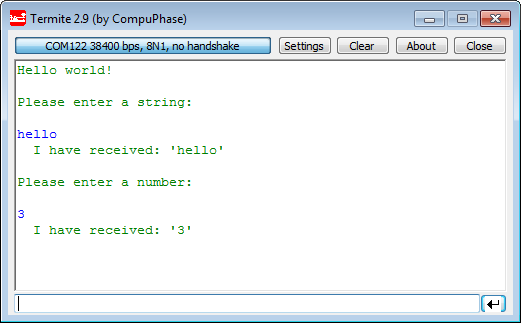
printf() and scanf() in action

printf() and scanf() in action

This post is about how to enable and use printf() and scanf() with GNU ARM libraries. I show it both for the Freescale Kinetis Design Studio (KDS) and for stock Eclipse Kepler with the GNU GCC ARM Embedded (launchpad) toolchain and libraries. The principles are the same, just the details are different ;-).

Continue reading