I’m using in several projects different variants of Raspberry Pi boards: they are great and providing a lot of processing power. However, they are not suitable for any hard realtime systems. For a different class of projects I’m currently evaluating the NXP i.MX7 processors: the cool thing with these is that they have up to two ARM Cortex-A7 running at 1 GHz, plus a Cortex-M4 running at 200 MHz. And here things get really interesting: I can run a realtime application and FreeRTOS on that M4, while running Linux on the A7 :-).
Tag Archives: software
Tutorial: Using Single Wire Output SWO with ARM Cortex-M and Eclipse
As a standard procedure, I add some console functionality to my embedded applications. That way I have a command line interface and can inspect and influence the target system. One interesting hardware feature of ARM Cortex-M is Single Wire Output (SWO): it allows to send out data (e.g. strings) over up to 32 different stimulus ports, over a single wire.
Tutorial: Blinky with Kinetis SDK V1.3 and Processor Expert
This tutorial goes through the steps how to create a blinking LED application, using Kinetis SDK and Processor Expert, using the TWR-KL43Z48M board from Freescale (now NXP):
ARM Cortex-M Interrupts and FreeRTOS: Part 3
Survey Results: After 0x8888888 Seconds, This is Your Feedback
A week ago I asked: what you would like to see next on this blog? Thank you all for your reaction and comments! To me, the result is interesting:
ARM Cortex-M, Interrupts and FreeRTOS: Part 1
The ARM Cortex-M microcontroller are very popular. And it has a very flexible and powerful nested vectored interrupt controller (NVIC) on it. But for many, including myself, the Cortex-M interrupt system can be leading to many bugs and lots of frustration :-(.
Understanding the NVIC and the ARM Cortex-M interrupt system is essential for every embedded application, but even for if using an realtime operating system: if you mess up with interrupts, very bad things will happen….
impulse: Segger SystemView in Eclipse
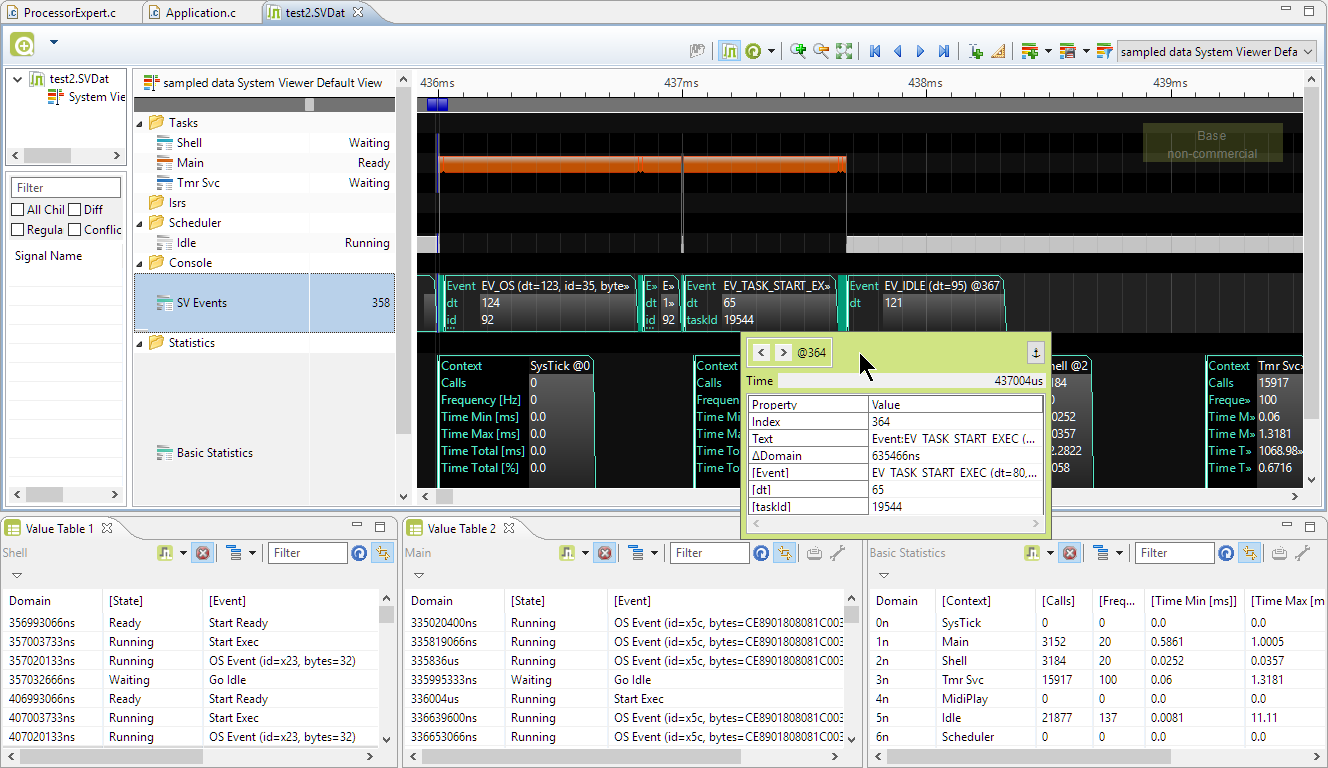
I’m using the Segger SystemView in many of my applications to get insights of the running application. A reader of my blog pointed me to the company ‘toem’ (http://toem.de/) based in Germany which offers powerful data viewer (‘impulse’) for Eclipse. I have tried this out, and it is really an amazing piece of technology with lots of potential. It allows me to view Segger SystemView data 🙂
NXP Pins Tool: Understanding Data for Offline Usage
I’m using the NXP Pins tool (see “Tutorial: Muxing with the New NXP Pins Tool“) now in several projects, and I think it is time to share a few tips and tricks.
So join me on a journey through the internals of the NXP Pins tool :-).
Hexiwear: Teardown of the Hackable ‘Do-Anything’ Device
Smartwatches are around for a while now. To me it is still questionable how useful the ‘big’ ones for iOS and Android are. But there are definitely the crowd funded smartwatch projects which caught my attention. Maybe it is about the ‘do-anything’ with connectivity? One of these gadgets is Hexiwear: a hackable open source device
While it *could* be a kind of smartwatch, the value of this thing is more that it includes a plethora of sensors with two microcontroller, and I can use Eclipse with GNU tools to build my firmware :-).
Alert: Hackster.io is giving away 100 Hexiwears, but you need to hurry up (submission until July 15th 2016)!
FreeRTOS Kernel Awareness for Eclipse from NXP
NXP has released their Kernel Awareness for FreeRTOS in Eclipse (Kinetis Design Studio):