Freescale has released the v3.0.0 version of the Kinetis Design Studio: this one comes with a great positive change: instead of a custom toolchain, it is coming with the standard GNU ARM Embedded (launchpad) toolchain from ARM. Beside of better code density and less RAM needed, there is one change which affects semihosting. Previously, semihosting was enabled by default in the V2.0.0 libraries. Now semihosting needs to be turned on. This post is how to do this.
Tag Archives: Debugging
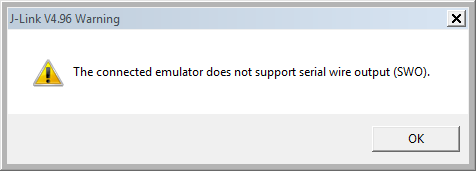
Solving “The connected emulator does not support serial wire output (SWO)” for Segger J-Link
SWO (Serial Wire Output) is a cool feature defined by ARM as part of the CoreSight debug block. However, not every debug connection supports SWO, as it requries extra pins routed from the microcontroller to the debug JTAG/SWD header.
If I’m using the Segger J-Link, and if my hardware does not support SWO, I will get a dialog telling me “The connected emulator does not support serial wire output (SWO).”
GDB Client and Server: Unlocking GDB
In case you face problems with launching GDB: Then I have a quick solution (well: workaround): kill the GDB server and or client process. The problem can show up in many way, but in general gdb is stuck or does not respond:
But it could be an error message like this too:
Error in services launch sequence Starting J-Link GDB Server timed out.
Debugging the FRDM-K64F with P&E Multilink
The FRDM-K64F board as other Freescale Freedom board have an onboard debugging device. For everyone who wants to debug the FRDM-K64F board with say a P&E Universal Multilink, here is my setup in case you do not get it working out of the box:
CodeRed Debug Perspective in Kinetis Design Studio
I very much liked the CodeRed Eclipse based IDE (see “Red Suite 5: Eclipse Juno, Processor Expert and unlimited FRDM-KL25Z“). But back in May 2013 CodeRed was acquired by NXP. I have not used much NXP devices for my projects, and as CodeRed was focusing on the NXP parts, CodeRed was not running daily on my desk any more :-(. Well, things might make a full back circle, as NXP announced back March 1st 2015 to acquire Freescale :-). And maybe as a taste how things might come out, the GNU ARM Eclipse plugin release from March 22nd 2015 includes a CodeRed debug view 🙂 🙂
That debug perspective mimics a CodeRed debug perspective. The advantage of this Eclipse perspective is that it works very well with small screens. This post is about adding this perspective to the recently release Kinetis Design Studio v3.0.0.
Breadcrumbing Mother’s Day: Minimized Debugging View with Eclipse
What I love with Eclipse: it has lots of small and useful features, either built-in or available as plug-in. Recently I started to use a feature which is present in Eclipse for some time: the ability to save screen real estate during debugging with the ‘breadcrumb’ view option:
Semihosting with GNU ARM Embedded (Launchpad) and Kinetis Design Studio
A while back I wrote two articles about Semihosting: “Semihosting with GNU ARM Embedded (LaunchPad) and GNU ARM Eclipse Debug Plugins” and Semihosting with Kinetis Design Studio. With using the GNU ARM Embedded (lauchpad) in my Kinetis Design Studio, time for a ‘summary’ post :-).
Proof of Concept: Open Source ARM SWD Debug and General Purpose Board
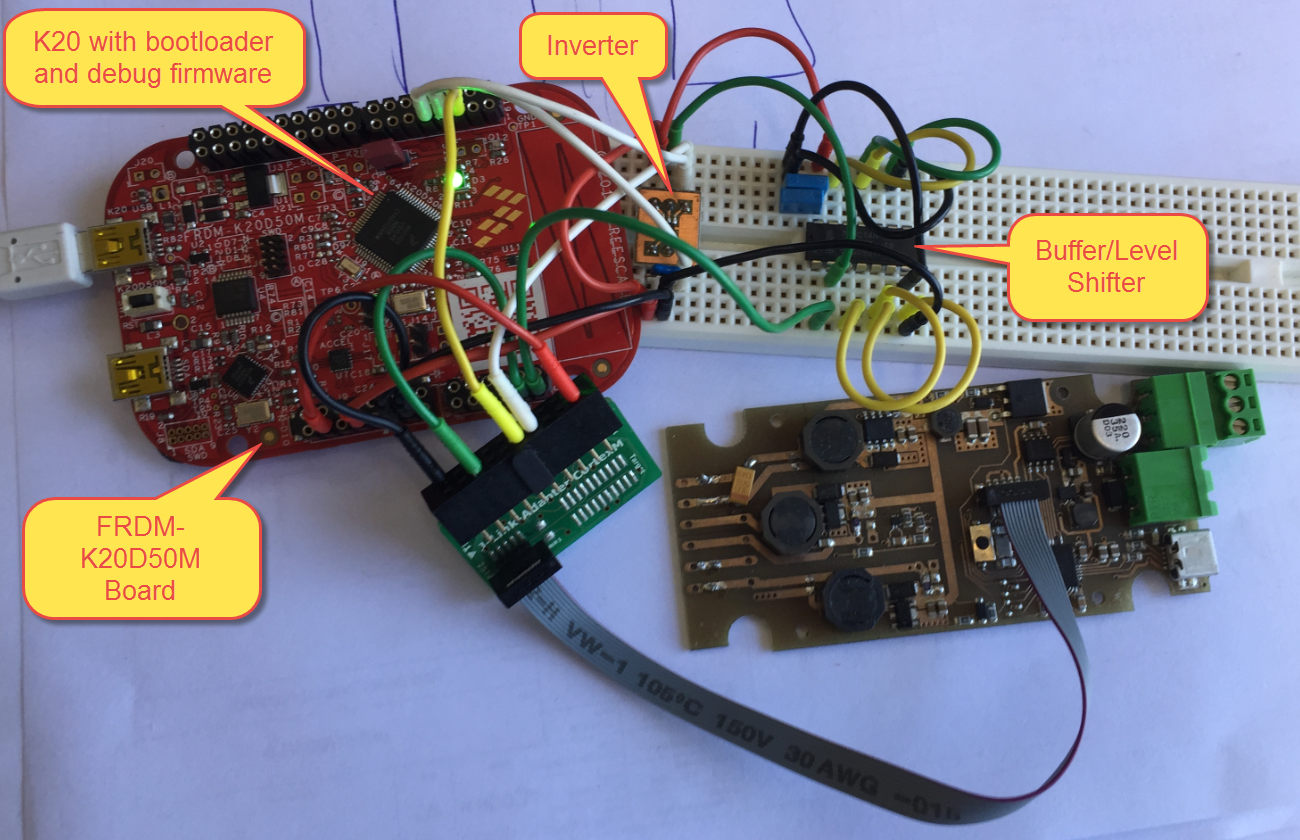
The Teensy is a great and tiny board (see “USB CDC with the Teensy 3.1 Board“), but it lacks real SWD/JTAG debugging capabilities (see “Hacking the Teensy V3.1 for SWD Debugging“). The Freescale Freedom boards are great, but for many applications too big, and have potentially too many components on it. So what about building a breadboard friendly tiny board which *has* SWD debugging ability *and* can be used to debug another boards?
So here is a working prototype based on the FRDM-K20D50M:
Serial Terminal View in Eclipse Luna
If you have read my article “Serial Terminal View with Eclipse Kepler“, then you are aware that using a Terminal view to a serial connection (COM port) under Eclipse Kepler is pretty much broken. I’m moving some of my projects to the more recent Eclipse Luna release, and the good news is that support is back 🙂
Updated P&E GDB Server for Eclipse: Connect/Attach and Advanced Flash Programming
P&E has upgraded their GDB implementation and interface used in combination with the GNU ARM Eclipse plugins: they support now advanced flash programming options plus the ability to attach/connect to a running target :-). This update is available as Eclipse update.