USB with the TWR-K60F120M and TWR-K70F120M

If you read my posts, then you probably know: I *love* the FRDM boards! But: Freescale has only the lower-end processors available with a FRDM board (yet?). As I need something more powerful for my Raspberry Pi Camera project, I’m using Tower boards instead. This gives me an ARM Cortex-M4 with 120 MHz, Floating Point unit plus 128 KByte SRAM :-).

For that project I need USB. So this post is about using the TWR-K60F120M and TWR-K70F120M with USB connectivity, using the USB CDC device class as example. Initially I thought I can do as easily with the FRDM boards. It turned out, that things are not that easy.
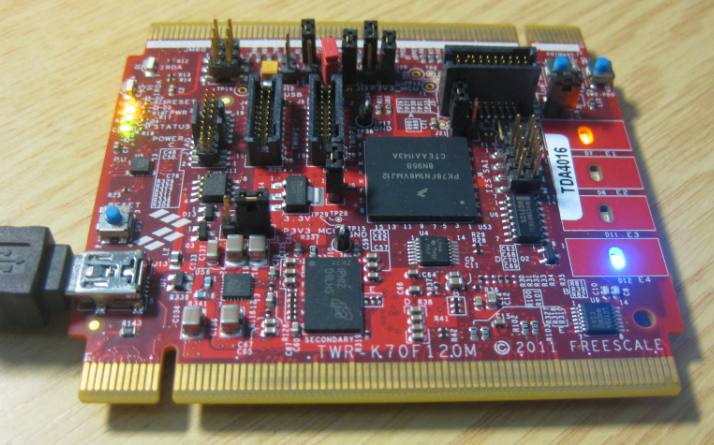
Freescale TWR-K70F120M Tower Board

Freescale TWR-K70F120M Tower Board
Continue reading

Eclipse Command Line Code Generation with Processor Expert

Eclipse based IDE’s have typically one limitation: the IDE has not much scripting capabilities. Yes, I can use things like JUnit for testing, but if it comes to build and debug C/C++ applications, then support gets really rare. An exception to this is CodeWarrior for MCU which features a command line version of the IDE which can be used for test automation as I used it in one of my tutorials. What I missed so far is to have a command line interface for Processor Expert to generate code. This is now possible with CodeWarrior for MCU10.5 :-).

Continue reading

Using the FRDM-KL25Z with CMSIS-DAP to program non-Freescale ARM Microcontrollers

Freescale might not have thought about this: how to use Freescale boards and silicon to develop for non-Freescale silicon? 😉

I tinkered around using the FRDM (e.g. FRDM-KL25Z) board as a general purpose programming or debugging device. See the links to the posts at the end of this article. I have used it to program and debug other Freescale ARM processors. It requires board changes and the usage of a different OpenSDA firmware which has its own limitations (no USB CDC serial bridge). But for about $15-20 I have a device to program my own external boards :-).

If you are using Keil tools, then the good news is: With CMSIS-DAP you can debug any other (even non-Freescale) ARM device as long it is supported by the IDE :mgreen:

FRDM-KL25Z debugging the nRF51422-DK (Source: Keith Wakeham)

FRDM-KL25Z debugging the nRF51422-DK (Source: Keith Wakeham)

Continue reading

Tutorial: Using the FRDM-KL25Z as Low Power Board

The FRDM-KL25Z is a great board: inexpensive (around US$15), small form factor, has easily accessible pins, and has a low power (capable, at least) microcontroller, and comes with an embedded debugging interface. So why not using this board right away ‘as is’ for a low power battery operated device? Great idea, you think? Yes, I thought too. Only to find out that the board needs 20 mA out of the box.

The good news is: It is possible on a week-end to get this 150 times better down to 132 μA, with an RTOS running all the time :-). I invite you to join a journey with board modifications, jumpers, schematics and many multi-meter pictures ;-)….

132 micro amps

132 micro amps!

Continue reading

Link Order: Using Multiple Definitions with ARM GNU Linker and Eclipse

Sometimes I have ‘multiple definitions’ in my projects: this means that I have functions defined in one source files, and I need to ‘overwrite’ one or more with a version in another source file.  For example I have a source file with utility functions (Utility.c), and I want to overwrite some of these functions with a different implementation in a different file (MyUtility.c). How can I do this?

Continue reading

Changing Initialization Sequence in Processor Expert

Now I have implemented a watchdog with Processor Expert for my system. But what I have found out? I ended up with a looping system, and the watchdog did not fire 😦

What went wrong?

Continue reading

Zumo Robot assembled

This week we were busy with building and documenting the first robots based on the Zumo Robot Chassis PCB.

Chassis Base PCB

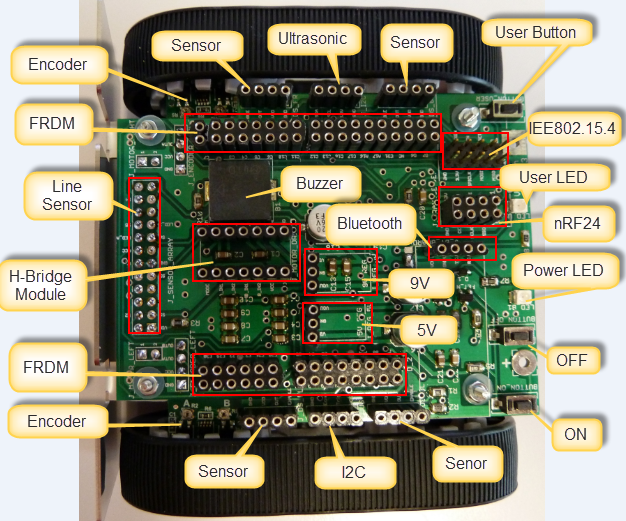
The chassis is designed to hook up the FRDM-KL25Z board from Freescale. It is using parts from Pololu (chassis, motors, DC-DC converter, line sensor, H-Bridge, encoders):

ZumoBaseBoardOverview

Zumo Base Board Overview

Continue reading

Overview of ARM Microcontrollers and Tools

In this semester course, students (and myself too, of course :-)) are building a Mini Sumo Robot. That robot is using the Freescale FRDM-KL25Z board with an ARM Cortex-M0+ on it. Today I’ll give an introduction to the ARM core to the class, and timing is right: this morning I have found an excellent overview about ARM microcontroller and tools written by Jay Carlson.: Getting Started with ARM Microcontrollers.

Continue reading

Zumo Robot Chassis PCB arrived!

Excellent news: I received this week the 40 INTRO Zumo Robot Base/Chassis PCBs, ready to bring the Zumo Robot project based on the FRDM-KL25Z board from Freescale to the next level:

Intro Zumo PCB TopSide

Intro Zumo PCB TopSide

Continue reading