It is one of these long weekends which allow to catch up on many things. One thing I finally completed was the move to FreeRTOS V7.1.1. With this I did some tests using the Tower boards, including the Kinetis one. So I have rebuild my Kinetis K60 application and was ready to flash the device. But then to my surprise I got this dialog:
Category Archives: CPU’s
Bit Banging I2C
The Freescale ColdFire V2 (MCF52259) is a great communication device: an embedded Processor like a Swiss Army Knife: Great peripherals, USB and Ethernet interface, a lot of flash application space and up to 64 KByte of RAM. I’m using that core in many projects, and there is great community support for it with boards and software. Unfortunately Freescale somehow provides Processor Expert support only half way for it. Support for the I2C bus is missing :-(.
Trimming S08 with P&E
Freescale S08 controllers have an internal clock generator (ICG) which allows the device to run without an external clock signal. But as devices differ, they need to be calibrated and trimmed. The microcontrollers are usually trimmed in the factory. How can I trim it myself if I need something better?
USB CDC goes medical
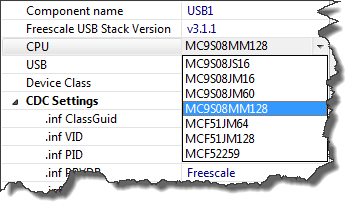
The FSL_USB_Stack Processor Expert component (see USB CDC reloaded) has been extended to support USB CDC for the Freescale S08MM128 targeted for medical devices:
Programming part of flash
In many cases I do a full erase-flash-debug cycle: I get my embedded microcontroller flash completely erased and then programmed with my application. Well, that does not work that way if I program with a bootloader. Yes, I can flash the bootloader and then load my target application with the bootloader, but that’s not the scenario I want to use in the development phase. I want to flash my application and keep the bootloader on the target. This means: I need to do erase and program a part of the memory. But how to do this?
Traps&Pitfalls: Overlapping Interrupt Priorities
It happens to me that I run into a really, really nasty problem. I spend hours (if not weeks) to get it resolved. Strong coffee and the problem keeps me up at long nights. I think every embedded system engineer knows what I’m talking about. Yeah, most of the time it is my fault or an oversight. But once in a while I’m convinced that I have found a real bug. Then I report it back to the vendor to fix it. I hope my report will prevent another engineers to run into the same problem. Or that I learn something else as a by-product. Oh yes….
Copy my Project
I’m using Subversion to keep track of changes in my eclipse MCU10 projects. That allows me to get back in time without the need to make copies of my project. But sometimes I do need to make a copy of my project: because I want to use a project as a base and then do something different with it. To make a copy of a project is simple, but requires some more steps if I’m using Target Tasks. Here is how I do this… Continue reading
Dissection of MCU10 Projects
Creating an eclipse managed make project with MCU10 is easy: Starting the wizard with File > New > Bareboard Project and after a few clicks I have a project. I don’t need to worry about all the files in the project structure, until……..well, until I need to put the files into a VCS.
USB or not: CDC with Processor Expert
I had a PREN student showing up into my office. He wanted to choose a microcontroller for that project. One requirement put on the table was “it needs USB”. Well, I asked why USB is required. I was not surprised by the answer: “to use USB instead of RS-232”. Wow. So what he really wanted was USB CDC (Communication Device Class). Yep. Most notebooks today have no serial COM port (see “Processor Expert Configurations“). But because “USB is serial” does not mean “USB CDC is simple”. Nope. USB is not simple. But it can be with Processor Expert.
Men In Black are back! Flashing and FX’ing…
I have mentioned in MCU10.2 released a new feature in CodeWarrior: support for the USB Universal Multilink FX from P&E Microcomputer Systems. Two Multilink FX arrived last week at the University, and finally I had my hands around it. The first thing which came to my mind when I saw the picture of the device on the P&E website: the black boxes are back!
Can I hope for a “Special FX Edition” in that box with cool sunglasses and a flash stick to erase and reprogram FLASH memory of microcontrollers? That would definitely make the flash erasing and programming easy and fast, as in the movie. 🙂
Continue reading