The good thing with the internet is: it allows engineers to collaborate. And here is an example: Marc is a reader of this blog had a problem with the I2C hardware of a Freescale Kinetis ARM microcontroller. In his case, the I2C bus could be stuck, and there seems no way to reset it with the I2C hardware on the microcontroller. So a solution would be to reset it with software instead.
Tag Archives: software project
Sumo Robots, one Week until Tournament
There is one week left until all the Sumo robots of the Infotronic course at the Lucerne University of Applied Sciences and Arts will enter a tournament. The robots have to pass a simple tests before they can enter the tournament: to push a ‘dummy’ robot outside the ring. This simple test is used at tournaments to avoid ‘passive’ robots just sitting in the middle of the ring ;-).
Sumo Robot with Accelerometer Remote Controller
Usually, there are two flavors of Sumo robot competition:
- Autonomous: no communication to the robot permitted after the start.
- Remote-controlled: there is a wireless remote controller driving the robot.
Just for fun, I have implemented a wireless remote controller application for my Zumo Robot using the Freescale SRB (MC13123) board. I’m using the Freescale MMA7260Q accelerometer on the SRB board to control the robot.
RNet: A Simple Open Source Radio Network Stack
I was searching the internet for an open source network stack for my nRF24L01+ transceivers. But these stacks were either too heavy or had a restrictive or not really non-open source license behind it. I was very reluctant to start with something I think already should exist. Two weeks ago I decided that I just do it from scratch, and here I am: I have the basics working 🙂
Tutorial: Using a Terminal Input and Output; *without* printf() and scanf()
So this tutorial is about using a terminal connection between my board and my host (e.g. a notebook) to read and write text:
FreeRTOS for the Freescale DSC 56F8400 Core
Yes, I have been busy with all the different ARM Cortex Mx cores I’m using in my projects. But beside of the ‘ARM domination of the world’, there are other interesting processors out there. While the ARM cores have added DSP (Digital Signal Processing) capabilities blurring the boundaries between pure MCU and DSP processors, there is still a place (or niche?) for specialized DSP processors. The power of such processors is in the domain of fast signal processing, e.g. for intelligent power switches or for advanced motor control.
Tutorial: Replacing IAR EW with Eclipse IDE
Are you using IAR tools and you are jealous looking at what others can accomplish with Eclipse? You wish you could use your IAR build tools but taking advantage of Eclipse too?
I do not want to start a religious IDE war here ;-). At least for IAR, there is a way to bring both worlds together: having IAR build and debug tools integrated in Eclipse :
IAR ARM v6.7 comes with improved Processor Expert Support
This week I saw on the IAR website that they have released the new IAR Embedded Workbench v6.7 for ARM. I was still on 6.5 using the free code size limited ‘Kickstart’ version), so I thought it would be a good time to upgrade to the v6.7. And there are good reasons as the connection to Processor Expert makes things much easier now.
S-Record Manipulation with GNU objcopy and Burner Utility
In my earlier post “S-Record Generation with gcc for ARM/Kinetis” I documented how to have the ARM GNU gcc toolchain to produce a S19 (Motorola (or now Freescale) S-Record) file. Here are a few more tips on that subject:
- Changing length of S-Records
- Only using 32bit addresses
- Combining S19 files
First Set of nRF24L01+ Wireless Sensor Nodes with FRDM-KL25Z
If you were wondering why I am pushing the FRDM-KL25Z boards hard to the micro-amps, then have a look at this:
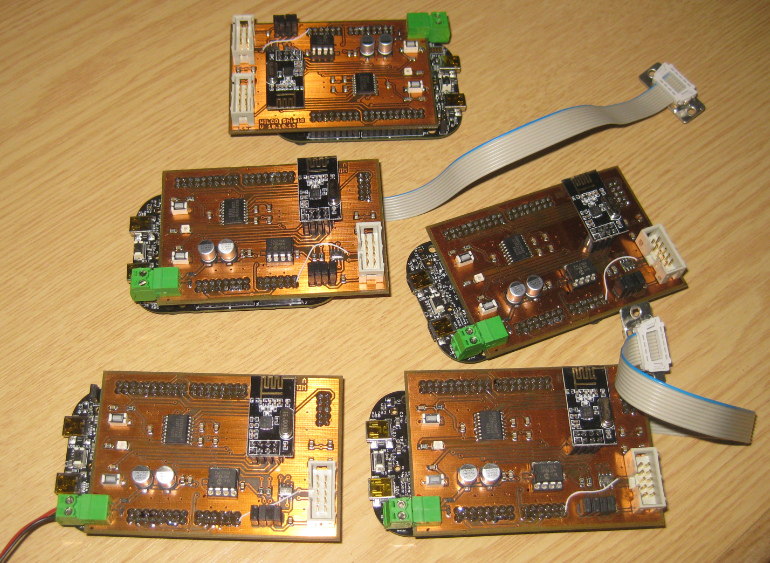
The five boards are the first set of prototypes with a FRDM-KL25Z for a battery operated wireless sensor network based on the nRF24L01+ 2.4GHz transceiver.