Segger just has released their OpenSDAv2 firmware. The OpenSDAv2 firmware is different from the OpenSDAv1 as it is using a different memory map and bootloader. The OpenSDAv2 e.g. is present on the new FRDM-K64F board. The availability of the Segger firmware is definitely good news for any owner of the FRDM-K64F board: so far only the CMSIS-DAP firmware was available (on top of the mbed bootloader). With this, it was not possible to use the board with CodeWarrior, except with using an external P&E Multilink or Segger J-Link. With that new Segger J-Link OpenSDAv2 firmware, I can now use the FRDM-K64F with any IDE which supports the Segger J-Link :-).
Tag Archives: OpenSDA
Binary (and S19) Files for the mbed Bootloader with Eclipse and GNU ARM Eclipse Plugins
The existing OpenSDAv1 (see “OpenSDA on the Freedom KL25Z Board“) bootloader is using the industry standard Motorola S-Record (S19) Files. However, new FRDM-K64F board (see “FTF: FRDM-K64F, Kinetis Design Studio and Kinetis SDK“) has OpenSDAv2 on it, which is an mbed bootloader. So how to create files with an IDE other than mbed for that bootloader which is present on the FRDM-K64F board by default? Well, creating binary files is one thing, but to have it working with the mbed bootloader is another challenge :-(.
DIY Free Toolchain for Kinetis: Part 7 – GNU ARM Eclipse Plugins
Tired by the tool chains provided by your silicon vendor? Do you want to use a free and open tool chain? Then you probably followed by “DIY Free Toolchain” series already. In “DIY Free Toolchain for Kinetis: Part 2 – Eclipse IDE” I used the standard GNU Eclipse plugins. As mentioned in above post, there is an even better and more powerful plugin available: the GNU ARM Eclipse plug-ins. There is a dedicated blog site which provides excellent documentation and direct access to new and frequent releases. And these days there is a true a Christmas gift for every Eclipse lover: the version 1.1.7 with the addition of J-Link debugger plugin :-).
New P&E OpenSDA Firmware v114
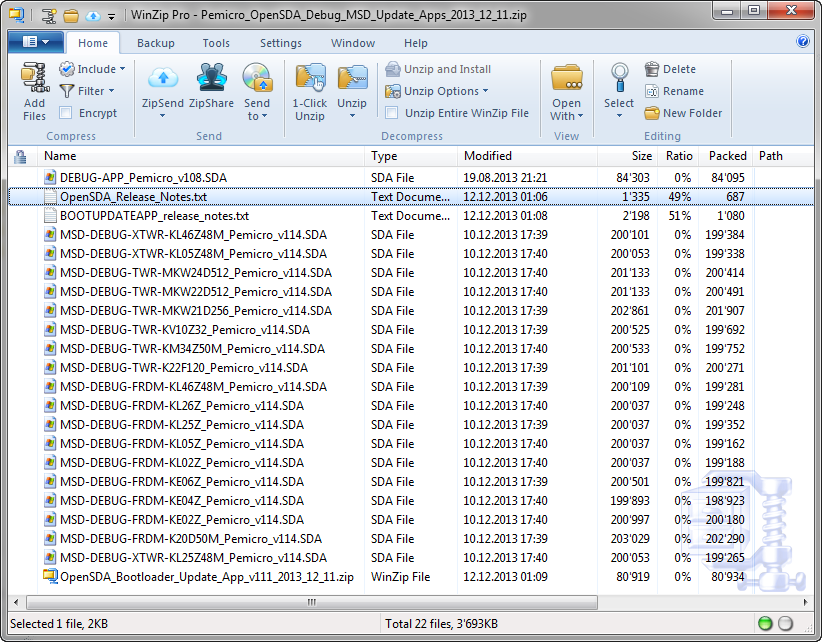
Good news for everyone having Windows 8.1: P&E has released Dec 11th 2013 a new FRDM board firmware which solves the bootloader issue found with Windows 8.1. The new firmware can download from https://www.pemicro.com/opensda/.
Kinetis Unique Identification Register
For my RNet stack I need a way to identify nodes in the network using a unique address. What I need is Media-Access (MAC) address. Base on such a unique address I can assign short addresses (e.g. with a DHCP or similar protocol to automatically assign shorter network addresses). So how to uniquely identify my network nodes?
The Freescale Kinetis microcontroller have nice feature: they have a Unique Identification Register (UID) which would be a perfect fit for a MAC address :-).
Review: ThunderBench with the Freescale FRDM Board and Processor Expert
For the Eclipse and Processor Expert lovers of this world: there is another Eclipse based IDE you can use: ThunderBench made by Emprog:
They support a range of ARM based devices, including the Freescale ones I’m using. So I downloaded the v3.24 30 day trial from their download page last week. Finally I have found some time to try it out. Could this be an alternative to use my Freescale FRDM boards with Processor Expert?
Using the FRDM-KL25Z with CMSIS-DAP to program non-Freescale ARM Microcontrollers
Freescale might not have thought about this: how to use Freescale boards and silicon to develop for non-Freescale silicon? 😉
I tinkered around using the FRDM (e.g. FRDM-KL25Z) board as a general purpose programming or debugging device. See the links to the posts at the end of this article. I have used it to program and debug other Freescale ARM processors. It requires board changes and the usage of a different OpenSDA firmware which has its own limitations (no USB CDC serial bridge). But for about $15-20 I have a device to program my own external boards :-).
If you are using Keil tools, then the good news is: With CMSIS-DAP you can debug any other (even non-Freescale) ARM device as long it is supported by the IDE :mgreen:
FRDM-KL25Z debugging the nRF51422-DK (Source: Keith Wakeham)
Tutorial: Using the FRDM-KL25Z as Low Power Board
The FRDM-KL25Z is a great board: inexpensive (around US$15), small form factor, has easily accessible pins, and has a low power (capable, at least) microcontroller, and comes with an embedded debugging interface. So why not using this board right away ‘as is’ for a low power battery operated device? Great idea, you think? Yes, I thought too. Only to find out that the board needs 20 mA out of the box.
The good news is: It is possible on a week-end to get this 150 times better down to 132 μA, with an RTOS running all the time :-). I invite you to join a journey with board modifications, jumpers, schematics and many multi-meter pictures ;-)….
FRDM Board Bootloader fails with Windows 8.1 Preview
Microsoft has released the Windows 8.1 Preview. So you can try out the next update of Windows 8. In short: Do NOT use Windows 8.1 Preview if you are using a Freescale FRDM board! Otherwise you will not be able to change the OpenSDA firmware (MSD or debug application).
❗ Update: P&E has released a new firmware v114 which combines USB CDC, MSD bootloader and debug application, and this firmware fixes the issue described in this post.
Well, I have not used it personally: I never use ‘test’ or ‘preview’ versions on my ‘production’ machine. It is ok to try things out on separate ‘scratch’ machines, but not on something I need to have stable for my work. Well, some of the students in my INTRO class were not able to resist and downloaded and installed Windows 8.1 Preview on their machines. With the result that the OpenSDA Bootloader does not work with Windows 8.1 Preview:
❗ It seems that the problem exists as well with the Windows 8.1 ‘final’ release.
FRDM Board not responding? Check your Virus Scanner!
In case you have this problem with the FRDM boards: You are using the FRDM bootloader mode (it shows up as BOOTLOADER) or the MSD mode (e.g. it shows up as FRDM-KL25Z) (see OpenSDA on the Freedom KL25Z Board) and it does not respond any more, or does not work as expected, then read on…