GNU Code Coverage on Embedded Target with Eclipse Neon and ARM gcc 5

For a research project, we are going to send a satellite with an embedded ARM Cortex microcontroller into space early next year. Naturally, it has to work the first time. As part of all the ESA paperwork, we have to prove that we tested the hardware and software thoroughly. One piece of the that is to collect and give test coverage evidence. And there is no need for expensive tools: Free-of-charge Eclipse and GNU tools can do the job for a space mission πŸ™‚

Eclipse with Coverage Views

Eclipse with Coverage Views

Continue reading

Adding GNU Coverage Tools to Eclipse

The GNU tools include powerful utilities to collect coverage information. With coverage I know which lines of my code have been executed, which is a very useful test metric. The GNU coverage tools are commonly used for Linux applications. But to my surprise not much for embedded application development, mostly because it requires a few extra steps to have it available? Why not using free and powerful tools for improving software quality? This article explains how to install the GNU gcov tools into the Eclipse IDE.

gcov with Embedded Target

gcov with Embedded Target

Continue reading

MCUXpresso IDE: Blinky the NXP LPC800-DIP Board

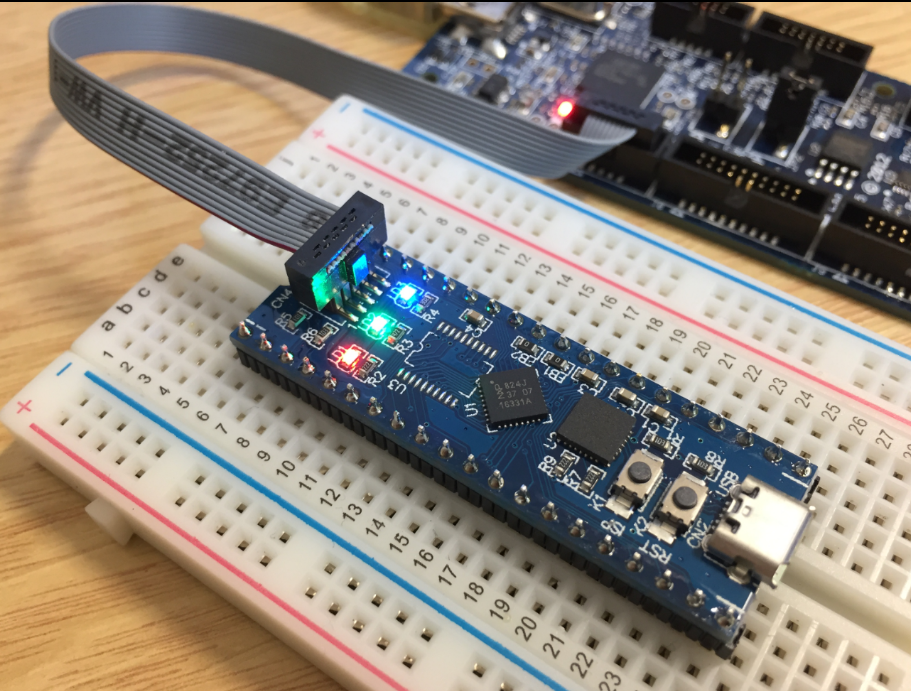
During Embedded World 2017 in NΓΌrnberg I was lucky to get a handful LPC800-DIP boards. To get all students who were lucky to get one, here is a tutorial to make that very exciting ‘blinky’ application on that board:

Blinky on the NXP LPC800-DIP

Blinky on the NXP LPC800-DIP

Continue reading

Tutorial: Secure TLS Communication with MQTT using mbedTLS on top of lwip

One of the most important aspects of the ‘IoT’ world is having a secure communication. Running MQTT on lwip (see “MQTT with lwip and NXP FRDM-K64F Board“) is no exception. Despite of the popularity of MQTT and lwip, I have not been able to find an example using a secure TLS connection over raw/native lwip TCP :-(. Could it be that such an example exists, and I have not found it? Or that someone implemented it, but has not published it? Only what I have found on the internet are many others asking for the same kind of thing “running MQTT on lwip with TLS”, but there was no answer? So I have to answer my question, which seems to be a good thing anyway: I can learn new things the hard way :-).

Blockdiagram MQTT Application with TLS using lwip

Block diagram MQTT Application with TLS using lwip

Continue reading

MQTT with lwip and NXP FRDM-K64F Board

In the area of IoT (Internet of Things), one obvious need is to have a way to send and receive data with an internet protocol. MQTT (or Message Queue Telemetry Transport) is exactly like that: a light-weight Machine-to-Machine communication protocol. With the MQTT protocol a microcontroller (or ‘client’) can send data and/or subscribe to data. For example to the Adafruit.IO:

Adafruit MQTT IO Feed

Adafruit MQTT IO Feed

Continue reading

MCUXpresso IDE: Installing Processor Expert into Eclipse Neon

In “MCUXpresso IDE: Importing Kinetis Design Studio Projects” I explained how Kinetis Design Studio projects can be imported and used inside the MCUXpresso IDE. Processor Expert projects can be used, but no new components added, modified or new Processor Expert projects created. To fully use Processor Expert, two plugins need to installed, and this is what this article is about.

Processor Expert in MCUXpresso IDE

Processor Expert in MCUXpresso IDE

Continue reading

MCUXpresso IDE: Importing Kinetis Design Studio Projects

Many of my currently active projects are using Kinetis Design Studio (KDS) V3.2.0 from NXP (I have published many of my projects on GitHub). Now with the advent of the MCUXpresso IDE (see “MCUXpresso IDE: Unified Eclipse IDE for NXPs ARM Cortex-M Microcontrollers“), I have migrated several projects from KDS to MCUXpresso. This post is about how to easily get KDS projects ported and running in MCUXpresso IDE.

Debugging KDS Project in MCUXpresso IDE

Debugging KDS Project in MCUXpresso IDE

Continue reading

The Influence of Software and Tools on ARM Cortex-M Microcontroller Vendor Selection

For me, the available software and tools are the primary key decision factor why I select a particular silicon vendor. Without good software and tools, a microcontroller only ‘sand in plastic case’, even if it is the best microcontroller in the world. I do have several probably excellent microcontroller boards, and they are only getting touched by more durst over the months and years.

Undusted LPC824 Board

Undusted LPC824 Board

Continue reading

MCUXpresso IDE: Unified Eclipse IDE for NXPs ARM Cortex-M Microcontrollers

There are many mergers going on in the industry, and one of the largest one was in 2016 the integration of Freescale Semiconductor with NXP Semiconductors, with both providing Eclipse based IDE’s to their customer base. Consequently, the company merger triggered a merger of the IDE’s, and last week NXP has released the result: the MCUXpresso IDE.

MCUXpresso IDE

MCUXpresso IDE

Continue reading

Tutorial: Using Eclipse with NXP MCUXpresso SDK v2 and Processor Expert

To me, software and tools are by far more important than the microcontroller. Because the silicon is a ‘one time kind of thing’, where the software has to be maintained and working over a longer time. And at least my software usually needs to be ported to a new device, so portability and available software and tools are critical to me.

The combination of MCUXpresso SDK (formerly Kinetis SDK) and Processor Expert is unfortunately not supported by NXP. But I have found a way to get them work together in a nice way, and this article is about making that combination possible :-).

SDKv2 Project with Processor Expert

SDKv2 Project with Processor Expert which is supposed not to work together

Continue reading