Sumo Robots, Sensors and everything else….

The semester is approaching its end, and students are making great progress: with added infrared and ultrasonic sensors, the robots are able to detect the other robot (more or less 😉 ). Additionally the RNet stack adds extra remote control capabilities.

Zumo Sumo Battle

Zumo Sumo Battle

Things are very much in the testing phase, and some robot (or operator?) failures are really funny 🙂 For sure much more advanced moves compared to previous week. Including extra benefits like a robot bringing a bottle of water! The following video hopefully gives an impression:

Happy Roboting 🙂

Sumo Robot with Accelerometer Remote Controller

Usually, there are two flavors of Sumo robot competition:

  1. Autonomous: no communication to the robot permitted after the start.
  2. Remote-controlled: there is a wireless remote controller driving the robot.

Just for fun, I have implemented a wireless remote controller application for my Zumo Robot using the Freescale SRB (MC13123) board. I’m using the Freescale MMA7260Q accelerometer on the SRB board to control the robot.

Accelerometer Remote Controller

Accelerometer Remote Controller

Continue reading

IEEE802.15.4 for the Zumo Robot

For the INTRO Zumo robot I have three wireless options: Bluetooth, nRF24L01+ and IEEE802.15.4 with the Freescale MC1320x transceiver. For the nRF24L01+ I have developed a simple radio network stack which I can use with the MC1320x transceiver too.

MC1320x and MC13213 SRB Board

MC1320x and MC13213 SRB Board

Continue reading

Sumo Robot Battle Tips

The INTRO course is progressing fast, with a lot of information passed on how to build a successful mini Sumo robot based on the Freescale FRDM-KL25Z and a modified Pololu Zumo chassis. The PID control loop implementation for speed and position finally starts to work properly with the help of FreeMaster. Things are not perfect yet, but the robots get better from day-to-day.

Zumo Test Battle

Zumo Test Battle

Continue reading

RNet: A Simple Open Source Radio Network Stack

I was searching the internet for an open source network stack for my nRF24L01+ transceivers. But these stacks were either too heavy or had a restrictive or not really non-open source license behind it. I was very reluctant to start with something I think already should exist. Two weeks ago I decided that I just do it from scratch, and here I am: I have the basics working 🙂

Two FRDM-KL25Z with nRF24L01+ Transceivers

Two FRDM-KL25Z with nRF24L01+ Transceivers

Continue reading

Tutorial: Using a Terminal Input and Output; *without* printf() and scanf()

So this tutorial is about using a terminal connection between my board and my host (e.g. a notebook) to read and write text:

Color Text in PuTTY

Color Text in PuTTY

Continue reading

Tutorial: Replacing IAR EW with Eclipse IDE

Are you using IAR tools and you are jealous looking at what others can accomplish with Eclipse? You wish you could use your IAR build tools but taking advantage of Eclipse too?

I do not want to start a religious IDE war here ;-). At least for IAR, there is a way to bring both worlds together: having IAR build and debug tools integrated in Eclipse :mrgreen: :

Using IAR Tools In Eclipse

Using IAR Compiler and Debugger in Eclipse

Continue reading

Review: ThunderBench with the Freescale FRDM Board and Processor Expert

For the Eclipse and Processor Expert lovers of this world: there is another Eclipse based IDE you can use: ThunderBench made by Emprog:

ThunderBench for ARM Eclipse Startup Screen

ThunderBench for ARM Eclipse Startup Screen

They support a range of ARM based devices, including the Freescale ones I’m using. So I downloaded the v3.24 30 day trial from their download page last week. Finally I have found some time to try it out. Could this be an alternative to use my Freescale FRDM boards with Processor Expert?

Continue reading

First Set of nRF24L01+ Wireless Sensor Nodes with FRDM-KL25Z

If you were wondering why I am pushing the FRDM-KL25Z boards hard to the micro-amps, then have a look at this:

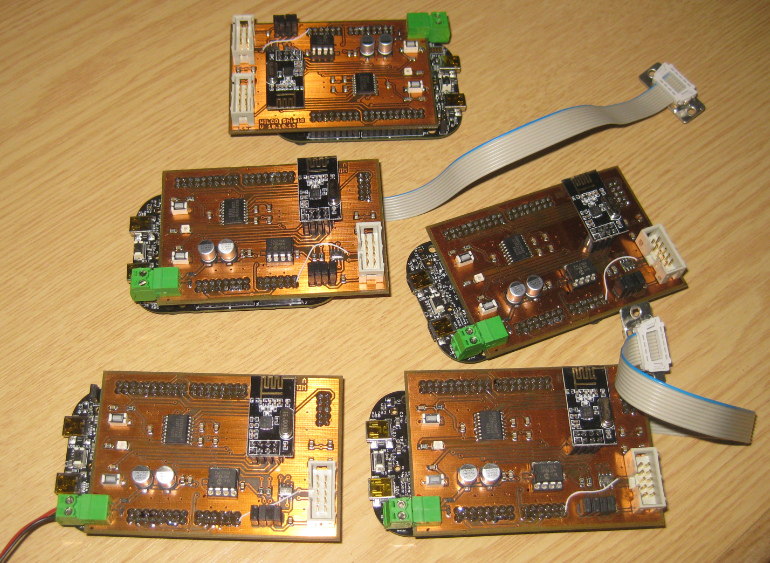
nRF24L01+ Network Nodes

nRF24L01+ Network Nodes

The five boards are the first set of prototypes with a FRDM-KL25Z for a battery operated wireless sensor network based on the nRF24L01+ 2.4GHz transceiver.

Continue reading

Using the FRDM-KL25Z with CMSIS-DAP to program non-Freescale ARM Microcontrollers

Freescale might not have thought about this: how to use Freescale boards and silicon to develop for non-Freescale silicon? 😉

I tinkered around using the FRDM (e.g. FRDM-KL25Z) board as a general purpose programming or debugging device. See the links to the posts at the end of this article. I have used it to program and debug other Freescale ARM processors. It requires board changes and the usage of a different OpenSDA firmware which has its own limitations (no USB CDC serial bridge). But for about $15-20 I have a device to program my own external boards :-).

If you are using Keil tools, then the good news is: With CMSIS-DAP you can debug any other (even non-Freescale) ARM device as long it is supported by the IDE :mgreen:

FRDM-KL25Z debugging the nRF51422-DK (Source: Keith Wakeham)

FRDM-KL25Z debugging the nRF51422-DK (Source: Keith Wakeham)

Continue reading