McuOnEclipse Components: 08-Nov-2015 Release

Time is flying fast, time for another McuOnEclipse components release on SourceForge with the following main changes and features:

  1. New component for Segger RTT makes adding a console communication interface super easy (and fast!)
  2. RTT support for the command line Shell component
  3. RTT component used for Percepio FreeRTOS Tracing
  4. Updated USB component, support for USB CDC blocking/waiting and endpoint configuration
  5. Updated FreeRTOS to V8.2.3, memory heap selection improved and setting for time slicing
  6. RingBuffer implements a Delete() method
  7. Extended Kinetis SDK support in components, added by default
Segger RTT Console
Segger RTT Console

Continue reading

Aligning S19 Records to 64-bit Boundaries

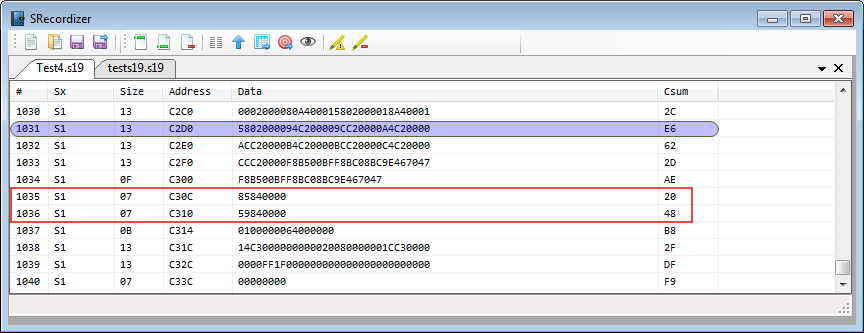
Many tool chains and linker are able to produce S19 files, such as with the GNU tools it is the ‘objcopy‘ which does this job (see “Binary (and S19) Files for the mbed Bootloader with Eclipse and GNU ARM Eclipse Plugins“). But these tools usually cannot handle the special cases. For example on the Freescale Kinetis K64F my serial bootloader (see “Serial Bootloader for the Freedom Board with Processor Expert“) had a problem with these lines in the S19 file:

Not aligned S19 file entries

Not aligned S19 file entries

Continue reading

Programming Kinetis with CodeWarrior from the DOS Shell

In “CodeWarrior Flash Programming from a DOS Shell” I showed how to program a device from the DOS shell. Because that example was for ColdFire and CodeWarrior for MCU10.2, here is the same for a Kinetis (FRDM-KL25Z) and CodeWarrior for MCU10.6. In my workspace (c:\tmp\wsp_10.6) I have a project folder (FRDM-KL25Z).

I’m using the ‘Flash Programmer’ to sneak the needed commands:

Sneaking Commands from Flasher

Sneaking Commands from Flasher

Continue reading

Overview: From Snippets to Code Generation

To build an application for a modern microcontroller today is not a simple thing. Well, it depends what ‘simple’ means. But compared to the ‘old days of 8bit micro controllers’ (which are still in use!) developing for a complex 32bit device is definitely a different thing. Not only the complexity has changed, but as well the breath of tools and helpers. In my view, the only constant is ‘change’, and I have changed the way how to develop several times in my career. In this post I present several different techniques I’m using in my development.

Processor Expert CPU View

Processor Expert CPU View

Continue reading

Improve Eclipse Performance with Increased Heap Size

I noticed that especially working with several projects in my workspace, Eclipse got sluggish and slowly responding. I have in Eclipse the Heap Monitor/Status enabled (see “Show Heap Status in Eclipse“):

Heap Status at the Limit

Heap Status at the Limit

So the used heap of the Java VM is hitting a limit of about 500 MByte, and seems to be trashing around? How to increase that heap size?

Continue reading

McuOnEclipse Components: 05-July-2015 Release

I know: A new McuOnEclipse Processor Expert components release was long overdue. But I have been extremely busy in the last months, but now the university semester is over, and I have finally some spare time to catch up on a lot of things. So here we go: there is a new component release available on SourceForge (https://sourceforge.net/projects/mcuoneclipse/files/PEx%20Components/): Components 2015-07-05.zip

McuOneEclipse Components on SourceForge

McuOneEclipse Components on SourceForge

Continue reading

Editing Compiler Include (or other) Settings in Eclipse

So now I have carefully set up my compiler include paths in Eclipse to tell the GNU compiler where to find my header files:

Include Paths

Include Paths

The question is: how can I apply these settings to another project?

Continue reading

CRC Checksum Generation with ‘SRecord’ Tools for GNU and Eclipse

One of the things missing for Embedded in the GNU linker is that it cannot generate a CRC checksum. Luckily, there is the solution of using SRecord:

SRecord 1.64 Web Page
Continue reading

Solving the 8192 Character Command Line Limit on Windows

There is a really annoying issue with using command line tools on Windows: the maximum length of the command line passed to cmd.exe is 8192 characters (see http://blogs.msdn.com/b/oldnewthing/archive/2003/12/10/56028.aspx). So you think this is not a problem for you, as you would not pass such a long command line to cmd.exe (the DOS shell under Windows)? Well, if you are using Eclipse (as I do) which generates make files (which is the normal way), then the cmd.exe very likely is involved to call the compiler/linker/etc, indirectly with the usage of make.exe. Compiling files is usually not a problem as it does not hit that 8192 limit. However, it is likely that link phase will end up with an error:

Error in the Problems View

Error in the Problems View

If you have such a problem, there is a solution ….

Continue reading

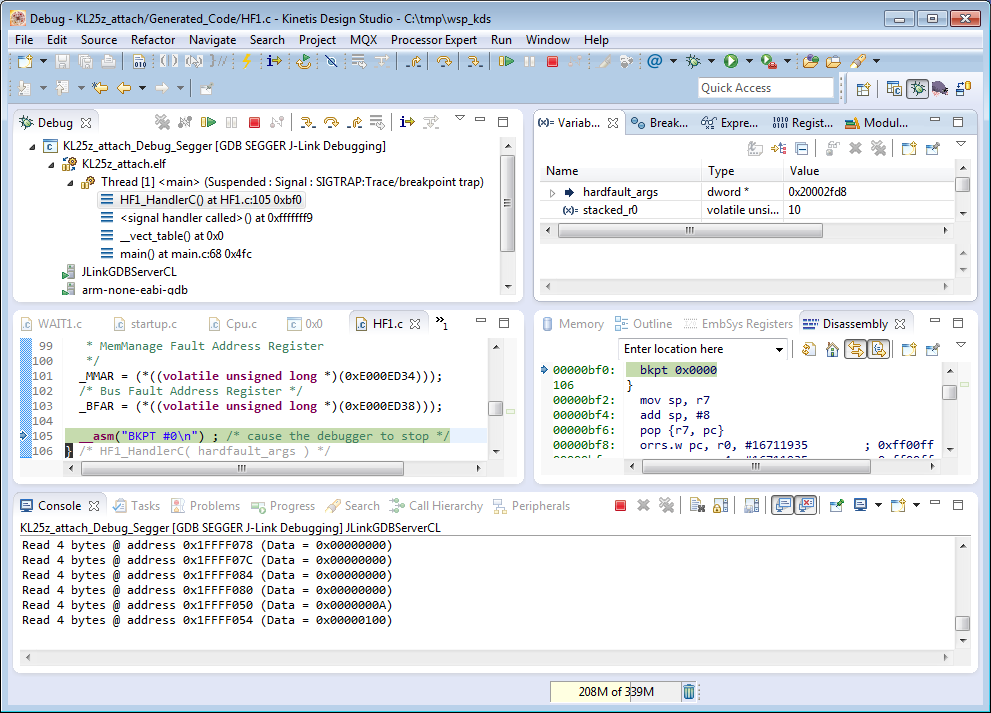
Attaching to a Running Target with Segger J-Link, GDB and Eclipse

This happens several times for me: I have a board running for a while (even for days), and then it crashes or is stuck somewhere. Yes, I usually use a watchdog do recover from that situation. But it would be good to know and debug the problem. With CodeWarrior I had the functionality in the debugger to ‘attach’ or ‘connect’ to a running (stuck/crashed) board. However, with Eclipse/Kinetis Design Studio/GDB this is a different debugger, and not possible. At connection time with the debugger the target does a reset, so I don’t know any more where the application crashed. But now I have a solution, at least with the Segger GDB :-).

Debug Hard Fault Attached Target

Debug Hard Fault Attached Target

Continue reading