Measuring ARM Cortex-M CPU Cycles Spent with the MCUXpresso Eclipse Registers View

The ARM DWT (Data Watchpoint and Trace) is an optional feature of the ARM-Cortex-M, and many Cortex-M3, M4 and M7 devices have it implemented. With it comes a cycle counter which counts the cycles spent. In Cycle Counting on ARM Cortex-M with DWT I described an approach how the application on the target can access the cycle counter.

The MCUXpresso IDE shows that cycle counter in the Eclipse Registers view:
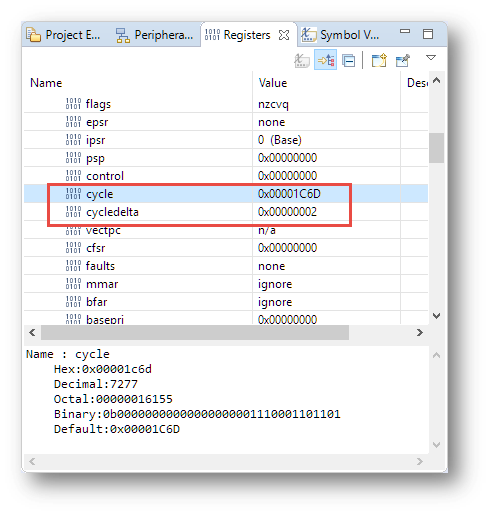
Cycle Counter in Register View

Cycle Counter in Register View

Continue reading

GNU Link Time Optimization finds non-matching Declarations

By default, the GNU compiler (gcc) optimizes each compilation unit (source file) separately. This is effective, but misses the opportunity to optimize across compilation units. Here is where the Link Time Optimization (LTO,  option -flto) can help out: with a global view it can optimize one step further.

The other positive side effect is that the linker can flag possible issues like the one below which are not visible to the compiler alone:

type of '__SP_INIT' does not match original declaration [enabled by default]
Warning by LTO

Warning by LTO

Continue reading

Understanding FreeRTOS Task Stack Usage and Kernel Awareness Information

When using the FreeRTOS Task List in the Eclipse based MCUXpresso IDE, it shows the list of tasks with their stack size used. But with the default FreeRTOS settings it is not able to determine the correct stack size and shows a warning icon:

Warning for Stack Usage

Warning for Stack Usage

Continue reading

Overview of MCUXpresso IDE v10.2.0

Decisions, decisions! Such long weekends like Pentecost are a real challenge for a family with engineers:

  1. Should we join that record long traffic jam to Italy and be stuck for more than 4 hours and analyze it?
  2. Or: should we stay home, turn the BBQ smoker engine on fire, load it with baby back pork rib racks for a slow-and-low smoke treatment, while doing some on-the-side IDE and technology exploration?

Well, my family vote was kind of clear: they have chosen that second option. Not to mention that hidden technology piece in it, but that was part of the deal ;-).

And I’m sorry: this article is not about BBQ (for this see “Smoking BBQ Baby Back Ribs – Swiss Style“), it is about technology: I’m using the NXP MCUXpresso IDE and tools for many of my projects (see “Eclipse MCUXpresso IDE 10.1 with integrated MCUXpresso Configuration Tools“). Right before the this extended weekend, NXP has released the new v10.2.0 version, so here is where that technology exploration piece comes into play. Checking the release notes, this version number change includes so many cool stuff I decided to have a look and to check it out. Of course always having an electronic eye on the baby back ribs!

MCUXpresso IDE v10.2.0

MCUXpresso IDE v10.2.0

Continue reading

Debugging ARM Cores with IP based Debug Probes and Eclipse

Using IP (Ethernet) based debug probes is a very handy thing: I don’t have to be directly connected to the debug probe (e.g. with the USB cable). This article explains how to use an IP-based Segger or P&E probe with the Eclipse based MCUXpresso IDE.

LAN Based Debugging

LAN Based Debugging

Continue reading

Recovering OpenSDA Boards with Windows 10

Windows 8 and 10 have added a ‘feature’ to scan and index devices attached to the host machine. This means that bootloaders or MSD (Mass Storage Device) programming implementations on evaluation boards developed in the Windows 7 age might not be prepared for that. Up to the point that it can impact the bootloader as outlined in “Bricking and Recovering OpenSDA Boards in Windows 8 and 10“. So far one of the easiest way to get out that situation was to use a Windows 7 machine. But if you only have a Windows 10 machine available, this article describes the needed steps to update the bootloader with Windows 10 host machines.

OpenSDA LED

OpenSDA LED

Continue reading

Listing Code and Data Size with GNU nm in Eclipse

The map file produced by the GNU linker includes lots of information, however it is very cryptic to read. In “Listing Code and Data Size for each Source File with GNU and Eclipse” I showed how the GNU size utility can be used to report the code and data size for each object file. The Eclipse based MCUXpresso IDE comes with another nice view which shows detailed information about code and data allocation:

Symbol Viewer in MCUXpresso IDE

Symbol Viewer in MCUXpresso IDE

Continue reading

Tutorial: CRC32 Checksum with the KBOOT Bootloader

In “Flash-Resident USB-HID Bootloader with the NXP Kinetis K22 Microcontroller” I presented how I’m using the tinyK22 (or FRDM-K22F) with a flash resident USB HID bootloader. To make sure that the loaded application is not corrupted somehow, it is important to verify it with a Cyclic redundancy Checksum (CRC). The NXP KBOOT Bootloader can verify such a CRC, but how to generate one and how to use it is not really obvious (at least to me), so this article explains how to generate that CRC.

CRC Values for KBOOT

CRC Values for KBOOT

Continue reading

Flash-Resident USB-HID Bootloader with the NXP Kinetis K22 Microcontroller

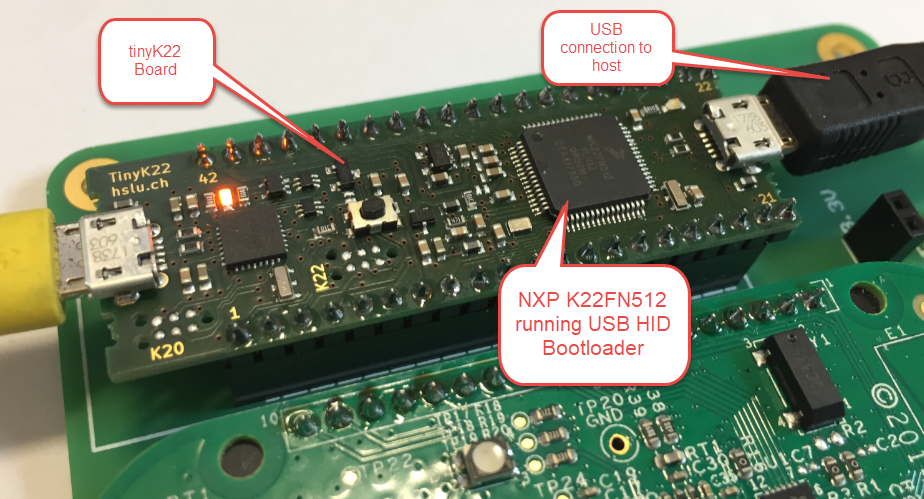
The tinyK22 board (see “tinyK22 Boards arrived“) gets rolled out at the Lucerne University of Applied Sciences and Arts, so I thought I write-up an article this weekend how to use that board with a Flash Resident Bootloader.

tinyK22 with USB HID Bootloader

tinyK22 with USB HID Bootloader

Continue reading