Semihosting (again!) with NXP Kinetis SDK V2.0

I kind of hoped that after “Why I don’t like printf()” and all my other articles about printf and semihosting, that topic would be 200% handled and I won’t have to deal with any more. Well, I was wrong and underestimated how the Kinetis SDK is interfering with semihosting. And I underestimated how many of my readers are still using semihosting (even as there are other and better alternatives), so I keep getting questions and requests for help. That’s ok, and I hope I can help :-).

So here is yet again another post about how to turn on semihosting with Eclipse, GNU ARM Embedded and the Kinetis SDK v2.0. This time with the FRDM-K64F board:

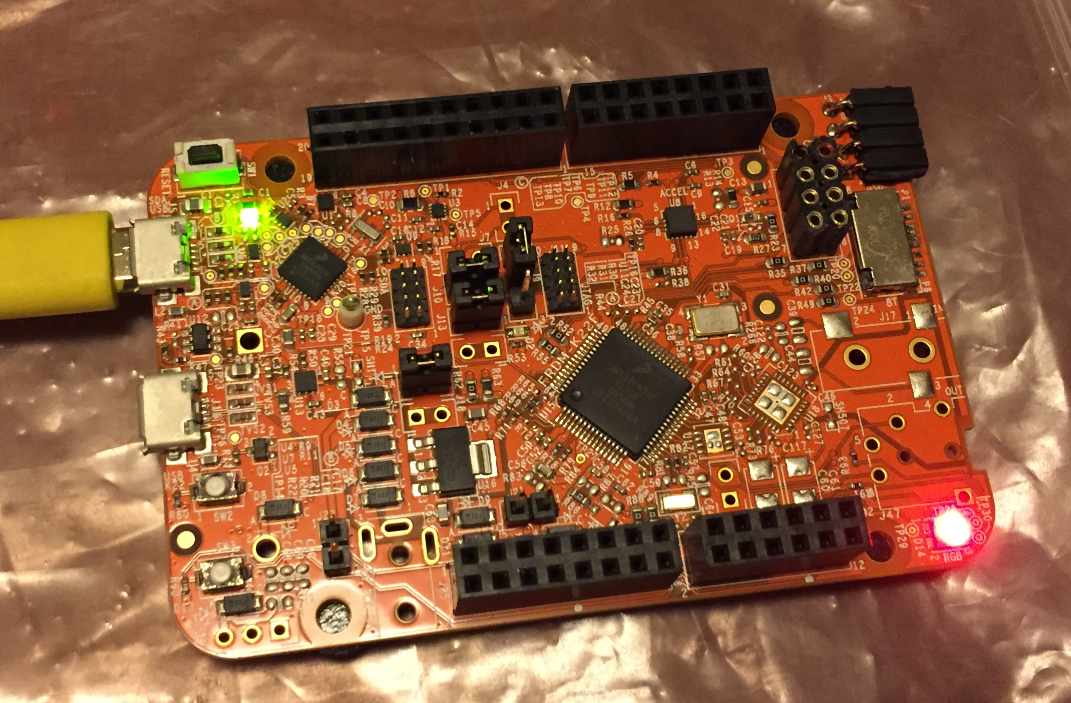
FRDM-K64F Board with lwIP running

FRDM-K64F Board

Continue reading

Hexiwear: Teardown of the Hackable ‘Do-Anything’ Device

Smartwatches are around for a while now. To me it is still questionable how useful the ‘big’ ones for iOS and Android are. But there are definitely the crowd funded smartwatch projects which caught my attention. Maybe it is about the ‘do-anything’ with connectivity?  One of these gadgets is Hexiwear: a hackable open source device

Hexiwear Device

Hexiwear Device

While it *could* be a kind of smartwatch, the value of this thing is more that it includes a plethora of sensors with two microcontroller, and I can use Eclipse with GNU tools to build my firmware :-).

Alert: Hackster.io is giving away 100 Hexiwears, but you need to hurry up (submission until July 15th 2016)!

Continue reading

First steps: ARM Cortex-M7 and FreeRTOS on NXP TWR-KV58F220M

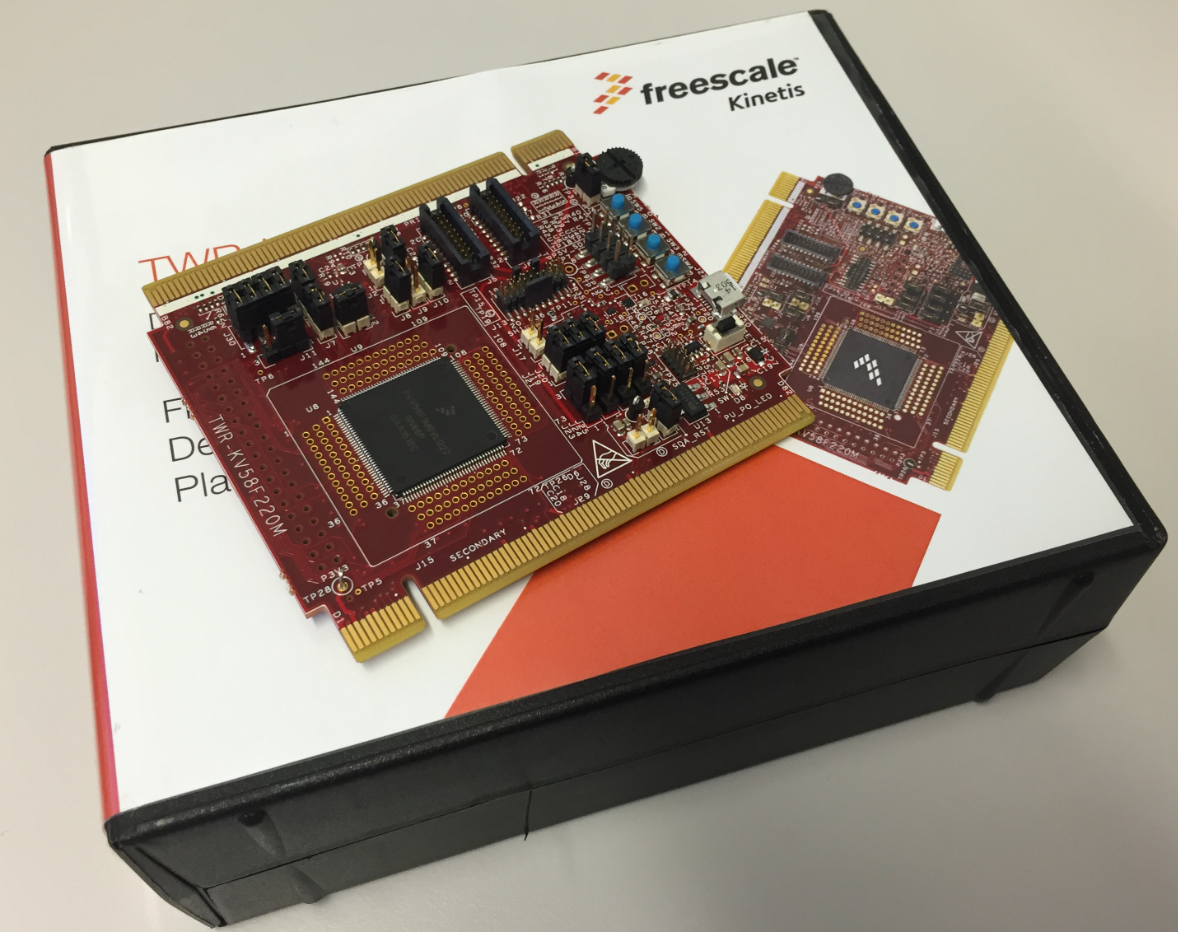
For a university research project I need a fast microcontroller with lots of RAM and FLASH memory. I have ordered a TWR-KV58F220M board from NXP which arrived yesterday. The special thing is that it has on of these new ARM Cortex-M7F on it:

TWR-KV58F220M Box

TWR-KV58F220M Box

Continue reading

Combining Multiple NXP Kinetis SDKs into One

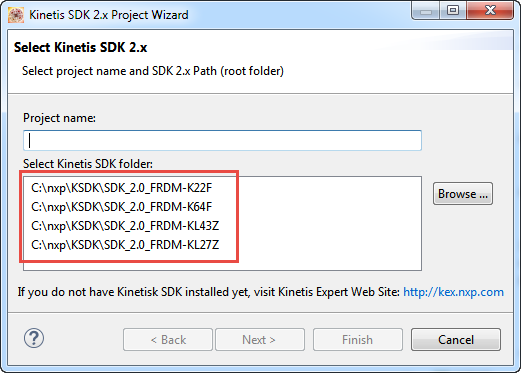
My wife tells me that I have too many boards on my desk. That is only *partially* correct: there are many, but not *too* many. But I’m working on too many tasks, but that’s a different aspect :-). I’m using more and more the Kinetis SDK V2.0, and as a result of this I have multiple SDKs installed on my machine. Because with the SDK V2.0 I get a download for each device/board installed (see “First NXP Kinetis SDK Release: SDK V2.0 with Online On-Demand Package Builder“). So my list of SDK folders is growing, as shown with the ‘New SDK 2.x’ wizard in Kinetis Design Studio:

Multiple Kinetis SDKs

Multiple Kinetis SDKs

The same time, the amount of free disk space is reducing. What if I could combine all these SDK’s?

Continue reading

McuOnEclipse Components: 29-May-2016 Release

Major changes in this new release:

  • FreeRTOS V9.0.0 with static memory allocation.
  • Shell with single character I/O function.
  • FatFS File System with extra shell commands for memory dump and file creation.
  • Segger SystemViewer library updated to V2.36a
Segger SystemViewer V2.36a

Segger SystemViewer V2.36a

Continue reading

FreeRTOS V9.0.0 with Static Memory Allocation

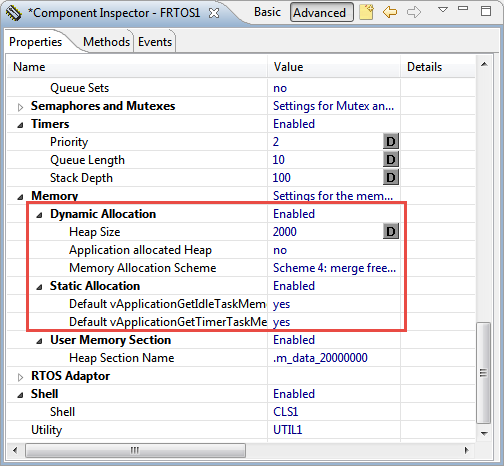
I’m using FreeRTOS in most of my applications. There were only a few exceptions where an RTOS has to be used in safety critical systems: there usually it is not permitted to use any dynamic memory allocation because this adds the risk that a memory allocation could fail at runtime because of memory fragmentation or memory leak. And FreeRTOS uses a dynamic memory (heap) for the task stacks and the RTOS resources including semaphore, mutex and queues.

This is now a thing of the past. This week a new FreeRTOS Version 9 was released which does not need any dynamic memory allocation anymore: it is possible now to build completely statically allocated systems with FreeRTOS :-).

Dynamic and Static Memory Allocation in FreeRTOS V9.0.0

Dynamic and Static Memory Allocation in FreeRTOS V9.0.0

Continue reading

NXP FlexIO Generator for the WS2812B LED Stripe Protocol

The challenge with the selection of a microcontroller for a project is: which one has the required number of UART, I2C, SPI? Combine this with the desired package (48pins, 64pins? LQFN?), the needed FLASH and RAM size and then even the hundreds of available microcontroller shrink to a handful only. And many times I need to make compromises: such as I need two hardware I2C, but the microcontroller matching all my other needs has only one I2C hardware. So I might end up with bit-banging the slower I2C bus. Doable, but not ideal.

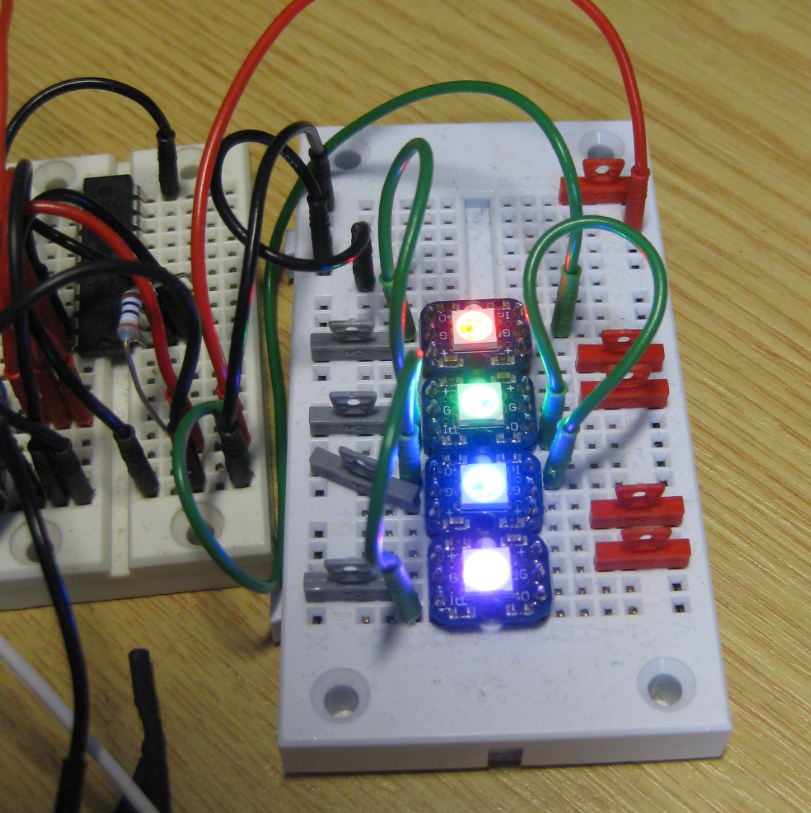
What is cool that some of the newer NXP Kinetis microcontroller come with an interesting hardware: FlexIO. A peripheral hardware which allows me to implement a custom protocol, including driving WS2812B (Adafruit NeoPixel) LEDs with a FRDM-KL43Z board:

Four NeoPixels with FlexIO

Four NeoPixels with FlexIO

Continue reading

Tutorial: FreeRTOS with NXP Kinetis SDK V2.0 and Processor Expert

In “Tutorial: Blinky with NXP Kinetis SDK V2.0 and Processor Expert” I used Processor Expert components with the NXP Kinetis SDK to blink some LEDs. This tutorial extends the earlier project and adds FreeRTOS.

FreeRTOS running on a NXP FRDM-K22F Board

FreeRTOS running on a NXP FRDM-K22F Board

Continue reading

Tutorial: Blinky with NXP Kinetis SDK V2.0 and Processor Expert

In “Mother of Components: Processor Expert with NXP Kinetis SDK V2.0 Projects” I presented an approach how to use Processor Expert components with the NXP Kinetis SDK. This article is a tutorial how to create a blinking LED project with that approach, using McuOnEclipse Processor Expert components and the Kinetis SDK V2.0. As board the FRDM-K22F is used:

Blinky on a FRDM-K22F with SDK V2.0 and Processor Expert

Blinky on a FRDM-K22F with SDK V2.0 and Processor Expert

Continue reading