Tutorial: Arduino Motor/Stepper/Servo Shield – Part 3: 74HCT595 Shift Register

For many projects, I have one common problem: I run out of I/O pins on my microcontroller :-(. Luckily, I’m not alone, and the industry has created solutions for this kind of problems. One is to use a shift register as the 74HCT595/SN74HC595 which gives me 8 extra output pins. All what I need to spend are are 3 GPIO pins. Not a bad deal: I spend 3 pins and I get 8 (or multiple of it) on return :-).

So why do I say this for this Arduino Motor/Stepper/Servo Shield tutorial? I have asked in this earlier post with a poll for the next topic (relais, motor or command line interface). Right now votes are mostly for relay. But before I can do relay (or DC motor), I need to first cover the 74HCT559. So here we go to have you ready for the next tutorial 🙂

Arduino Motor Shield

Arduino Motor Shield with 74HC595

Continue reading

Bricking and Recovering FRDM-KL25Z Boards: Reset, SWD Clock and Low Power

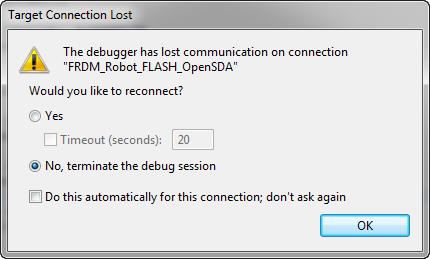
I’m working with a student on building a small autonomous robot platform, based on the FRDM-KL25Z board. We integrated new software modules, compiled and linked, and then downloaded the application to the board. While debugging and stepping through the application startup, I had this:

The Debugger has lost communication on connection

The Debugger has lost communication on connection

Outsch! That’s not good. Even worse, trying to connect again to the board failed :-(. What happened?

Continue reading

Adding Quadrature Encoder to the Zumo Chassis

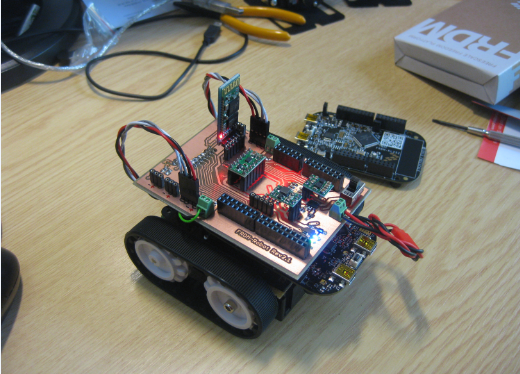
The Pololu Zumo chassis is nearly perfect for my needs: it is small and compact, and neatly works with the FRDM-KL25Z board. I’m able to use it for line following or maze solving. But it lacks a position (quadrature) encoder on the wheels which is either very useful or even required for the lecture assignments for my next class. The Pololu Zumo chassis mainly has been designed for Robot-Sumo competitions, where such quadrature sensors are not really needed. Pololu offers optical quadrature sensors for their 42×19 mm wheel which I used in this project. So why not adding these sensors to the Zumo chassis?

FRDM-Robot with Quadrature Sensors Mounted

FRDM-Robot with Quadrature Sensors Mounted

Continue reading

Eclipse Problems View: Only Show Problems for Project

Having many projects open the same time, and working on them in parallel is a challenge. Ok, the human brain is not built for multitasking, but I still try ;-). What I typically I end up in my Eclipse Problems View to have entries from multiple projects mixed up:

Problems View with Entries for multiple Projects

Problems View with Entries for multiple Projects

How to show it that I can fix the problems for ony project only, and not showing all problems from all projects?

Continue reading

Traps and Pitfalls: No Hex/Bin/S19 File Created with GNU?

I stumbled now twice over a problem, and only after a lot of head scratching (you should see my head now 😉 ) I have found the cause (and solution) for it. In the hope that I can save the readers of this blog some time, here is what happened.

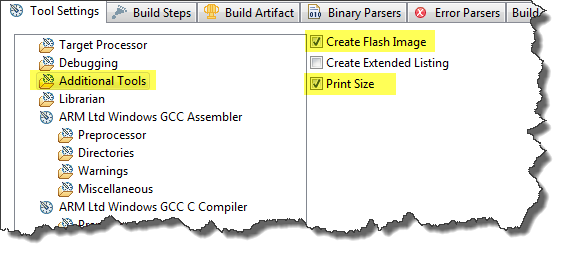
I described in earlier posts how to enable GNU build tools to generate hex/bin/S19 files, or to write the code size to the console view. That works fine for me. But then I received a project were obviously this does not work: even with the project settings configured properly, there is no S19 file, and no code size printed. What’s wrong?

Additional Tools in ARM GNU Eclipse Panel

Additional Tools in ARM GNU Eclipse Panel

Continue reading

FRDM-KL25Z RevE Board arrived

About a year ago I started to use the FRDM-KL25Z board (RevD). Finally, I had it in my hands: the RevE board from Mouser 🙂 Using the RevD board, I faced several problems:

  1. 3.3V supply voltage drop because of low-cost diode D1 (see this post)
  2. Hard to use USB host mode, as no 5V supplied to the USB bus (see this post)
  3. No 5V generated from V_IN (see this post)

The good news: all of them have been improved 🙂 in the FRDM-KL25Z RevE Schematics:

FRDM-KL25Z RevE Board

FRDM-KL25Z RevE Board

Continue reading

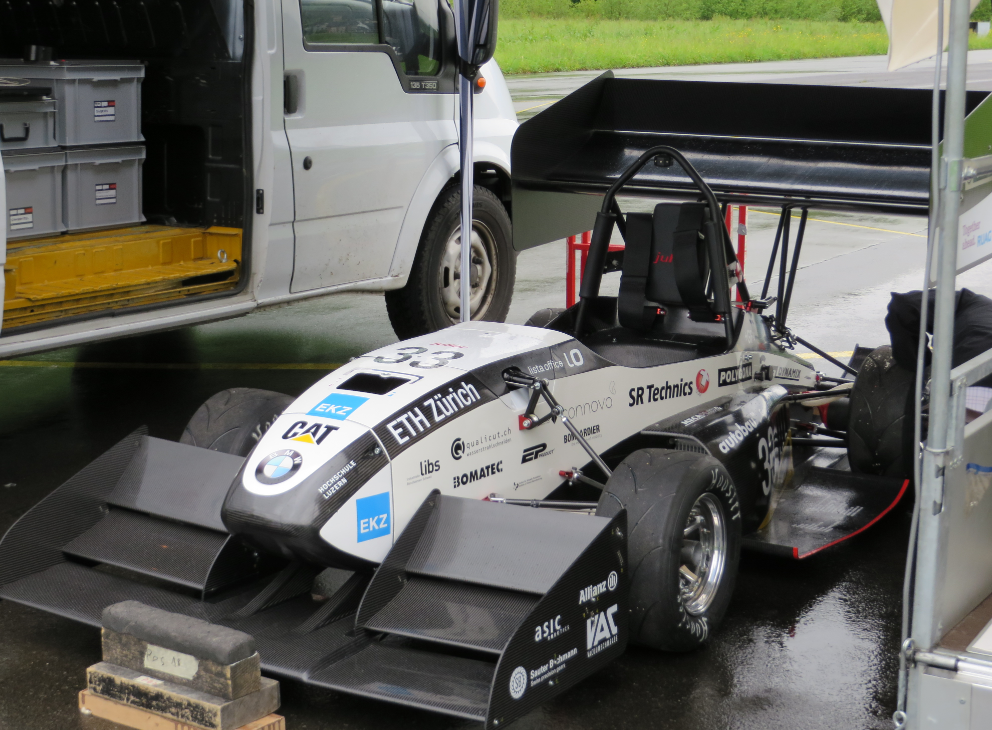
Julier Formula Student Electrical Race Car as Television Star

Yesterday the local television station Tele 1 collected film material for a report about the “Julier” Formula Student team. The team did run more tests on the Alpnach air field, and this time the weather was much better compared to the last weekend. With the risk to get sun burned 😉

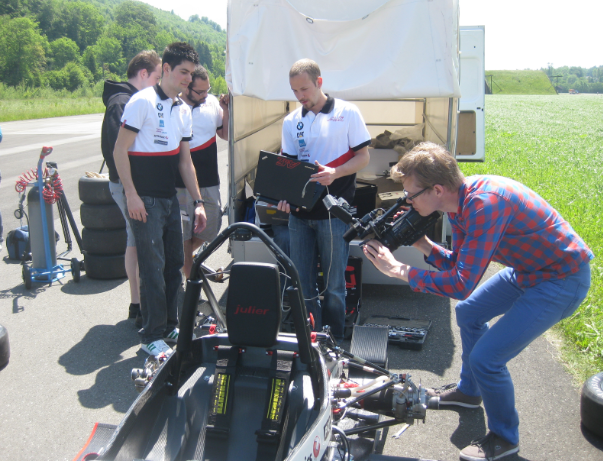
Until Tele 1 publishes the material, I have here pictures from the scene, the team and the car.

Camera, and Action

Camera, and Action

Continue reading

Julier 4WD Test Drive in Alpnach

While weather is bad and Switzerland suffers from record high rain water levels, the Formula Student “julier” team was testing their race car this week-end after the rollout. This time to test the 4WD with more torque. Plus water-resistance ;-). So here are impressions, pictures and a video from this week-end:

Julier Formula Student Race Car

Julier Formula Student Race Car

Continue reading

Tutorial: Arduino Motor/Stepper/Servo Shield – Part 1: Servos

This post starts a small (or larger?) series of tutorials using the Arduino Motor/Stepper/Servo Shield with the FRDM-KL25Z board. That motor shield is probably one of the most versatile on the market, and features 2 servo and 4 motor connectors for DC or stepper motors. That makes it a great shield for any robotic project :-).

Arduino Motor Stepper Servo Shield with FRDM-KL25Z

Arduino Motor Stepper Servo Shield with FRDM-KL25Z

Continue reading

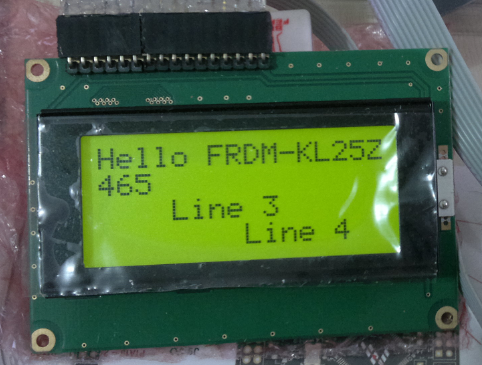
Character LCD with 4 Lines

Character LCD’s (like 2 lines with 16 characters each) as in this post are easy to use. Much easier to use compared to full graphical LCDs.

The ones I’m using have either 1 or 2 lines, but I saw that there are 4 line displays too. So far my LCD component only supports one or two lines.

4 Line LCD

4 Line LCD (Source: Ezequiel Bazotti)

Continue reading