Extended Driver for the MMA8451Q Accelerometer

In “Tutorial: Accelerating the KL25Z Freedom Board” I used the MMA8451Q accelerometer on the FRDM-KL25Z board in a very primitive way: I’m reading directly some low-level registers from the device through an I2C low-level component. No calibrating, no special device feature setting, only raw values. Since then, things have been evolved: In “Tutorial: Creating a Processor Expert Component for an Accelerometer” I started to create a driver for this accelerometer, and since then a lot more functionality has been added.

Tracing Accelerometer Values to the Shell

Traced Accelerometer Values to the Shell

Continue reading

Stepping Backwards while Debugging: Move To Line

It happens to me many times: I’m stepping with the debugger through my code, and ups! I made one step too far!

Debugging, and made one step over too far

Debugging, and made one step over too far

What now? Restart the whole debugging session?

Actually, there is a way to go ‘backwards’ 🙂
Continue reading

First Steps with the P&E Tracelink

“As an engineer, you should ask for the best tools available. Spending money for better tools can make the difference between finding a problem quickly, or wasting days or weeks, and ultimately failing a project.” (unknown)

I had to learn it the hard way: some ‘hard-to-find-problems’ sometimes only can be found with some amount of luck, or with using a good trace solution. CodeWarrior already supports trace, such as using the MTB on the Cortex-M0+. But with this I’m limited to the on-chip trace buffer or on-chip RAM, which is better than nothing. But to solve the real hard problems, a bit of more power and memory is needed. And here where the P&E Tracelink comes into play: with 128 MByte trace buffer it would allow me to record a lot more trace data :-).

Continue reading

Decoding S19 Files

I’m recently dealing again with S19 (S-Record) files. I can easily generate S19 files from my ARM .elf files, but what I need is a simple decoder of the file format.

The good thing is: such a decoder is provided with CodeWarrior for MCU10.x 🙂

That capability is built into the Decoder.exe which is delivered with the Freescale S08 (or S12) tool chain, and is located inside the MCU\prog folder:

Decoder.exe inside MCU prog Folder

Decoder.exe inside MCU prog Folder

Continue reading

Tutorial: Creating a Processor Expert Component for an Accelerometer

If you are a frequent reader of this blog, then you know: I’m a big fan of Processor Expert components. While there are many Processor Expert components delivered with CodeWarrior, it lacks many components and device drivers beside of the normal on-chip peripherals. But value gets added to an embedded project with all the external devices, sensors and actuators. That’s why I have created many more components which are available on my GitHub site. Readers of this blog have asked several times to create a tutorial on how to create a Processor Expert component. So why not working on that on a long Easter weekend full of cold rain and snow?

So here we go: a tutorial how to create a Processor Expert component for the MMA8451Q accelerometer found on the FRDM-KL25Z board:

MMA8451Q Accelerometer on the FRDM-KL25Z Board

MMA8451Q Accelerometer on the FRDM-KL25Z Board

Continue reading

RFduino: Wireless Cortex Arduino to the Size of a Finger Tip

How cool is this: combine ‘Arduino’, ‘Bluetooth’ and ‘Low Power’ with ‘small size’: an ARM Cortex-M0 board with low power Bluetooth 4.0, shrunk to size of a finger tip! 🙂

This Kickstarter project asked for $5k funding, and it has received over $245k! The video shows the prototype interacting with an iPhone:

It combines Arduino compatibility with the power of an ARM Cortex M0. Given the low-cost and versatility of that board, that would make that board an ideal base for many projects.

Adding an internet gateway, and I will have the ‘Internet of Things’ (IoT) 🙂

Happy RFing 🙂

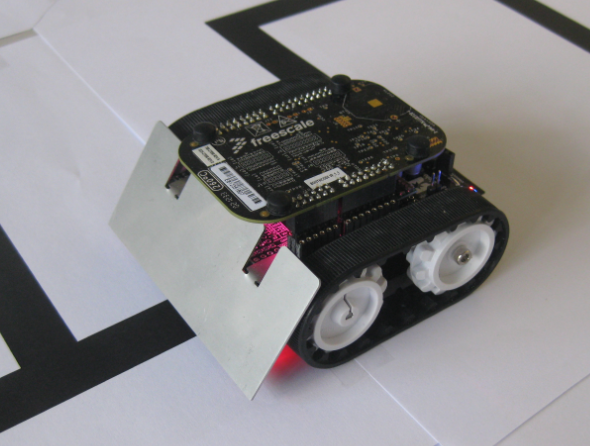
Maze solving FRDM-KL25Z Robot goes backward for Dead-Ends

The maze solving robot based on the Freedom FRDM-KL25Z and Pololu Zumo shield has new features:

  1. For dead-end paths, instead turning around, the robot is driving backward
  2. Higher speed for going forward/backward/turns
  3. In the finish area, the robot turns around
  4. It reverts the solution path, so the robot can directly run from the finish area to the start
FRDM-KL25Z Robot on Practice Area

FRDM-KL25Z Robot on Practice Area

Continue reading

Freedom Logic Analyzer with DMA

The FRDM-KL25Z Open Source Logic Analyzer based on SUMP presented here was already very useful with the added trigger support. But it was not capable to do a sampling rate above a few hundred kHz. That’s ok for slower probing, but not for anything with a higher speed. Using DMA (Direct Memory Access) instead of timer based sampling can remove that limitation :-).

FRDM-KL25Z used as Logic Analyzer on another FRDM-KL25Z board

FRDM-KL25Z used as Logic Analyzer on another FRDM-KL25Z board

Continue reading

Freedom Robot solves the Maze

Finally I have found some time over the past week-end to enhance my Zumo robot. After I had my line following robot based on the Pololu Zumo chassis and the FRDM-KL25Z, I thought it should be easy and logical to solve a maze. Logical: yes. Easy: not that much. In fact it took me longer than expected. As always, there are a lot of tiny and important problems to solve (the maze alone was easy 🙂 ).

Zumo in the maze

Zumo in the maze

Continue reading

Tutorial: PWM with Processor Expert

For many of my applications I’m using a PWM (Pulse Width Modulated) signal. One example is the motor driver used in this project where I use one PWM signal for each motor. Another usage of PWM is to control the brightness of an LED. Processor Expert makes usage of the PWM hardware easier. Still, for some settings it is good to have the resulting signals in mind. So in this post I’m showing how the settings impact the PWM signal generated.

Continue reading