First NXP Kinetis SDK Release: SDK V2.0 with Online On-Demand Package Builder

There are plenty of different software packages available for microcontroller these days from all the silicon vendors. Finding a good software package is one challenge, getting what I really need is another one. Freescale is now part of NXP since December 2015, so this is probably the first release of the former Freescale part now as NXP: The NXP Kinetis SDK Version 2.0.

It comes with an interesting distribution way: instead of downloading huge packages with all-and-everything in it, I can build it ‘on demand’ online and get what I need, on demand from a web-based front end:

NXP Kinetis Expert with Kinetis SDK

NXP Kinetis Expert with Kinetis SDK

Continue reading

Controlling NXP Freedom Board RGB LED with openHAB and Raspberry Pi

In “Blinky LED with openHAB on Raspberry Pi” I have used openHAB on a Raspberry Pi to control an LED attached to the Pi, and in “Controlling NXP Freedom Board RGB LED with openHAB and Raspberry Pi” I have explored how to connect a NXP Freedom Board over USB CDC to the Raspberry Pi. In this article I’m going to combine both: to control the LED on a NXP Freedom board remotely with openHAB on the Raspberry Pi.

ColorPicker with openHAB and FRDM-KL25Z

ColorPicker with openHAB and FRDM-KL25Z

Continue reading

Debug Multiple Boards with GDB at the Same Time

Many times it is very useful to debug multiple boards at the same time. For example if I’m debugging a communication stack between two boards: that way I can debug the protocol on both sides. Eclipse is a great framework which allows that. This post shows how to debug multiple boards (e.g. the NXP Freedom boards) in parallel from the same Eclipse IDE using GDB and the Segger J-Link:

Two NXP Freedom Boards debugged at the same time

Two NXP Freedom Boards debugged at the same time

Continue reading

USB CDC with the Raspberry Pi

For my home automation project with openHAB I want to attach Freescale (now NXP) FRDM (Freedom) boards so they can take care about the realtime aspects and to act as gateways to my other systems. One way is to use USB CDC (Serial over USB) as communication channel. USB has the advantage that it powers the board, plus I can attach multiple devices: up to four on the Raspberry Pi 2 and even more with using a USB hub. In a standard configuration with a USB WiFi and a USB HID (mouse plus keyboard) dongle I still can attach two Freescale (ahem, NXP) Freedom boards to the Raspberry Pi:

FRDM-K22F and FRDM-K64F attached to Raspberry Pi 2

FRDM-K22F and FRDM-K64F attached to Raspberry Pi 2

Continue reading

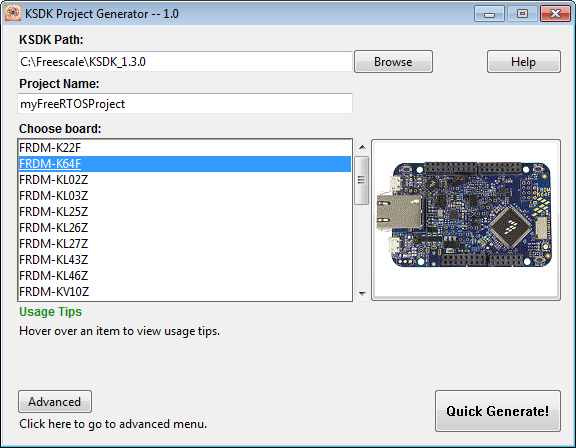
Tutorial: FreeRTOS Projects with Kinetis SDK V1.3 and the SDK Project Generator

This tutorial describes how to create a Kinetis SDK V1.3 project using the Freescale project generator in Kinetis Design Studio.

project generator

project generator

Continue reading

New Gadget to Explore: Freescale FRDM-K82F Board

It’s not Christmas yet, but: For a research project I’m currently evaluating a new microcontroller where I need a bit more leg room. Right on time I saw that there is a new board available which caught my interest: The Freescale FRDM-K82F :-). Without thinking too much about it, I have ordered that board from Mouser Thursday last week and I had it in my hand today 🙂 Time to put up a quick post about it:

New Box on the table

New Box on the table

Continue reading

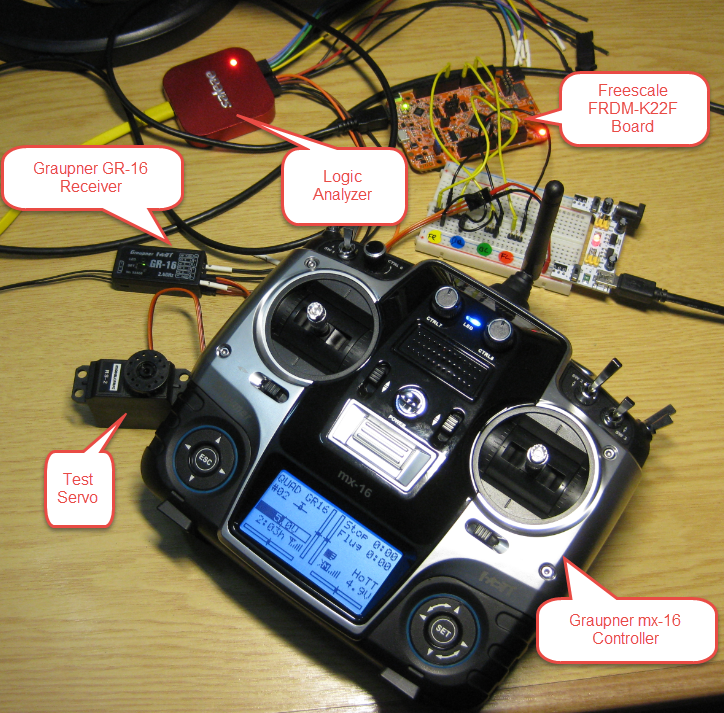
Kinetis Drone: Remote Controller with SUMD

The bad news: my ESC (see “Kinetis Drone: Graupner ESC S3055 Failure“) for my Kinetis drone is still not repaired :-(. Anyway, I have plenty of other things to make for my drone project. One is to work on the remote controller:

Test Setup

Test Setup

Continue reading

Tutorial: lwip with FreeRTOS and the Freescale FRDM-K64F Board

This tutorial is about how to create a lwIP project with FreeRTOS using the Kinetis SDK V1.3.0 with Kinetis Design Studio on the Freescale FRDM-K64F board.

FRDM-K64F Board with lwIP running

FRDM-K64F Board with lwIP running

Continue reading

Zumo Robots at Maker Faire in Rome (16. – 18. Oct. 2015)

I won’t be able to attend the Maker Faire in Rome (16. – 18. Oct. 2015). But five of the Sumo bots students from the previous semesters have built and programmed will be there.

Sumo Robots

Sumo Robots

Continue reading