Turning the Freedom Board into a Logic Analyzer

I think the most important tool for a firmware engineer is a Logic Analyzer. I always have one on my desk. Working in different locations, sometimes I forget to carry it with me. And  for sure I would need it. To buy another one to compensate my laziness? Or maybe there is another solution? And here I stumbled over an article about the Logic Sniffer project recently: it is about an open source logic analyzer hardware and firmware project. What a cool idea! Why not using my FRDM-KL25Z Freedom board as a Logic Analyzer? Heck, that would be awesome 🙂

I2C Capture with Decoder

Logic Analyzer with the KL25Z Freedom Board

Continue reading

Eclipse Workspace Tips

Usually, one of the first things I see if I launch Eclipse is this dialog:

Select a Workspace Dialog

Select a Workspace Dialog

Actually, that ‘workspace’ thing is one of the most important things in Eclipse to understand. To mess around it can cause a lot of pain. So I have collected some ‘lessons learned’ around workspaces.

Continue reading

Tutorial: IAR + FreeRTOS + Freedom Board

Maybe Eclipse is ‘too much’, and you are looking for something different? The cool thing with Processor Expert is that while this is Eclipse based, you can use it easily with other tool chains like IAR Embedded Workbench. So you have the choice, and I have explored things a little with porting FreeRTOS for Cortex-M0+ to IAR :-).

IAR Embedded Workbench with FreeRTOS

IAR Embedded Workbench with FreeRTOS

In this tutorial I’m showing how use IAR with FreeRTOS and the Freedom FRDM-KL25Z Board, using Processor Expert components.

Continue reading

Eclipse Spell Checker

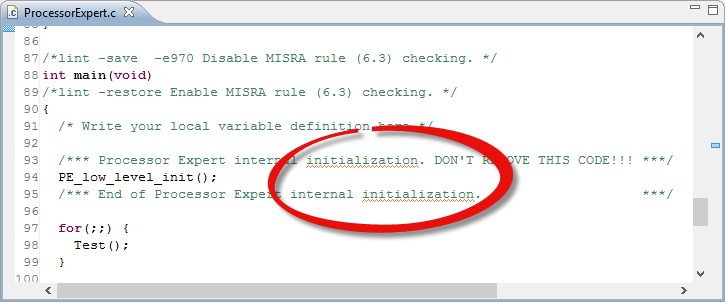
One of the nice things of modern IDE’s are: they offer many extras for free. Many times it is related to programming and coding. But I love as well the ones which makes things easier and better which is not directly related to the executed code. One thing Eclipse offers is an on-the-fly spell-checking, similar to Microsoft Word:
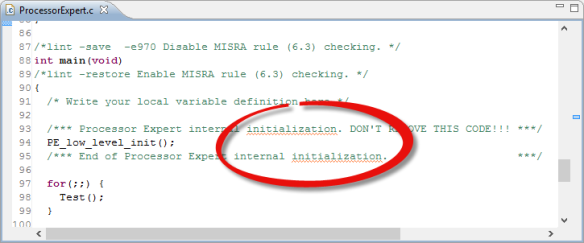
Spellchecked Sources

Spellchecked Sources

Hovering over the text offers me to correct the flagged error:
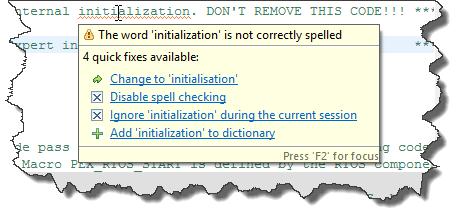
Initialization vs. Initialisation

Initialization vs. Initialisation

But wait: is that example not spelled correctly?

Continue reading

Enabling the Expert Level in Processor Expert

Processor Expert in Eclipse and CodeWarrior is cool thing, and acts as the ‘expert’ for anything around the microcontroller used. But by default, it is acting in the ‘Basic’ level only.

Component Inspector Levels

Component Inspector Levels

But there are ways to get it to the Expert level :-).

Continue reading

Live View for Variables and Memory

Debugging is usually a ‘stop-inspect-continue’ process. That does not work very well for watching a system which continuously changes its state. For this usually I toggle an LED, or write things to the console to watch with a human eye what is going on. But there is something very powerful in the CodeWarrior debugger too: to display variables and memory content while the target is running.

Variable Live View

Variable Live View

Continue reading

Back to Basic(s) with the Freedom Board

If you think that my LED tutorial is too complicated to program a simple LED, then this article might be of interest for you. Because there is an easy and basic way: And I mean it: really basic. And the name is the program(ming language) ;-).

One of my very first contact with computers was the Commodore C64: this was a very successful home computer system back in the 1980’s: a 8bit machine with 64 KByte of RAM and a built-in Basic Interpreter in ROM:

Commodore C64 Startup Screen

Continue reading